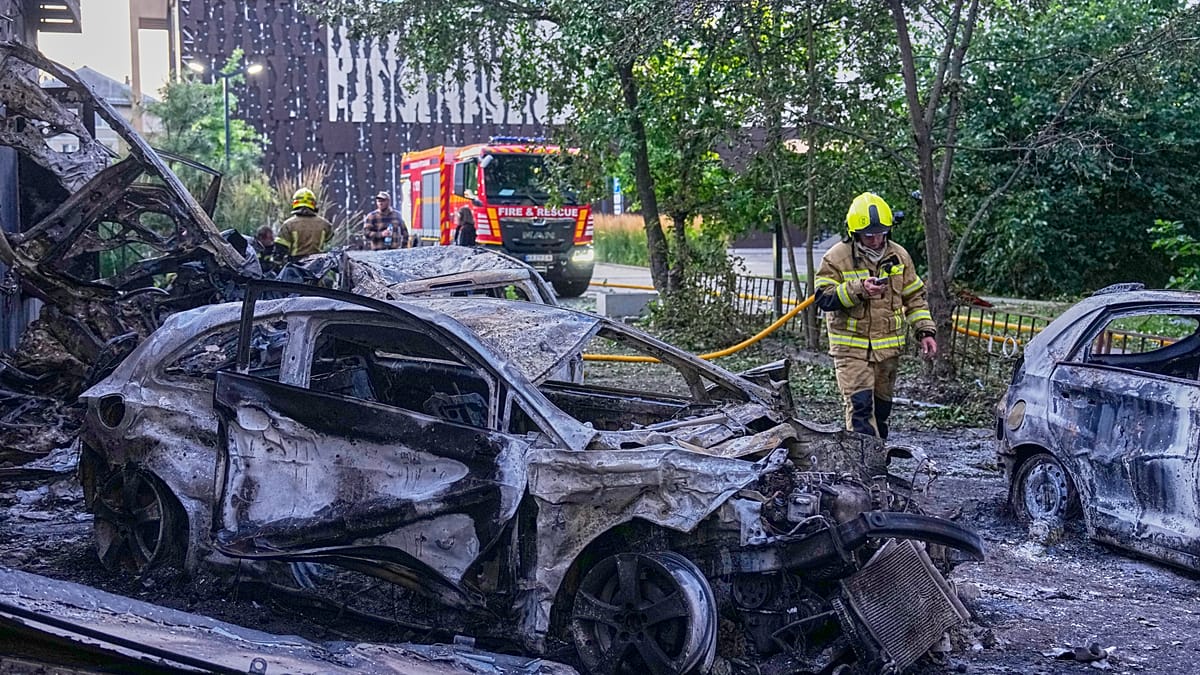
At least one person has been killed and 16 others wounded in Russia’s latest large-scale aerial assault on Ukraine, which began shortly after 1:30 a.m. local time and lasted for several hours. Ukraine’s air force reported that Moscow launched 41 missiles and 125 attack drones, with the majority directed at the capital, Kyiv, and its surrounding region.
Ukraine’s emergency services confirmed that the strikes ignited fires across five districts of Kyiv, damaging residential buildings, offices, and industrial facilities. Several residents were rescued from burning structures, while one person was later found dead under the rubble. Fires were also reported in the Solomyanskyi, Desnianskyi, and Dnipro districts.
Zelenskyy Highlights Escalating Russian Firepower
Ukrainian President Volodymyr Zelenskyy stated that most of the missiles and drones were aimed at the capital. “In total, over the course of this week, Russia has used around 1,450 attack drones, more than 1,640 guided aerial bombs, and 99 missiles of various types against Ukraine,” he wrote on X, underscoring the sustained intensity of the bombardment.
Russia’s defence ministry claimed the attack targeted sites linked to the Ukrainian military, though no independent verification was provided. The overnight barrage came just a day after Ukraine conducted a large-scale drone strike on targets inside Russia, hitting warehouses and an oil facility. This follows a pattern of reciprocal strikes that have escalated in recent weeks.
Kyiv has faced a series of major Russian attacks, putting continued strain on Ukraine’s air-defence capabilities. Patriot systems remain the most effective tool for intercepting Russian ballistic missiles, but Ukrainian officials have repeatedly warned that they lack sufficient interceptor missiles to maintain adequate coverage. The European Union has been working to bolster Ukraine’s defences, including through a recent drone pact and accession talks advanced by European Commission President Ursula von der Leyen during her visit to Kyiv.
The attack also comes amid broader geopolitical tensions, with Greece recently blocking EU sanctions on Russian liquefied natural gas, demanding a transit exemption. Meanwhile, a Russia-linked disinformation campaign, Storm-1516, has been behind a fake threat involving Hezbollah and Bastille Day, highlighting the information warfare accompanying the kinetic conflict.
As Ukraine continues to face relentless aerial assaults, the need for sustained European support remains critical. The EU’s commitment to Ukraine’s defence and its long-term integration into European structures is being tested by both the war and internal political divisions among member states.