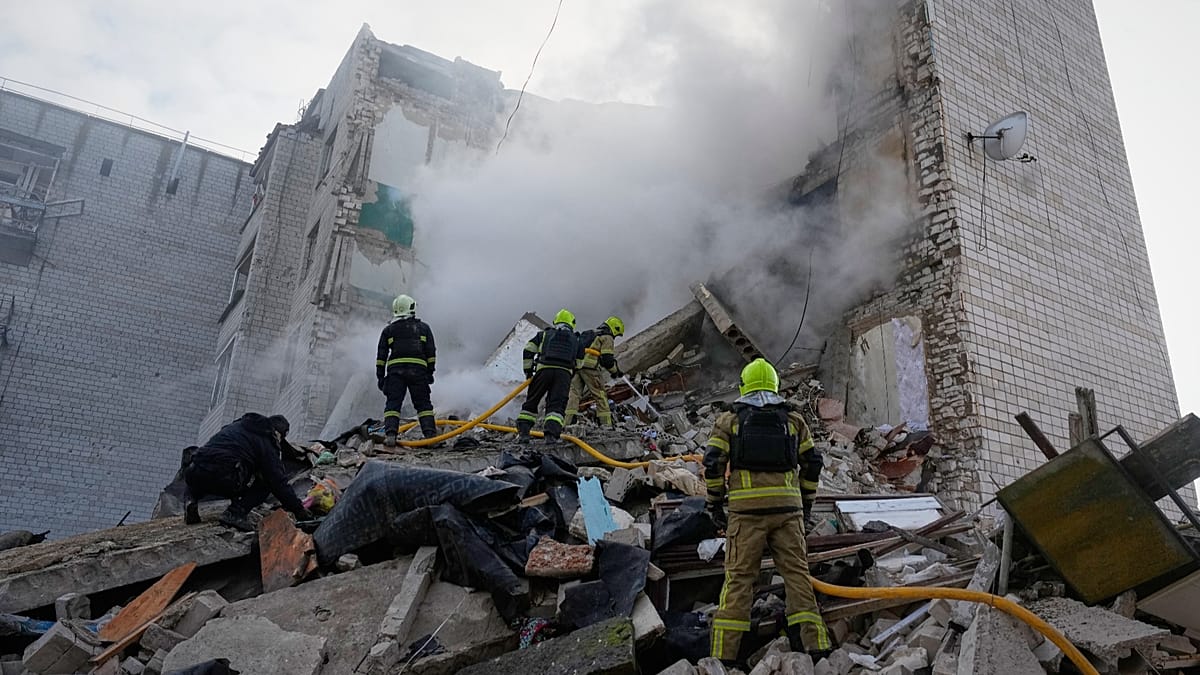
Rescuers in Ukraine worked through Monday to reach residents trapped under the rubble of a partially collapsed apartment block in the Kyiv region, after a fresh wave of Russian air strikes killed at least 15 people across the area. The overnight attacks came as Moscow intensifies its aerial bombardment ahead of a second winter of the full-scale war, now in its fifth year.
The deadliest strike hit the town of Dymer, about 45 kilometres north of the Ukrainian capital, where a five-storey building was destroyed. Kyiv regional official Tymur Tkachenko said the death toll there had risen to 11, with one more body recovered from the debris. Ukraine's State Emergency Service earlier reported that a teenager and a woman in her forties were among the dead, and that rescuers were searching for 11 people, including two children, who remained unaccounted for.
Among those pulled alive from the rubble were a 79-year-old woman and a child, Tkachenko said. The attack drew a sharp rebuke from Ukraine's human rights ombudsman, Dmytro Lubinets, who called it part of "Russia's genocidal war against Ukraine." In a statement on X, he urged the international community to "stop looking away" and to "condemn this terror, hold Russia accountable, and act now to stop the killing of innocent Ukrainians."
Strikes on civilian targets
In the town of Vyshneve, just southwest of Kyiv, a Russian strike on a supermarket killed three people and wounded 15, including three children, according to Mayor Illya Dikov. Tkachenko described the attack: "People had simply gone to the store to buy groceries. An ordinary shopping trip turned into a tragedy due to a Russian attack."
Another strike on a private home in Bila Tserkva, south of Kyiv, killed one person and set the building ablaze. In the Dnipropetrovsk region, Prime Minister Serhiy Koretsky said Russia had hit a power substation, part of a broader campaign targeting Ukraine's energy infrastructure as temperatures drop toward freezing.
The attacks follow a week of heightened tensions, with Ukrainian forces striking the Crimea bridge three times, severing the road section and halting train services. Russian President Vladimir Putin, after a summit with US President Donald Trump and China's Xi Jinping, vowed a "much more painful" response to those strikes. The meeting in a neutral venue sparked concerns in Kyiv and European capitals that the leaders might make sweeping decisions on the war without consulting Ukraine or its allies.
For Europe, the escalation carries immediate security implications. The strikes on civilian infrastructure in the Kyiv region echo patterns seen in previous winters, when Moscow targeted the power grid to break Ukrainian morale. The European Union has repeatedly condemned such tactics as war crimes, and several member states have provided air defence systems to help Ukraine protect its cities.
As the war grinds on, the human cost continues to mount. The overnight attacks in the Kyiv region are a stark reminder of the daily toll on ordinary Ukrainians, many of whom have endured nearly three years of relentless bombardment. International organisations and human rights groups have documented widespread violations of international humanitarian law, including attacks on residential areas and critical infrastructure.
Ukrainian officials have called on Western partners to supply more advanced air defence systems and long-range weapons to counter Russian strikes. The recent deadly strike on a Lviv street and the missile attack on Zelenskyy's hometown have underscored the urgency of these requests.
Meanwhile, the diplomatic front remains fraught. The summit between Putin, Trump, and Xi has raised fears that the war could be settled over the heads of Kyiv and Europe. European leaders have insisted that any peace plan must involve Ukraine and respect its territorial integrity. The EU's foreign policy chief has called for a unified European stance, warning that concessions to Moscow would set a dangerous precedent.
As winter sets in, the resilience of Ukraine's energy grid will be tested again. The strikes on substations and power lines are designed to disrupt heating and electricity supplies, compounding the suffering of millions. The international community, including the EU, has pledged support for repairs and emergency assistance, but the scale of the challenge remains immense.
For now, the immediate priority is the rescue operation in Dymer and Vyshneve, where families are waiting for news of loved ones. The death toll may rise as rescuers clear the debris. The attacks have also drawn attention to the broader pattern of Russian strikes on civilian areas, which have killed thousands since the invasion began in February 2022.
European Pulse will continue to monitor the situation and provide updates as more information becomes available.