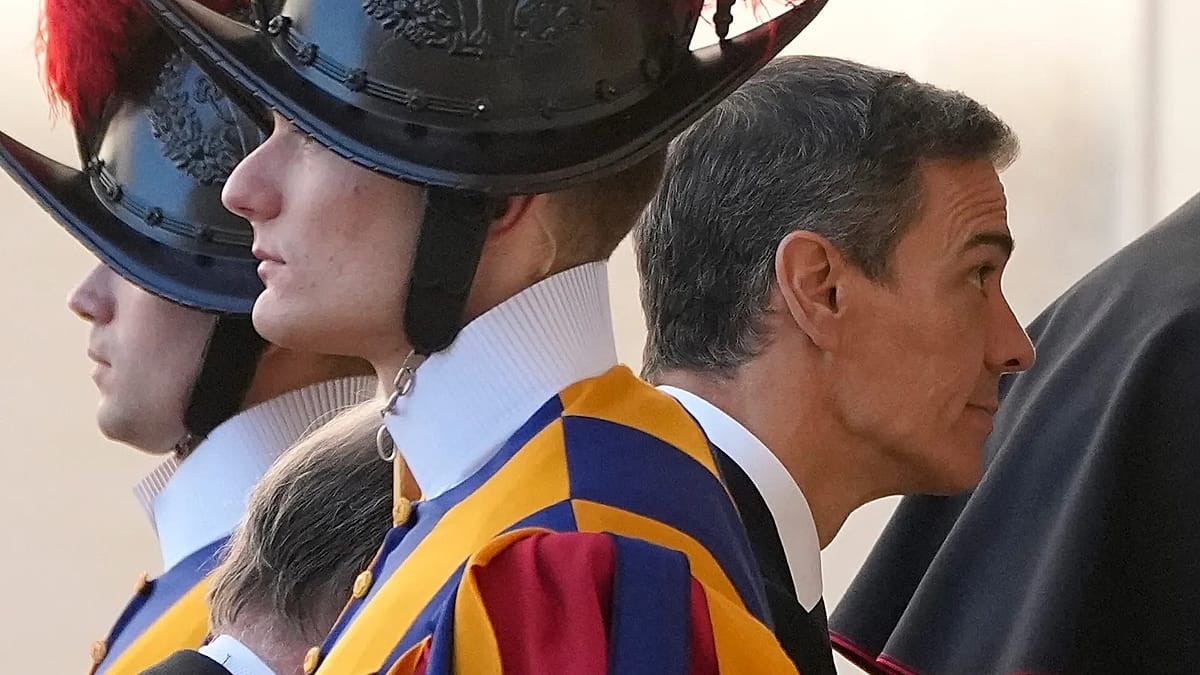
Spanish Prime Minister Pedro Sánchez stated on Wednesday that he sees no grounds to distance himself from his predecessor, José Luis Rodríguez Zapatero, who has been placed under formal investigation for corruption. Speaking at a press conference in Rome after a meeting with Pope Leo XIV, Sánchez said, “I think there is no sufficient reason, there is no reason to change that position.” He reiterated his government’s “full cooperation with the judiciary” and respect for the presumption of innocence.
Zapatero, who served as prime minister from 2004 to 2011, has been summoned to testify next month. The investigation concerns whether he used his political influence to help secure a €53 million state bailout for the small airline Plus Ultra in 2021, and whether he or his family personally benefited from the transaction.
Details of the Probe
The investigating judge suspects that Zapatero may have been part of a network involving shell companies and behind-the-scenes lobbying designed to push favourable decisions through the Socialist government’s channels. Authorities are also examining possible commissions and financial flows connected to the case. This marks the first time in Spain’s modern democratic history that a former prime minister has been placed under formal investigation, though other former premiers have been called to testify in corruption cases.
Among the evidence cited in the investigation, which was seen by AFP earlier this week, is the discovery during a search of a safe belonging to Zapatero of numerous luxury watches and jewellery of undetermined value. Associates of the former prime minister have said the items are linked to family inheritances. Zapatero has consistently denied any wrongdoing and claims he never received payments from Plus Ultra.
The case adds to the pressure on Sánchez, whose administration has already been weakened by corruption investigations affecting relatives and former top political allies, as well as a string of heavy regional electoral defeats. On Wednesday, police entered the Madrid headquarters of Sánchez’s Socialist Party to demand documents as part of a separate probe into former party member Leire Diez. She is accused by Spain’s top criminal court, the National Audience, of participating in a network aimed at undermining judicial proceedings involving the party or the government.
Sánchez said the Socialist Party “respects the judiciary” and cooperates with investigations, adding that it had previously cut ties with Diez after concerns emerged. He also dismissed opposition calls for early elections, arguing that Spain required “stability” and pointing to what he described as social and economic progress under his administration.
The Zapatero case has drawn attention to broader issues of political influence and transparency in Spain. For context, similar anti-corruption efforts are underway elsewhere in Europe, as seen in Ukraine’s Deputy PM stating that anti-corruption probes show Kyiv meets EU standards. Meanwhile, the Spanish police seizure of cash and jewelry in this probe has been detailed in a separate report: Spanish Police Seize Cash, Jewelry in Zapatero Influence Probe.
As the investigation unfolds, it remains to be seen whether the case will further erode public trust in Spain’s political establishment or whether Sánchez’s steadfast support for Zapatero will prove politically costly. The prime minister’s insistence on stability and progress may be tested as more details emerge.