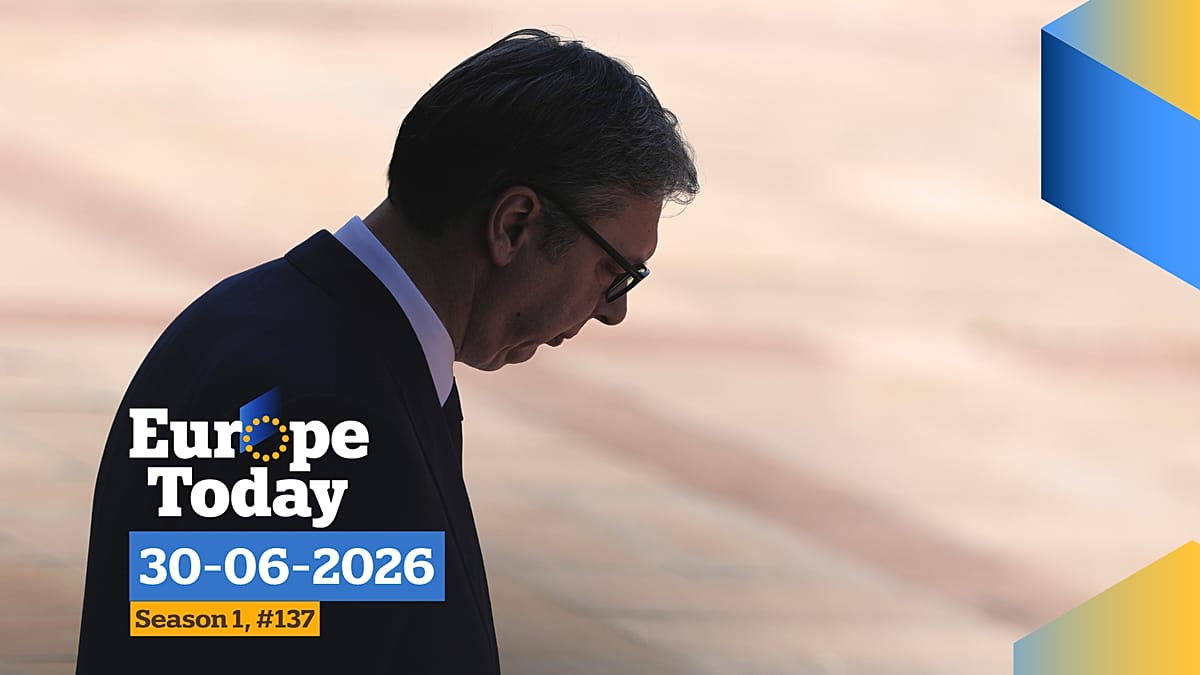
Serbia is bracing for early elections after President Aleksandar Vučić announced his resignation, a move that could redefine the country's political trajectory and its relationship with the European Union. The decision, which triggers a snap vote, comes as Brussels and Beijing grapple with escalating trade tensions that have significant implications for European competitiveness.
Serbia's Political Shift
Vučić, who has dominated Serbian politics for over a decade, cited a need for a fresh mandate amid growing domestic pressures. His resignation, effective immediately, sets the stage for a campaign that will test the strength of his Serbian Progressive Party against a fragmented opposition. The election outcome will be closely watched in Brussels, where Serbia's EU accession talks have stalled over issues including rule-of-law reforms and normalization with Kosovo.
Analysts suggest that Vučić's move is partly a response to recent protests and a desire to consolidate power before potential economic headwinds from the EU-China trade dispute. Serbia, a candidate country, has balanced ties between Brussels and Beijing, attracting Chinese investment in infrastructure while seeking EU membership. The snap election could either accelerate reforms or deepen Belgrade's reliance on non-EU partners.
EU-China Trade Talks Hit Critical Phase
In Brussels, European Trade Commissioner Maroš Šefčovič has set an October deadline to resolve key disputes with China, including market access for European goods and intellectual property protections. The talks, which concluded this week, are seen as a test of the EU's ability to assert its economic interests without triggering a full-blown trade war. China's growing influence in sectors like semiconductors and aerospace has raised concerns in European capitals, as detailed in our analysis of Europe's hidden leverage.
The European Investment Bank's recent €3 billion loan to Airbus underscores the bloc's push to bolster strategic industries. EIB President Nadia Calviño described the loan as a record for the bank, aimed at enhancing Europe's competitiveness in aerospace and defense. This move aligns with broader EU efforts to reduce dependence on Chinese supply chains, particularly in high-tech manufacturing.
US-Iran Talks Resume in Qatar
Meanwhile, US and Iranian delegations have returned to Doha for fresh negotiations aimed at solidifying an interim nuclear agreement into a lasting deal. The talks, mediated by Qatar, come amid heightened tensions after recent US strikes on Iranian military sites. Iran has denied direct negotiations with Washington, but the presence of its delegation signals a willingness to engage. For Europe, a stable Iran deal is critical to avoiding further instability in the Middle East and securing energy supplies. The EU has maintained a diplomatic channel with Tehran, as seen in our earlier report on the delegation's mission.
European Football's Tough Night
Off the political stage, European football suffered a blow as Germany and the Netherlands were eliminated from the World Cup in a dramatic night. Germany's exit, following a loss to South Korea, has sparked debate about the future of the national team. The results underscore the shifting dynamics in global football, with European dominance increasingly challenged by teams from other continents.
As Serbia prepares for its elections, the interplay of domestic politics, EU relations, and global trade will shape the continent's near-term outlook. The outcome in Belgrade, alongside the EU-China negotiations, will test Europe's ability to navigate a multipolar world while maintaining internal cohesion.