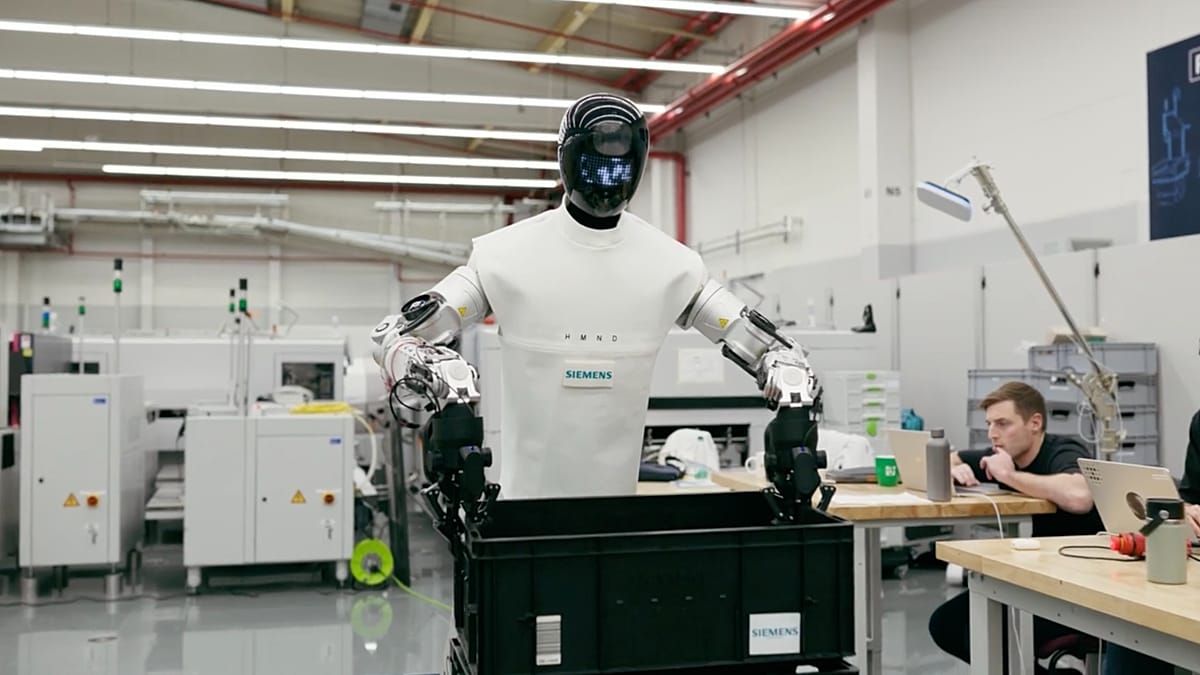
German industrial conglomerate Siemens and US chipmaker Nvidia have completed a live trial of a humanoid robot on a factory floor, advancing their vision of production environments where artificial intelligence enables machines to adapt and collaborate with human workers.
The test took place at Siemens’ electronics plant in Erlangen, a city in Bavaria, southwestern Germany. The robot, HMND 01, was developed by UK-based robotics firm Humanoid and powered by Nvidia’s AI platform. During the trial, it handled routine logistics tasks—picking up, moving, and placing containers used by human employees—operating autonomously for more than eight hours. Siemens reported that the robot completed over 90% of its assigned tasks, moving roughly 60 containers per hour.
A Step Toward Adaptive Factories
The project is part of a broader partnership between Siemens and Nvidia to create what they describe as the world’s first AI-driven, adaptive factories. Unlike traditional automation, which relies on fixed programming, these systems are designed to perceive their environment, reason about tasks, and adjust in real time.
“Factories of the future demand robots that can perceive, reason, and adapt autonomously alongside human workers,” said Deepu Talla, vice president of robotics and edge AI at Nvidia. “With Siemens providing the industrial integration backbone and Humanoid deploying NVIDIA's full physical AI stack, from simulation-first training to real-time edge inference, this deployment paves the way for humanoid robots meeting real production targets on a live factory floor.”
The companies emphasised that much of the robot’s development occurred in virtual environments using Nvidia’s simulation and training tools. This approach reduced the need for physical prototyping and cut design time from up to two years to roughly seven months, they said.
Humanoid’s robots have previously demonstrated capabilities in walking, dexterity, and rapid learning in real-world settings. The Erlangen trial marks the first time such a system has been deployed on a live production line.
Addressing Labour Shortages
The trial comes amid persistent labour shortages across European manufacturing sectors. While conventional automation has struggled to handle complex, variable tasks, the companies argue that humanoid robots could fill gaps by taking on roles that currently require human involvement.
The development also highlights the growing role of AI in industrial applications. Nvidia, best known for its graphics processing units (GPUs) used in data centres and AI training, has been expanding into robotics and edge computing. The company recently joined the Dow Jones Industrial Average, replacing Intel in a symbolic shift that reflects its rising influence in the tech sector. Meanwhile, European reliance on Nvidia’s chips for AI development has been a topic of debate, as policymakers weigh the continent’s dependence on non-European technology.
Siemens and Nvidia described the trial as a “milestone in the journey to bring physical AI from vision to industrial reality.” However, they did not provide a timeline for broader commercial deployment.
The test in Erlangen represents a concrete step toward integrating humanoid robots into European factories, though significant challenges remain in scaling the technology, ensuring safety, and managing costs. For now, the companies are focused on proving that AI-powered machines can work alongside humans—not replace them—in the continent’s evolving industrial landscape.