For centuries, the Silk Road was not only a network of trade routes but also a conduit for musical exchange. Instruments traveled alongside spices and silks, carrying melodies that marked celebrations, rituals, and daily life. Today, across Central Asia, these traditions endure through craftsmanship, oral performance, and evolving musical practices, linking past and present through sound.
Andijan: Reviving Lost Instruments
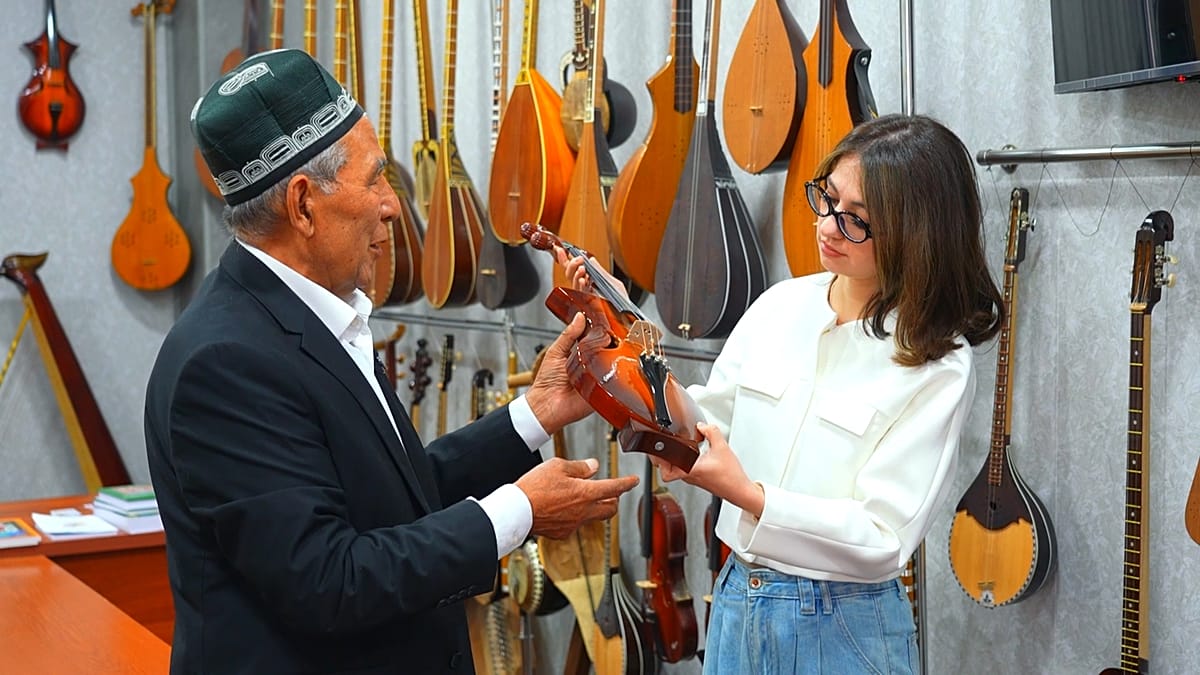
In Andijan, Uzbekistan, musical heritage is preserved and developed through the work of instrument makers. At one of the country's largest specialized workshops, master craftsman Abdumalik Madraimov has spent more than 55 years producing instruments such as the dutar, tambur, ghijjak, and doira. His approach combines historical research with practical production, focusing on both preservation and reconstruction.
"Many instruments from history were forgotten," Madraimov explains. "We have recreated them in modern forms and returned them to cultural life." His team studies instruments from the Timurid and post-Timurid periods, using historical sources to reconstruct lost designs. Some of these reconstructed instruments are now played in schools and performed on professional stages across the country.
The workshop functions as both a production facility and a research center. Instruments are made for different skill levels, from schoolchildren to professional musicians, ensuring access to musical education. Modern equipment is introduced alongside traditional techniques, allowing for more precise sound production while maintaining authenticity. Apprentices learn directly from experienced masters, continuing a system of knowledge transfer that has existed for generations. Instruments produced here are also sent abroad and preserved in international collections, reflecting growing global interest.
Surkhandarya: The Living Art of Oral Performance
Further south, in Surkhandarya, music exists in a different form—not written or fixed, but performed, remembered, and reshaped in real time. Here, bakhshi performers carry epic storytelling traditions through improvisation. Accompanied by the dombra, they perform long narrative pieces, combining music, poetry, and personal expression. Each performance is unique, shaped by the performer's voice, experience, and interaction with the audience.
"A bakhshi does not memorise, they improvise," says performer Shodmon Khujamberdiyev. "The dombra guides the story and the emotion." This tradition is passed down through listening rather than notation. Young performers learn by observing their teachers, gradually developing their own style. The instrument becomes an extension of the performer, influencing rhythm, tone, and emotional delivery.
For many, the dombra is more than an instrument—it is a source of inspiration. Its sound shapes the narrative, allowing performers to express inner states and respond to the surrounding environment. Even today, bakhshi performances remain part of cultural gatherings, maintaining a link between past storytelling practices and contemporary life.
Karakalpakstan: The Craft of Sound
In Karakalpakstan, attention shifts to the making of instruments themselves. Craftsmanship plays a central role, with instruments such as the qobyz created entirely by hand. The process is precise and time-consuming. Natural materials—mulberry or jida wood, camel skin, and horsehair—are carefully selected and prepared. The timing of each step is critical, from cutting the wood to assembling and tuning the instrument. Each detail directly influences the quality and depth of the sound.
"The qobyz is made from natural materials, and every detail matters," says musician and craftsman Marat Zhakysmuratov, who learned the craft from his father. "If the process is done correctly, the instrument can last for decades." This knowledge is often passed down within families, forming part of a broader tradition of mastery. At the same time, demand for instruments is growing, supported by increased interest among young people and the expansion of music education.
Alongside the qobyz, the Karakalpak dutar reflects its own regional identity. Differences in structure, including the number of frets and the size of the body, influence both sound and performance style. Some instruments are used for singing, while others are designed specifically for instrumental performance. Craftsmanship here is closely connected to cultural continuity. Each instrument carries not only sound, but also the techniques, materials, and knowledge of those who created it.
A Tradition Carried Forward
Today, these instruments remain part of everyday cultural life, produced in workshops, performed on stage, and taught in schools. They are present in both formal education and informal settings, from concert halls to local gatherings. Interest among younger generations is growing. Students are learning to play traditional instruments, while some also explore craftsmanship, continuing the cycle of production and performance. Cultural initiatives, festivals, and institutional support contribute to this process, creating new opportunities for preservation and development.
Recognition at the international level has also played a role, bringing attention to instruments that were once at risk of disappearing. This has encouraged both performers and craftsmen to continue their work, adapting traditions to contemporary contexts. For European audiences, these practices offer a window into the enduring cultural connections that once spanned the Silk Road—a reminder that music, like trade, has always been a bridge between peoples.