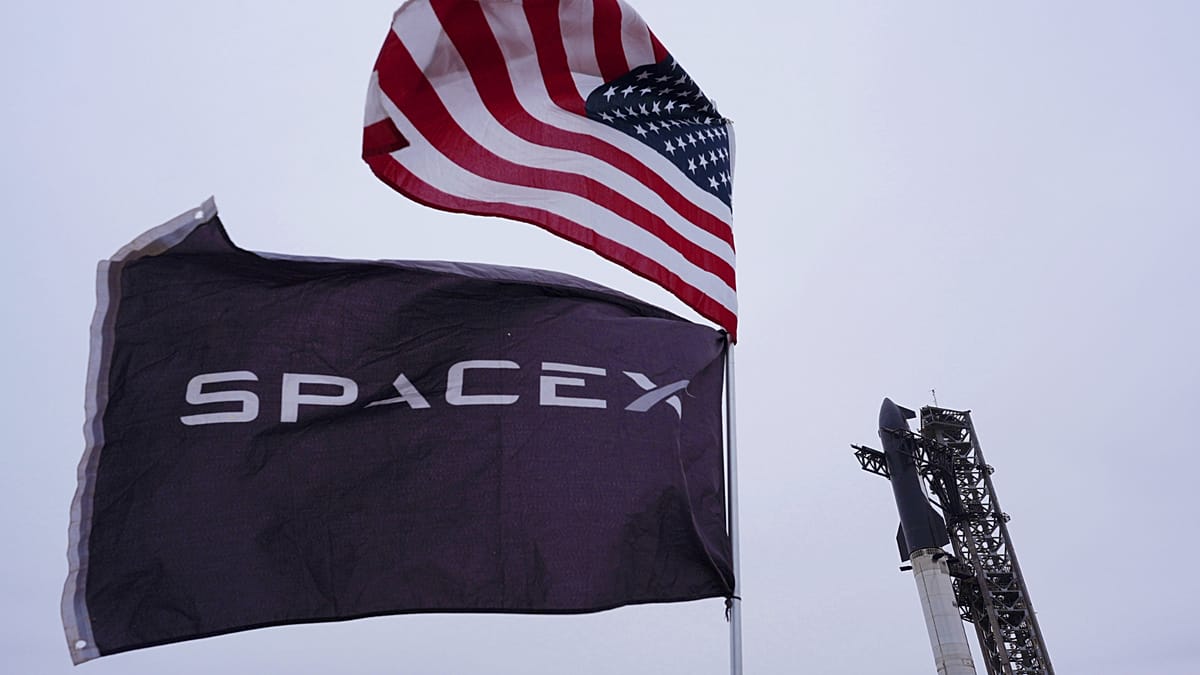
Elon Musk's SpaceX made its long-awaited public market debut on Friday, listing on the Nasdaq under the ticker SPCX in what is now the largest initial public offering in financial history. The company raised $75 billion (€64.5bn) by pricing 555.6 million Class A shares at $135 each, giving it a valuation of roughly $1.78 trillion (€1.54trn).
Shares opened at $150, more than 10% above the IPO price, and quickly climbed past $160 in the first minutes of trading. The offering eclipsed Saudi Aramco's $29.4 billion (€25.4bn) IPO from 2019, which had held the global record for nearly seven years.
Speaking before the New York session opened, Musk said SpaceX's mission is to "take the fiction out of science fiction." The company, which combines aerospace engineering with artificial intelligence, has long been a private-market darling, and its public listing was one of the most anticipated events on Wall Street this year.
European Access and Index Inclusion
SpaceX earmarked up to 30% of its offering for retail investors, with 10% specifically reserved for European buyers. In the end, the retail allocation was set at 20%. For European investors looking to participate, the listing provides a rare opportunity to buy shares directly, though only about 3% to 4% of the company's total shares are currently available for public trading. Options contracts on SPCX are expected to begin trading next week.
The IPO also brings Musk closer to becoming the world's first trillionaire. Forbes estimated his pre-IPO stake in SpaceX at around 42%, worth roughly $500 billion (€435bn). At the IPO valuation, those holdings are valued at approximately $690 billion (€600bn), adding nearly $190 billion (€165bn) to his net worth. Thousands of SpaceX employees are also benefiting from the listing, many becoming millionaires overnight.
Index inclusion is expected to follow swiftly. Under Nasdaq's fast-entry rule introduced in May, newly listed stocks can be evaluated for the Nasdaq-100 as early as the seventh trading day. SpaceX's market capitalisation already ranks it within the top 10 members of that index. Analysts estimate that funds tracking the Nasdaq-100 will need to purchase at least $7 billion (€6bn) worth of SpaceX shares around the inclusion date, creating a wave of mechanical demand.
The company has also qualified for the Russell US Equity Indexes and the FTSE Global Equity Index Series under fast-entry rules from FTSE Russell. However, the S&P 500 will not follow suit; S&P Dow Jones Indices confirmed in early June that it will maintain its 12-month seasoning requirement and GAAP profitability test, meaning SpaceX will not join that index before mid-2027.
For European readers interested in the broader context of this IPO and how to assess risks, our guide SpaceX IPO: How European Retail Investors Can Buy Shares and Assess Risks provides detailed analysis. The listing also comes amid a wave of high-profile tech IPOs, including OpenAI and Anthropic, which together with SpaceX are testing market capacity in what some analysts call an unprecedented $4 trillion wave, as covered in SpaceX, OpenAI, and Anthropic IPOs Test Market Capacity in Unprecedented $4 Trillion Wave.
The IPO marks a significant milestone for Musk, who now controls three publicly traded companies: Tesla, SpaceX, and X (formerly Twitter). It also underscores the growing intersection of artificial intelligence and space technology, sectors where European firms are increasingly competing. As European regulators weigh their own approach to AI and space policy, the success of SpaceX's public offering may influence investment trends across the continent.