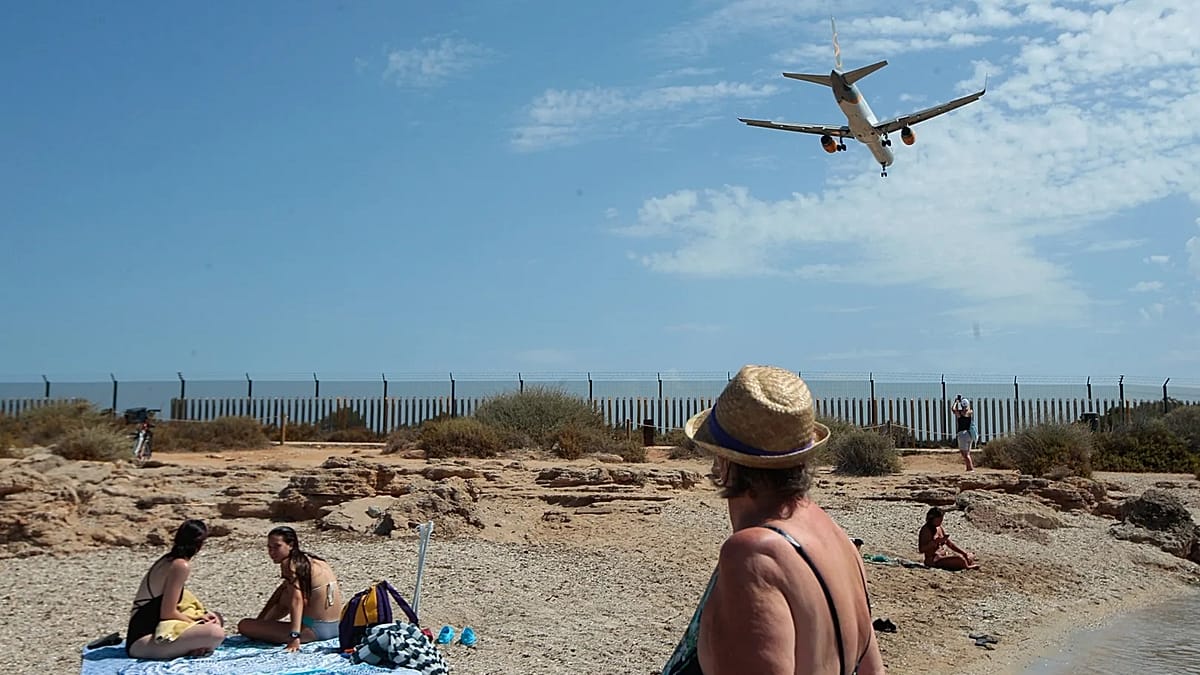
Spain is poised to set another tourism record this summer, with the government forecasting 43 million international arrivals between June and September — a 6% jump from the same period in 2025. Foreign visitors are expected to spend nearly €64 billion, according to Turespaña, the tourism agency under the Ministry of Industry and Tourism. But behind these bullish numbers lies a stark domestic reality: one in three residents cannot afford to take a week away from home.
The 2025 Living Conditions Survey from Spain's National Statistics Institute (INE) shows that 32.2% of the population could not afford a holiday of at least one week in the past year. While that figure has edged down 1.2 percentage points from 2024, it still leaves a significant share of Spanish households excluded from the summer break many take for granted.
Essential costs crowd out leisure
Ileana Izverniceanu, communications director at the Spanish Organisation of Consumers and Users (OCU), told Euronews that the problem goes beyond rising travel prices. “The fact that one in three Spaniards cannot go on holiday this summer is not an isolated event, but the reflection of an economic reality that OCU has been observing for years,” she said.
The OCU's own holiday survey found that 27% of Spaniards say they will not take a holiday this year, and another 8% are unsure. The organisation's Family Solvency Index, which tracks households' financial capacity, has recovered slightly to 47.4 points but remains well below pre-pandemic levels. “On paper, the economy is improving, but many families still do not feel that recovery in their day-to-day lives,” Izverniceanu added.
Housing, food, and utilities are absorbing an ever-larger share of income. According to OCU data, 45% of families struggle to cover housing costs — rent, mortgages, electricity, gas, and water. Among tenants, nearly half have difficulty paying rent. Food is another pressure point: 42% of households find it hard to afford groceries, especially meat and fish. Other essentials are also pinching budgets: 48% struggle with motoring costs, 46% with dental care, and 36% with energy bills.
“Against this backdrop, it is hardly surprising that holidays become one of the first expenses many families cut from their budget,” Izverniceanu said.
OCU estimates that 52% of households find it difficult or very difficult to afford a holiday. Those who do travel are adapting: they shorten trips, choose closer destinations, seek cheaper accommodation, or cut back on leisure spending. The average cost of a beach holiday for a family is €1,555; a trip abroad runs to €2,327; even a few days in a village costs €665. “For many families, these amounts are simply unaffordable,” the OCU spokesperson noted.
The inability to save compounds the problem. Some 69% of households surveyed say they struggle to set aside any income, making an exceptional expense like a holiday a direct threat to covering basic needs. “When most of the budget goes on housing, food, energy or transport, taking a break inevitably slips down the list of priorities,” Izverniceanu explained.
The broader economic picture is mixed. The INE survey also found that 36.4% of the population could not cope with unforeseen expenses in 2025, up from 35.8% the previous year. The share of people at risk of poverty or social exclusion stood at 25.7%, while severe material and social deprivation affected 8.1% of the population — both figures only marginally improved from 2024.
These domestic strains coexist with a booming tourism sector. The Ministry of Industry and Tourism expects foreign tourist spending to rise 10% this summer compared with 2025, outpacing the growth in arrivals. The contrast is particularly sharp in cities like Barcelona, Madrid, and Málaga, where tourist crowds are thick even as local residents grapple with housing affordability and living costs.
For OCU, the situation demands a policy response. “Holidays should not be regarded as a luxury, but as an important part of physical and mental wellbeing and of family work-life balance,” Izverniceanu said. The organisation is calling for measures to ease the cost of living, particularly in housing, energy, and food. It also advises families to plan ahead, compare prices, and use secure booking platforms — though it acknowledges that such tips are of little help to households that can barely cover essentials.
As Spain basks in another record-breaking tourist season, the gap between the visitor experience and the reality for many residents has never been wider. The question for policymakers is whether the country's economic recovery can be shared more broadly — or whether holidays will remain a privilege for the few.