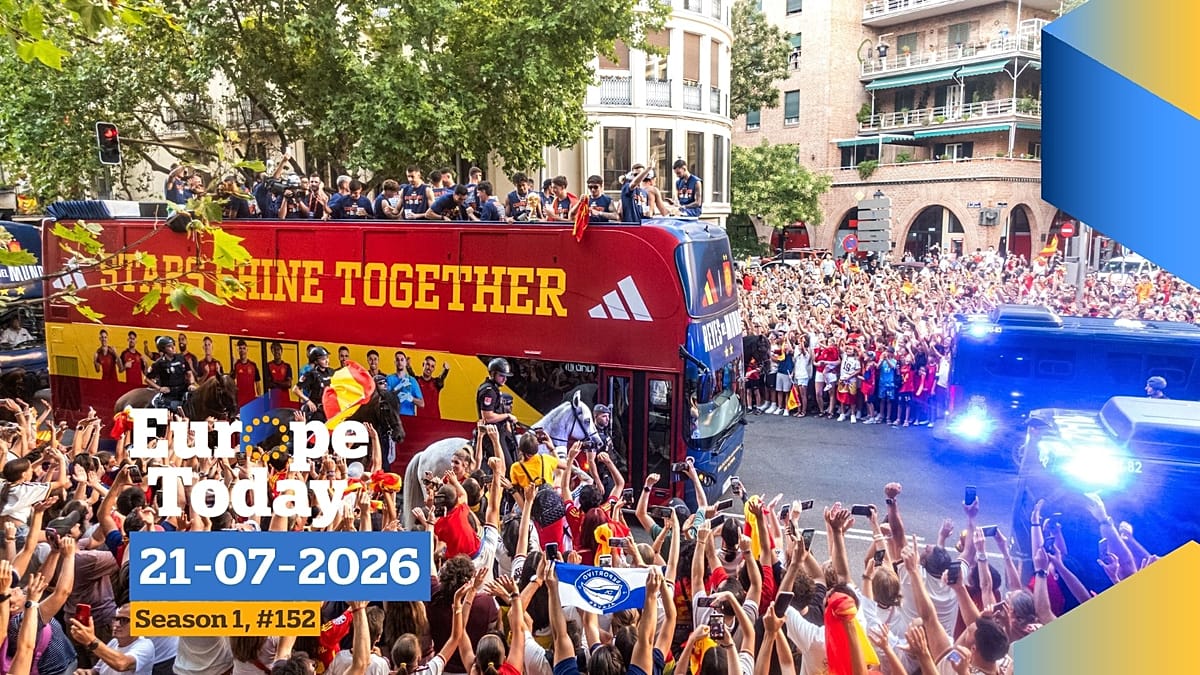
This week, Europe witnessed a convergence of major political and sporting events, from the streets of Madrid to the corridors of power in London and Berlin. Spain's World Cup victory sparked massive celebrations, while the United Kingdom welcomed a new prime minister and Germany's government prepares for a reshuffle.
Madrid's Million-Strong Welcome for La Roja
An estimated two million people lined the streets of Madrid to welcome home Spain's World Cup-winning football team. The victory, secured in a tense extra-time final against Argentina, has cemented La Roja's status as a dominant force in international football. The team's triumphant bus parade through the capital's iconic landmarks, including the Puerta del Sol and Plaza de Cibeles, drew ecstatic crowds waving Spanish flags and chanting players' names.
Spanish football journalists Jorge López-Torrecilla and Pablo Montaño, speaking on our programme, highlighted the team's tactical evolution and depth of talent. "This is not just a win; it's a statement," Montaño said. "Spain has built a system that produces world-class players consistently." The economic impact of the victory is also notable: a €4 billion boost is expected, though analysts caution that such gains are often temporary.
Andy Burnham Takes Office in the UK
Across the English Channel, Andy Burnham was officially sworn in as the United Kingdom's new Prime Minister, following the resignation of his predecessor. In his first address to the nation, Burnham outlined a decade-long plan focused on stability and renewal, pledging to address regional inequalities and invest in public services. The former mayor of Greater Manchester brings a distinctly northern perspective to Downing Street, a shift from the recent London-centric leadership.
Professor Tony Travers of the London School of Economics noted that Burnham's cabinet appointments signal a break from the past. "He is assembling a team that reflects his priorities: devolution, health, and social cohesion," Travers said. The new government faces immediate challenges, including a strained economy and ongoing negotiations with the European Union. For a deeper look at his policy direction, see our analysis of Burnham's first policy pledges.
Germany's Government Reshuffle
In Berlin, Chancellor Friedrich Merz has announced a forthcoming government reshuffle, prompted by the departure of Jens Spahn as parliamentary leader of the centre-right CDU. The move is seen as an attempt to revitalise the coalition's agenda ahead of key legislative battles. Euronews' Sonja Issel reported that Merz is expected to appoint younger, more dynamic figures to key ministries, particularly in economic and digital policy. The reshuffle comes at a critical time, as Germany grapples with energy transition costs and a sluggish industrial sector.
Hungary's Presidential Search
In Budapest, a political drama unfolded when Prime Minister Péter Magyar publicly urged chess grandmaster Judit Polgár to become Hungary's next president. Polgár, a global icon in chess, politely declined the offer, citing her commitment to educational and cultural projects. An interim president has since been appointed, but the episode highlights the ongoing search for a unifying figure in Hungarian politics, which has been marked by polarisation in recent years.
European Pulse: A Continent in Motion
These events, while distinct, reflect broader European trends: the power of sport to unite, the shifting political landscapes in major member states, and the constant recalibration of leadership. As Spain celebrates, the UK adjusts to a new government, and Germany prepares for change, the European Union's member states continue to navigate their own paths within the shared framework of the continent.
For more on Spain's World Cup journey, read our match report on the final victory. And for a look at the cultural impact of the win, see the political subplot behind the celebration.