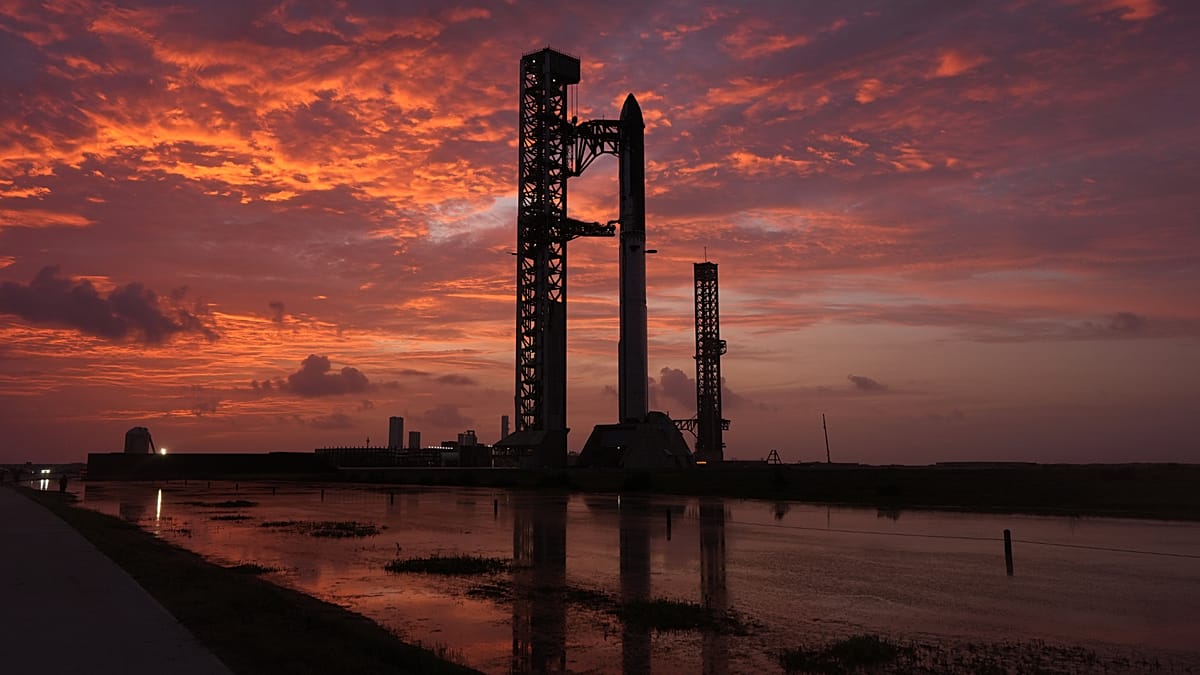
SpaceX's colossal Starship rocket was grounded on Thursday after four of its 33 Raptor engines failed to ignite during the final countdown, aborting the launch just one second before liftoff. The abort, which occurred at the company's Starbase facility near Brownsville, Texas, left the 124-metre-tall vehicle anchored to the pad as clouds of vapour and smoke billowed around it.
Elon Musk, SpaceX's founder and CEO, confirmed via X that two engines would be replaced “to be confident of a good flight” before the next attempt, which he said is most likely to occur early next week. This was the first time a full-scale Starship experienced a last-second abort, though earlier prototypes had ended in explosive fireballs during test flights.
Technical Details and Implications
SpaceX's launch webcast, filmed from a drone high above the pad, showed engine ignition beginning three seconds before the planned liftoff. Onscreen data indicated that four engines failed to fire, prompting the remaining 29 to shut down automatically. The rocket's autonomous launch system halted the countdown as designed—too few operating engines could have doomed the launch. The launch team immediately began draining fuel from the rocket.
The mission was to be Starship's 13th flight, carrying 20 of SpaceX's newest and most advanced Starlink satellites. These satellites were intended to attempt inter-satellite communication with Starlinks already in orbit while photographing Starship's heat shield during the planned hour-long flight. Neither the first-stage booster nor the spacecraft were meant to be recovered, with both ending up in the sea.
This setback comes as NASA relies on Starship to land astronauts on the moon within the next few years. The space agency has contracted both SpaceX and Jeff Bezos' Blue Origin to build and fly lunar landers—Starship and Blue Moon, respectively—for the Artemis programme. Both landers need to be ready by next year so that the Artemis III crew can practise docking their capsule with them in orbit around Earth. The subsequent mission, Artemis IV, planned for no earlier than 2028, would use one of these landers to take two astronauts to the moon's south polar region.
While the abort is a temporary delay, it underscores the technical challenges of developing the world's largest and most powerful rocket. The incident also highlights the importance of robust automated safety systems in preventing catastrophic failures.
For European readers, the Starship programme has indirect but significant implications. SpaceX's Starlink constellation, which these satellites were to join, already provides internet services across parts of Europe, including rural and remote areas. A successful deployment of the advanced satellites could enhance connectivity on the continent. Moreover, NASA's lunar ambitions, supported by Starship, may eventually involve European astronauts and scientific payloads, given the European Space Agency's role in the Artemis accords.
As SpaceX prepares for the next launch attempt, the global space community will be watching closely. The company's ability to quickly diagnose and rectify engine issues will be critical to maintaining its launch cadence and meeting its contractual obligations to NASA.