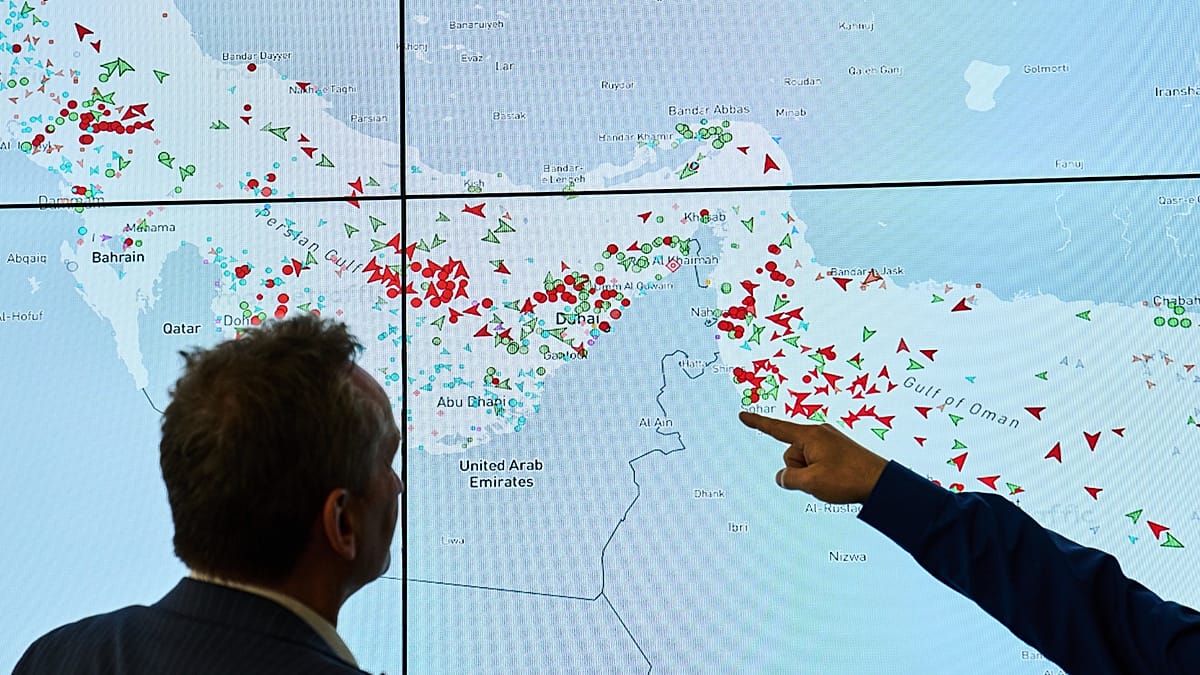
After months of conflict and a naval blockade that disrupted global energy markets, vessels have begun to trickle through the Strait of Hormuz. US President Donald Trump declared on Tuesday that “ships are starting to move, many loaded up with oil, out of the Strait of Hormuz,” and predicted the waterway would be “completely open” by Friday. Iranian state media confirmed that three oil tankers and two laden cargo ships had passed through the area, which had been subject to a US blockade since late February.
The reopening of this 38-kilometre-wide chokepoint—through which roughly one-fifth of the world’s oil and liquefied natural gas normally flows—is a central element of the ceasefire deal between Washington and Tehran, announced on Sunday. Yet key questions about the strait’s future governance remain unresolved, even as Trump urged “ships of the world” to “start their engines” and “let the oil flow.”
Who Will Manage the Strait?
The Strait of Hormuz is a natural passage bordered by Iran and Oman, both of which already exercise regulatory roles. However, Tehran published a map in late May claiming control over a stretch that extends deep into the territorial waters of the United Arab Emirates and Oman. Five Gulf states subsequently warned shipping companies through the International Maritime Organisation not to comply with Iranian directives.
Iran has also floated the idea of imposing tolls on passing vessels, suggesting it would collect fees jointly with Oman. Muscat quickly rejected that notion, stating that no tolls can be legally imposed on a natural waterway. Since the deal was announced, Iran’s foreign ministry spokesperson Esmaeil Baghaei has shifted the language, saying Iran would charge “maritime service fees” rather than tolls. The state-run Fars news agency reported that the agreement will include a legal blueprint for the Persian Gulf’s waters, envisaging joint management by Iran and Oman.
Trump initially claimed on Sunday that the strait had been reopened, only to backtrack and clarify that the full reopening depends on the signing of a framework agreement in Switzerland on Friday. A senior US administration official said that Trump, Vice President JD Vance, and Iran’s parliamentary speaker, Mohammad Bagher Ghalibaf, have already signed the text electronically. “The president wanted to sign it personally because he wanted to show his dedication to bring this through to a successful resolution,” the official said.
Nuclear Enrichment and Frozen Assets
The deal also addresses Iran’s nuclear programme and frozen assets. Baghaei said Washington has committed to releasing Iranian funds abroad and compensating Tehran for wartime damage. Iran’s Mehr news agency reported a 14-point memorandum of understanding that includes the release of $24 billion (€20.6 billion) in frozen Iranian assets during a 60-day negotiation period after the framework is signed. Vance told Fox News that no US taxpayer money will go to Tehran under the deal.
On the nuclear front, Trump told The New York Times that the US is still negotiating whether Iran will suspend enrichment for 20 years, hinting he might settle for 15. Vance told NBC that US and International Atomic Energy Agency inspectors will be allowed into Iran, and that “one of the core parts of the agreement is that the IAEA and the United States are going to help Iran destroy the highly enriched stockpile.”
Iran’s Deputy Foreign Minister Kazem Gharibabadi said the deal brings an “immediate end” to the war, with talks on a final agreement to be held within two months. Iranian military leaders hailed the accord as a victory, claiming it had “humiliated” the US and Israel, while President Masoud Pezeshkian called it “a great achievement” for the region. However, Foreign Minister Abbas Araghchi struck a cautious tone: “We have a history of broken commitments… a history of agreements being torn up. All of this is present in our minds.”
The reopening of the Strait of Hormuz has already had market effects: the Ibex 35 broke the 19,000 barrier on Tuesday, buoyed by the prospect of stable oil flows. Meanwhile, the G7 summit in Évian has provided a backdrop for discussions on the deal, with Trump reportedly urging Israeli Prime Minister Benjamin Netanyahu to curb operations in Lebanon—a conflict that escalated after Iran-backed Hezbollah launched rockets at Israel in early March. The question of whether the agreement will also halt fighting in Lebanon remains unresolved, as Baghaei said Washington must ensure Israel stops its strikes there.
As the world awaits Friday’s signing ceremony in Switzerland, the precise governance of the Strait of Hormuz—and the broader stability of the region—hangs in the balance. For European energy markets and shipping companies, the stakes could not be higher.