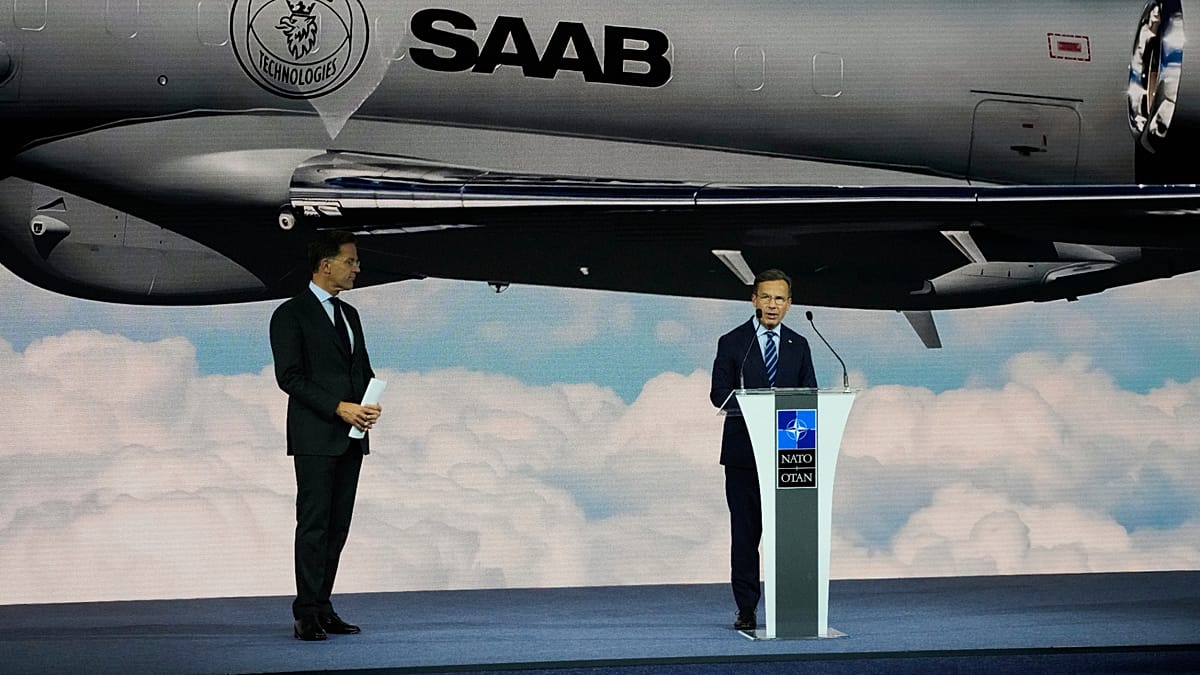
At the NATO Summit Defence Industry Forum in Ankara, the alliance announced it will replace its ageing Boeing E-3A surveillance fleet with GlobalEye, an airborne early warning and control (AEW&C) system built by Swedish defence company Saab. The decision marks a significant shift in NATO's procurement strategy, following the collapse of a previous deal with Boeing in 2025.
NATO plans to open negotiations with Saab to purchase up to ten GlobalEye aircraft, according to the Swedish government. The selection comes as allies face renewed pressure to bolster defence spending, a theme highlighted by demands from Washington for higher contributions.
What GlobalEye Brings to the Alliance
GlobalEye is a modified Bombardier Global 6500 business jet equipped with long-range radar, sensors, and command-and-control systems. Saab claims it can detect, identify, and track objects at distances exceeding 550 kilometres, with its radar capable of reaching even farther under certain conditions. The aircraft can stay airborne for more than 11 hours, offering a significant improvement over the Boeing E-3A's 10-hour endurance and 400-kilometre detection range.
Swedish Defence Minister Pål Jonson emphasised the strategic importance of such capabilities. “In a serious security situation, the ability to detect threats early and control operations in the air, at sea and on the ground is becoming increasingly important,” he said at the summit. “GlobalEye provides precisely the kind of advanced situational awareness that modern defences need to combat everything from drones, missiles and other types of threats.”
NATO currently operates 14 Boeing E-3A aircraft, which have been in service since 1982. Unlike most alliance assets, these are owned and operated by NATO itself rather than by individual member states. A single E-3A can monitor an area roughly the size of Poland, while three coordinated aircraft can continuously scan all of Central Europe. Saab has not yet disclosed an equivalent coverage figure for GlobalEye.
The selection is NATO's second attempt to replace its ageing fleet. In 2023, the alliance chose Boeing's E-7A Wedgetail, but that plan fell through in 2025 after the US Air Force dropped the aircraft from its budget in favour of space-based surveillance. The shift to a European supplier underscores the continent's growing defence industrial ambitions, a theme echoed in calls by Ursula von der Leyen and Mark Rutte for greater burden-sharing.
Eleven NATO countries are backing the purchase: Belgium, Canada, Denmark, Germany, Latvia, Lithuania, Luxembourg, the Netherlands, Norway, Romania, and Sweden. No contract has been signed yet; Saab will now enter formal negotiations with the NATO Support and Procurement Agency.
The GlobalEye deal reflects a broader trend of European nations investing in advanced surveillance and deterrence capabilities, particularly in light of ongoing tensions with Russia. As Ukraine continues to press for NATO support, the alliance's ability to monitor air, sea, and land threats in real time becomes ever more critical.