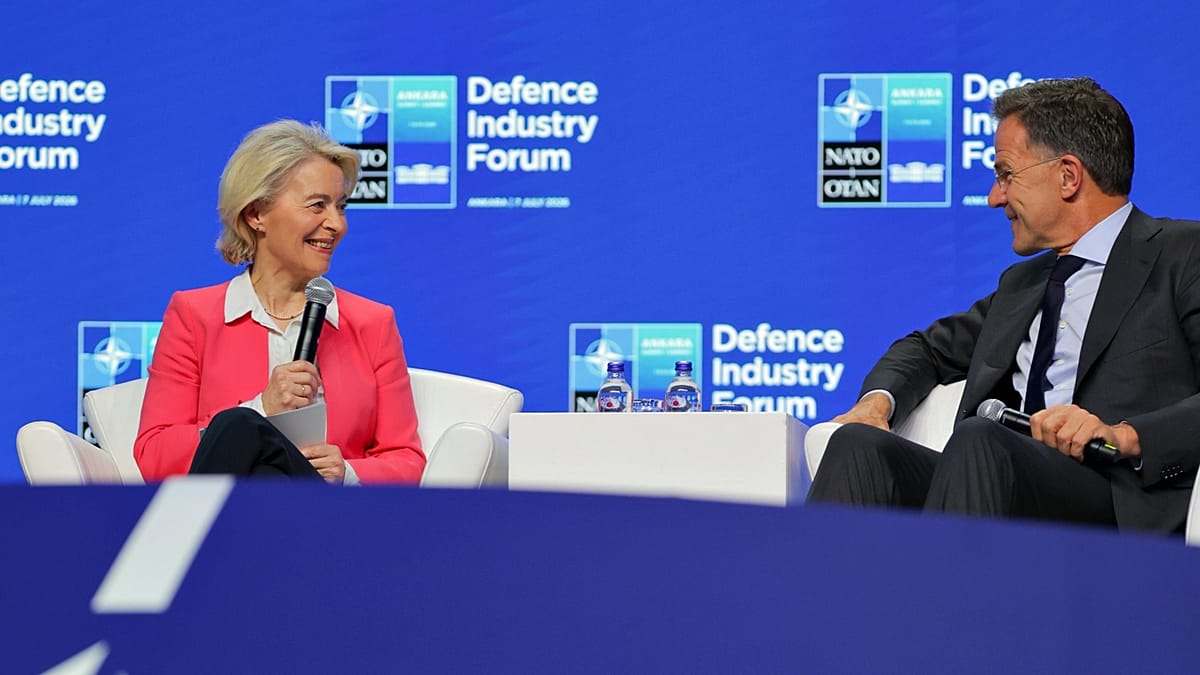
ANKARA — The European Union and NATO must deepen their partnership to reduce Europe's long-standing reliance on the United States for security, Ursula von der Leyen and Mark Rutte declared on Tuesday at an industrial forum ahead of the alliance's annual summit in the Turkish capital.
Speaking side by side, the European Commission president and the NATO secretary general stressed that closer cooperation between the two organisations is essential for the continent's defence. “We both know how important close cooperation between the European Union and NATO is,” von der Leyen said. “But to make this possible, what we need is interoperability.”
Rutte, a former Dutch prime minister, outlined a “clear division of labour” between the EU and NATO: the alliance handles command structures, capabilities and standards, while Brussels focuses on industry, investment and regulation. Twenty-three of the EU's 27 member states also belong to NATO, giving the two bodies overlapping membership and shared strategic interests.
“We cannot continue, as we did, being over-reliant on the United States. We need a much stronger Europe within a stronger NATO,” Rutte said, describing the ongoing transformation driven by EU-NATO cooperation as “unparalleled.” He added: “To stay transatlantic, we have to become more European.”
Growing pressure on European allies
The Ankara summit takes place against a backdrop of rising transatlantic tensions, fuelled by the White House's unilateral decision to strike Iran and a gradual reduction of US military assets stationed in Europe. European leaders are eager to demonstrate to US President Donald Trump that they are increasing their defence investments at a rapid pace — a trend often labelled the “Europeanisation of NATO.”
Yet the picture across the continent remains uneven. Poland, the Baltic states and the Nordic countries have sharply boosted military spending toward the new 5% of GDP target. In contrast, Spain, Belgium, Luxembourg and the Czech Republic still lag significantly behind. This disparity has become a recurring point of friction within the alliance, as German Chancellor Friedrich Merz and Baltic leaders pledged stronger deterrence ahead of the summit.
Von der Leyen touted the financial instruments her Commission has put forward to ramp up homegrown defence capabilities: €150 billion under the SAFE loan programme and €135 billion provisionally allocated in the next EU budget. “In this geostrategic and geopolitical environment, we need a massive surge in defence investment,” she said. “With this taxpayers' money, we want, of course, a return on investment. And we want good jobs in Europe. We want research and development in Europe. So that's important for us.”
Rutte warned that NATO requires a “huge increase” across its entire defence industrial base, on both sides of the Atlantic, to keep pace with Russia's war machine. “Russia has the whole of its economy now on a war footing. The car industry in Russia is producing for the war effort, and that means that we've got to do this also in Europe, Canada and the US,” he said.
The push for greater European self-reliance comes as Trump has called US support for NATO 'ridiculous', intensifying pressure on allies to meet spending commitments. European officials hope the Ankara summit will showcase their determination to shoulder more of the burden, even as internal differences over defence budgets persist.