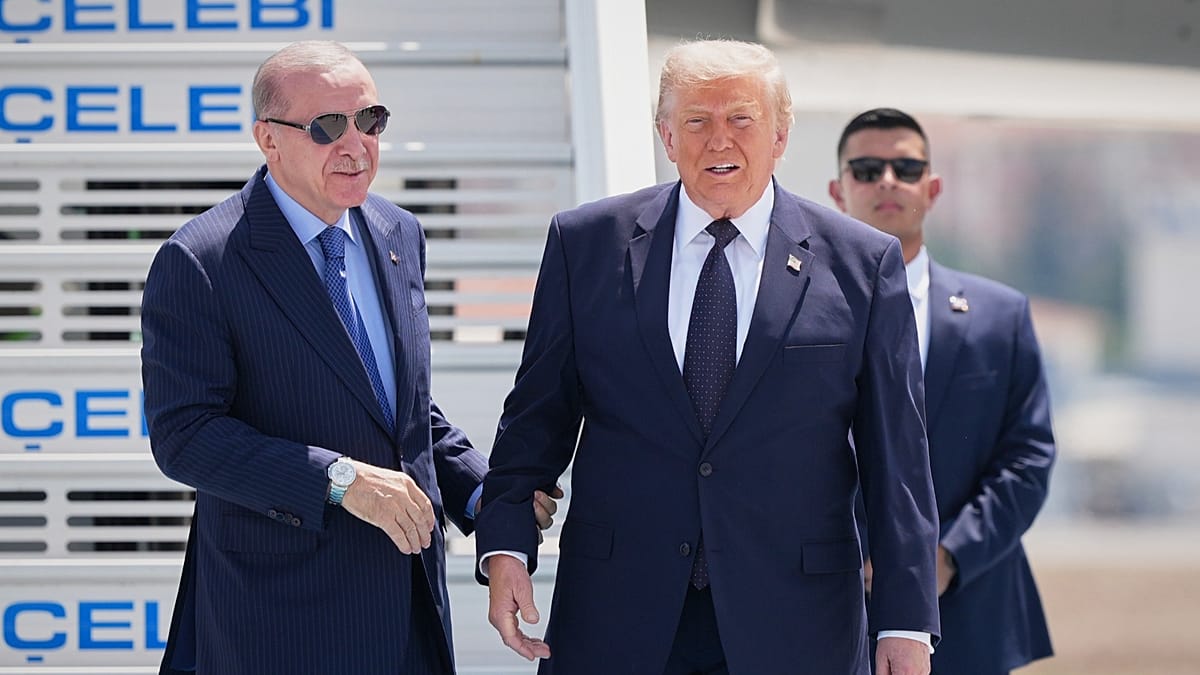
US President Donald Trump touched down in Ankara on Tuesday for a two-day NATO summit, arriving amid a fraught atmosphere with European allies over defence spending and Iran policy. The meeting, hosted by Turkish President Recep Tayyip Erdoğan, comes a year after NATO members pledged to raise security-related spending to 5% of GDP under pressure from the White House.
NATO Secretary General Mark Rutte opened the summit with a defence industry forum, announcing new arms contracts worth billions of dollars. “Allies and industry from both sides of the Atlantic will reveal new major projects and sign contracts worth literally billions of dollars,” Rutte said. “These are billions that are invested in our security, boosting our economies and supporting hundreds of thousands of new jobs.” Among the initial deals were contracts for drones, refuelling aircraft, and surveillance planes designed to bolster Europe’s ability to defend itself.
European leaders are hoping to avoid a major confrontation with Trump, who has repeatedly criticised allies for not moving fast enough on defence spending. In a post on Truth Social last week, Trump wrote: “Ridiculous for the U.S.A. to continue along this one-sided path when the relationship is not reciprocal. They were not there for us!!!” The US president has also been angered by European restrictions on US forces using bases to strike Iran, a point of contention that has overshadowed the summit.
Europe’s Balancing Act
Diplomats are banking on Trump’s good relationship with Erdoğan and a charm offensive by Rutte to keep the US leader’s mood in check. However, Trump has had recent fallings-out with other leaders, including Italy’s Giorgia Meloni, whom he mocked with a “restraining order” post on social media. The volatile situation means European leaders are treading carefully.
On Iran, European allies led by France and Britain have proposed a naval mission to help secure the Strait of Hormuz, and have moved vessels closer to the region. But they are waiting for clarity on the fragile US-Iran deal before committing their navies. The Europeans want to show willingness without being drawn into a conflict that could escalate.
Underlying the summit is a growing recognition that the US is inexorably pulling back from its role as Europe’s security guarantor. Washington has made clear it wants allies to take the lead on conventional defence of the continent and has announced cuts to the assets it makes available to NATO commanders. European nations are now trying to prove they are ready to play a greater role while keeping the US military engaged.
Rutte sought to frame the shift as positive. “All of this is evidence of a real shift in mindset,” he said. “This is NATO 3.0. A stronger Europe in a stronger NATO.” The summit is seen as a test of whether Europe can deliver on its promises, with NATO Summit in Ankara: Europe Steps Up as US Draws Down capturing the mood.
Despite the tensions, the summit has produced concrete announcements. The new contracts are designed to boost Europe’s military capabilities, particularly in surveillance and logistics. But the underlying question remains: can Europe convince Trump that it is a reliable partner, or will the alliance face further strain?
As the summit continues, all eyes are on Trump’s interactions with European leaders. The outcome will shape NATO’s credibility and the future of transatlantic relations. For now, European capitals are hoping for a conciliatory tone, but preparing for a more unilateral US approach.