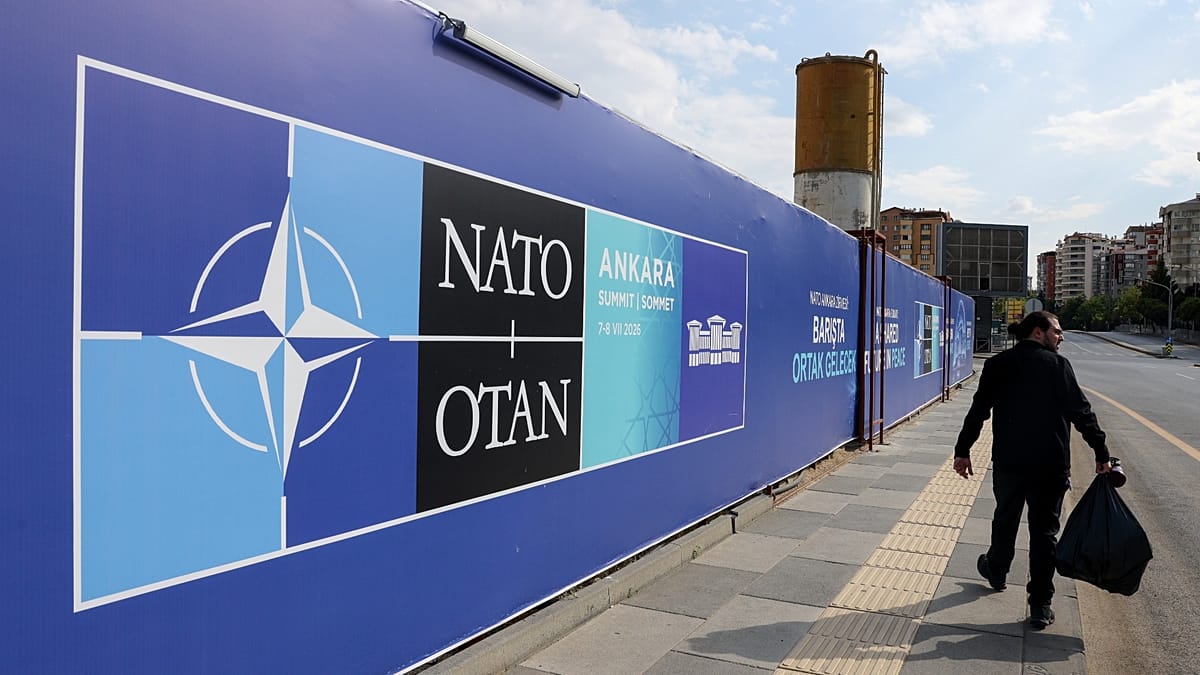
NATO Secretary General Mark Rutte is expected to declare this week's summit in Ankara one of the most consequential in the alliance's history, as European and Canadian allies unveil record defence spending commitments. The gathering of 32 heads of government comes at a pivotal moment, with the alliance's leadership pushing for a transformation of Europe's defence capabilities to meet modern warfare demands.
Behind the scenes, however, the shadow of US disengagement looms large. The summit, which some diplomats describe as the beginning of the "Europeanisation of NATO," is taking place against a backdrop of months of upheaval. Just six months ago, allies took seriously Washington's threat to annex Greenland, a semiautonomous territory of NATO member Denmark. Since then, US President Donald Trump has expressed fury over what he calls allies' "abandonment" of the US in its conflict with Iran.
Spain and Italy denied the US access to military bases for operations against Iran, while Germany and eventually the UK granted limited basing rights. Trump has since labelled European governments "cowards" and dismissed the alliance as a "paper tiger."
The Shift to NATO 3.0
The concept of "NATO 3.0," introduced by the Trump administration, envisions a European-led alliance that no longer relies on conventional US military support. This transition is already underway: US Secretary of War Pete Hegseth last month announced a review of the 80,000 US troops stationed in Europe, with an eye to reducing numbers. The Pentagon has also cut back on capabilities it contributes to the alliance in wartime, including long-range bombers, cruise missile-armed submarines, and fighter jets. European countries are now scrambling to fill these gaps.
At Tuesday's NATO defence forum, Rutte will press allies to accelerate investment. He is expected to point to a $139 billion increase in core defence spending by Europe and Canada over the past year—a 20 percent rise—and to what he calls "Trump's trillion": a surge in defence expenditure since the first Trump administration, which he frames as a direct response to US pressure.
Several major contracts are anticipated, including a deal worth over $1 billion (€880 million) for 200 Patriot missiles for Poland, and another $1.15 billion (€1 billion) for precision-guided artillery shells. Additional agreements worth $12.8 billion cover Arctic satellite communications and systems such as GlobalEye, Airbus, and Triton.
Yet the question remains whether money alone is enough. Fabrice Pothier, CEO of Rasmussen Global, told Euronews that while allies have committed to spending 5 percent of GDP on defence by 2035, governments and industry have yet to prove they are willing to take risks. "You have some defence manufacturers in Germany, France, and Spain sitting comfortably with national contracts and not really getting out of their comfort zone," he said. "They are producing systems that are very advanced but way too complex to produce fast enough to respond to today's needs."
Pothier added: "Can we use this famous trillion dollars to actually produce enough systems to keep adversaries like Russia or Iran at bay? This is the key question."
Former US ambassador to NATO Kurt Volker urged the alliance to learn from Ukraine's innovative, cost-effective approaches. He noted that the US had spent billions on expensive Patriot systems to counter cheap Iranian drones. "Ukraine has developed high-tech, low-cost systems that are very effective," Volker said. "If you spend a Patriot missile costing a million dollars to shoot down a drone that costs $30,000, that's an unsustainable position."
The summit will also address the war in Ukraine, where Ukrainian forces have made gains using long-range strikes on Russian oil and gas infrastructure and advances in drone and anti-drone technology. NATO countries face mounting pressure to ramp up investment for the continent's future defence, especially as the US draws down its presence.
With less time than usual allocated to political discussions, the Ankara summit is set to be a defining moment for the alliance—one that tests whether Europe can truly shoulder its own security burden.