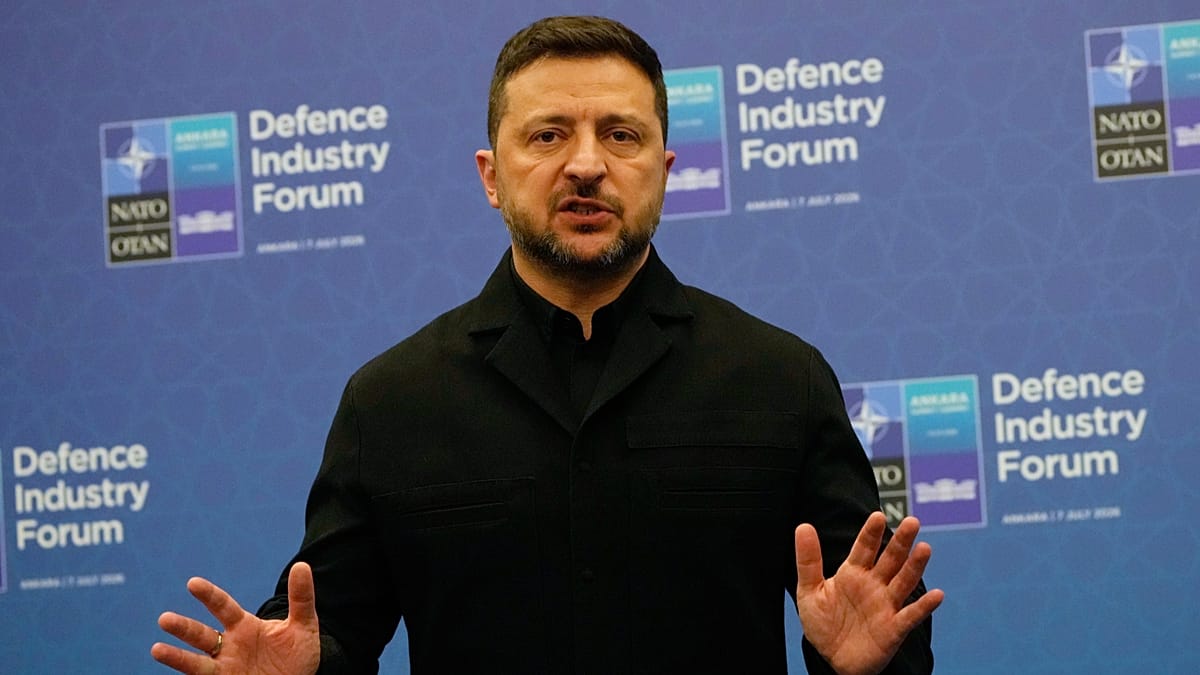
President Volodymyr Zelenskyy has made a renewed case for Ukraine’s membership in NATO, arguing that the country’s battlefield innovations and demonstrated defensive capabilities make it an asset rather than a liability for the alliance. Speaking at NATO’s Summit Defence Industry Forum in Ankara, he insisted that Ukraine has evolved from a security recipient into a provider of cutting-edge military technology for Europe.
“Do you really believe it would be right to leave outside NATO, a country and people with this level of defensive capability?” Zelenskyy asked the forum. “If we already have these capabilities, if Ukrainians already know how to fight like this, then it does make sense for these capabilities to become a part of the Alliance's collective defence. That would make all of us stronger.”
His remarks come at a time when the geopolitical landscape has shifted. US President Donald Trump has ruled out Ukrainian membership, and for a period Kyiv appeared to shelve the ambition. But the US-Israel conflict in Iran has reframed Ukraine’s profile from a vulnerable frontline state to a leader in drone warfare, as Gulf states sought advanced interceptors to counter Iranian strikes. This has positioned Kyiv at the forefront of military innovation, a point Zelenskyy was keen to underline.
From Vulnerable to Vital
Zelenskyy emphasised that Ukraine’s military has become a “source of extraordinary defensive capability” for Europe, driven by rapid technological adaptation. He pointed to the elimination of Russia’s strategic rear as a key achievement. “We have completely eliminated the very idea of Russia having a strategic rear,” he said, noting that Moscow had long believed its territorial depth protected its military production. “Ukrainian drones broke through Russia's defences and struck a Russian oil refinery in Siberia.”
On Monday, Ukrainian forces hit the country’s largest fuel production site in Omsk, more than 2,500 kilometres from the border. “This is not an exception. It's the new reality and there is no major oil refinery left in Russia that has not been struck by Ukraine,” Zelenskyy declared. The strike underscores Kyiv’s growing mid- and long-range strike capabilities, which he argued should be integrated into NATO’s collective defence to strengthen deterrence against Russia.
However, Zelenskyy acknowledged a critical gap: anti-ballistic air defence. Current Western production levels are insufficient for the scale of attacks seen in Ukraine and the Middle East. “Those who defend life need more Patriots,” he said, referring to the US-made system, while urging Europe to develop its own mass-produced alternatives without delay. This plea resonates with ongoing debates in Berlin and other capitals about Ukraine's air defence vulnerabilities.
The push for NATO membership also ties into broader discussions about Ukraine’s European integration. While the EU has granted candidate status, the path to full membership remains complex. Zelenskyy’s argument in Ankara suggests that military capability should accelerate political decisions. As Ukraine's EU ambassador recently noted, the focus should be on real integration, not just labels.
Yet the political obstacles are significant. Beyond Trump’s opposition, some European allies remain cautious about provoking a direct confrontation with Moscow. Zelenskyy countered that Ukraine’s membership would enhance NATO’s deterrent power, making aggression less likely. “If we already have these capabilities, it does make sense for them to become a part of the Alliance's collective defence,” he reiterated.
The forum in Ankara also highlighted the growing role of non-EU states like Turkey in European security architecture. As a NATO member with complex relations with both Russia and Ukraine, Turkey’s hosting of the event signals its mediating role. For Kyiv, the message was clear: Ukraine is not a burden but a contributor to European security, and its place in NATO is “entirely natural”.