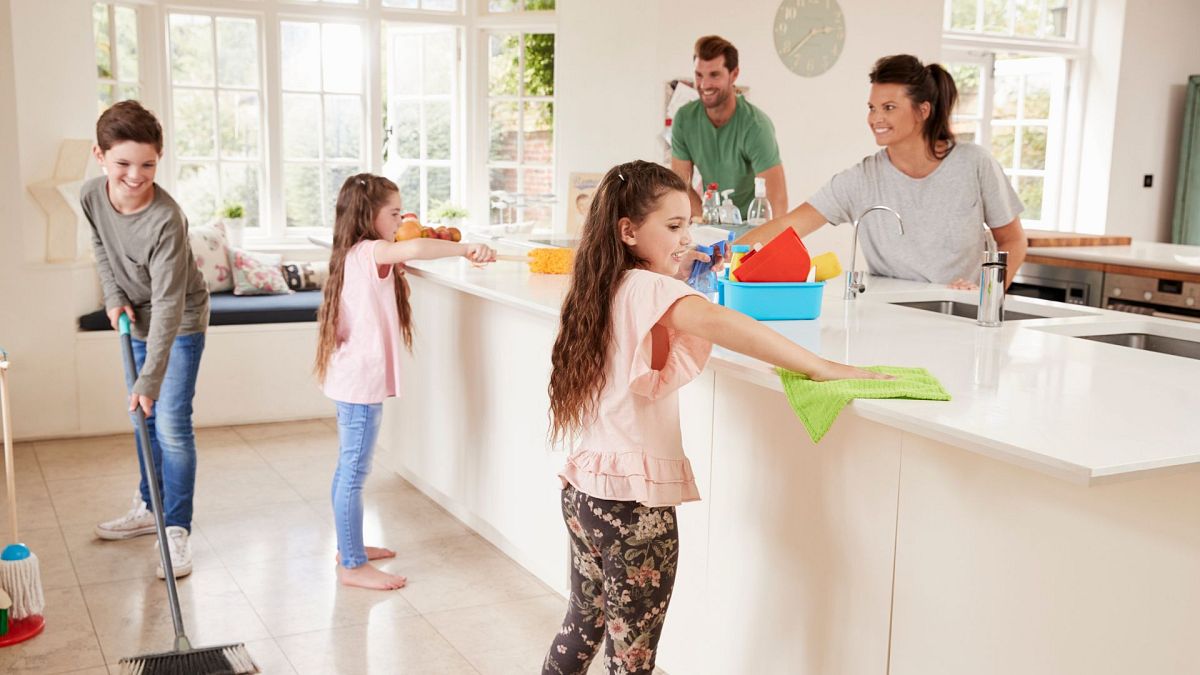
Disagreements over who does the dishes or folds the laundry are a familiar source of tension in many European households. A new Swedish app, Accord, seeks to address this by providing a structured way for couples and families to share and monitor domestic responsibilities.
Launched in September 2024, Accord has already attracted more than 25,000 users across Europe. The app functions as a shared checklist: families create groups, assign tasks like cleaning, grocery shopping, or laundry, and mark them off upon completion. A progress page then visualises the division of labour over time, making it clear who is contributing what.
“Accord is for couples and families who simply want less stress and more harmony in their day-to-day lives,” said Victor Fredrikson, a co-founder of the app, which was developed by three students at KTH Royal Institute of Technology in Stockholm.
Tackling a Persistent Gender Gap
The app’s mission is rooted in addressing a well-documented inequality. According to data from the European Commission, 79% of women in Europe cook and do housework every day, compared to just 34% of men. This imbalance often fuels frustration and arguments within relationships.
“It’s a challenge to find family harmony. And one of the biggest factors preventing this from happening is the inequalities between men and women,” Fredrikson explained. “What Accord does is it brings families closer to organise chores and activities together and to work on this, minimising the stresses and arguments that so often come with it.”
Among its users, the gender gap in household chores has reportedly shrunk by 60%, a shift Fredrikson calls a “huge improvement.” The app is available in multiple languages, including Spanish, French, German, English, and Swedish, reflecting its pan-European reach.
The idea for Accord emerged from a personal frustration. “Two years ago, I was still living at home with my parents and my dad was always nagging at me to clean my room. One day, he asked, ‘Why don’t you just programme an app so I don’t have to nag at you anymore?’” Fredrikson recalled. He took the suggestion seriously, pitching it to a classmate the next day. The team soon realised that the lack of structure in household management—unlike the workplace—was a core issue behind many arguments.
Beyond a Strict 50-50 Split
The developers emphasise that fairness is not about rigid equality. “I think one thing maybe that scares people off from the app a little bit is thinking that we want absolute fairness and 50-50 in terms of the amount of tasks or the exact time that you spend on different things,” Fredrikson said. “But it’s way more about this conversation to be had. Seeing, appreciating what the other person is actually doing and getting that visualisation very clear on who’s doing what, how much, and then ultimately starting that conversation.”
The app also incorporates the concept of energy management. Fredrikson noted that a female user explained she hated doing the dishes but enjoyed cooking, even though cooking took longer. “For her, the fairness in distribution was less about splitting chores down the middle by minutes and more about balancing the tasks that drained her compared to energising her,” he said. Accord now allows users to assign effort points to tasks based on perceived difficulty.
Lina-Marie Lundqvist, a part-time special educator in Sweden who uses Accord with her partner and children, says the app has made a tangible difference. “Now there are tasks that are distributed clearly, and everyone has taken responsibility for taking this,” she said. “I don’t have to be the project manager and be the initiator all the time. ‘Can you empty the dishwasher?’, ‘Can you do this?’, ‘Can you do that?’ So now the kids and my partner can do things without me having to be the initiator.”
While Lundqvist acknowledges she still does most chores because she works part-time while her partner works full-time, the app has fostered a sense of teamwork. “When I got home from work one day and the laundry was folded and the dishwasher was unpicked without me even having to remind. It was such a hallelujah moment,” she added.
As Europe grapples with broader issues of work-life balance and gender equality, tools like Accord offer a practical, data-driven approach to a deeply personal challenge. The app’s growth suggests that many households are ready to trade nagging for a more equitable system.