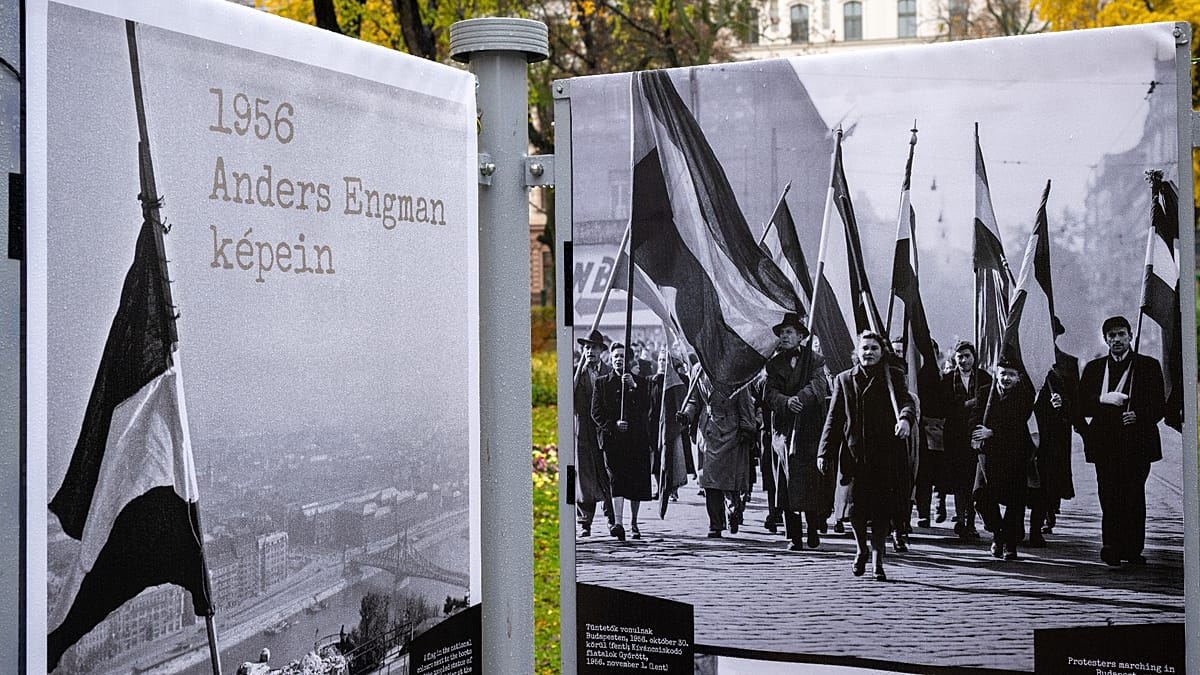
An open-air exhibition in the garden of the Hungarian National Museum in Budapest is now displaying photographs taken by Swedish photojournalist Anders Engman during the 1956 Hungarian uprising. The show, which opened this week, offers a rare and deeply personal view of the revolution that shook the country and reverberated across Europe.
Engman, who was only 23 when he arrived in Hungary as a reporter for a Swedish weekly, captured the historic days with remarkable sensitivity. His lens recorded not only the barricades and street fighting but also the faces of ordinary people caught in extraordinary circumstances. Among his most famous images is a portrait of Erika Szeles, a 15-year-old girl who was killed in the fighting—a photograph that has become an enduring symbol of the revolution's human cost.
Zsuzsanna Szabados-Jámbor, deputy director-general of the Hungarian National Museum, emphasized the broader significance of Engman's work. "The images he shot in Budapest, in Győr, along the Hungarian-Austrian border and later in the refugee camp in Austria are today not only key documents of the revolution but also of the history of international press photography," she said at the opening ceremony.
A lifetime's most important work
At the ceremony, Engman's widow, Inga-Britt Liljeroth, recalled that her late husband always considered his time in Hungary as the defining moment of his career. Although he went on to work in more than 100 countries over the following decades, the revolution remained his most important assignment. "When he was asked what had influenced him the most and what was the most important thing he had ever done, he always immediately replied: Budapest, 1956," she said.
Engman's photographs are notable for their intimacy and restraint. One of the most striking images shows artist Tibor András drawing on the shot-up Grand Boulevard, a scene that captures both the destruction and the resilience of the city. The painter's son, also named Tibor András, was present at the exhibition and shared a poignant memory of his father's determination to document the events.
"My mother locks the door because my father wants to go out to draw, and she says, don't go anywhere, you have two children, if you die, what will happen to us? My father was a hot-tempered man, he put on his spring shoes, look, these are spring shoes he is wearing, because my mother had hidden his clothes, he opened the window overlooking the small room corridor and jumped out of the window. This shook me terribly as a little boy, that my father ran off and went out because he felt that he had to be there."
The exhibition is part of a broader commemoration of the 70th anniversary of the uprising, which remains a pivotal moment in Hungarian and European history. The revolution, which began as a student protest in Budapest and quickly spread across the country, was brutally suppressed by Soviet forces, leading to a massive refugee crisis. Engman's photographs of refugees crossing into Austria are a stark reminder of the human toll and the solidarity shown by neighboring countries.
Inga-Britt Liljeroth still holds several hundred more photographs from the revolution, and the Committee of National Remembrance is already in discussions with her about their future presentation. This suggests that more of Engman's work may soon be made public, offering further insight into those turbulent days.
The exhibition runs in the museum's garden, providing a contemplative setting for visitors to reflect on the events of 1956. It also coincides with other commemorative events in Budapest, including official ceremonies and cultural programs. For those interested in the visual history of the revolution, this show is an essential stop.
Anders Engman's legacy as a photojournalist is firmly tied to his work in Hungary, but his career spanned the globe. His images from 1956 remain a testament to the power of photography to bear witness and to preserve memory. As Europe continues to grapple with questions of democracy and sovereignty, these photographs serve as a powerful reminder of the struggles that shaped the continent.
The exhibition is a collaboration between the Hungarian National Museum and the Committee of National Remembrance, with support from the Swedish Embassy in Budapest. It will remain open through the autumn, offering both Hungarians and international visitors a chance to see history through the eyes of a young Swedish reporter who never forgot what he saw.