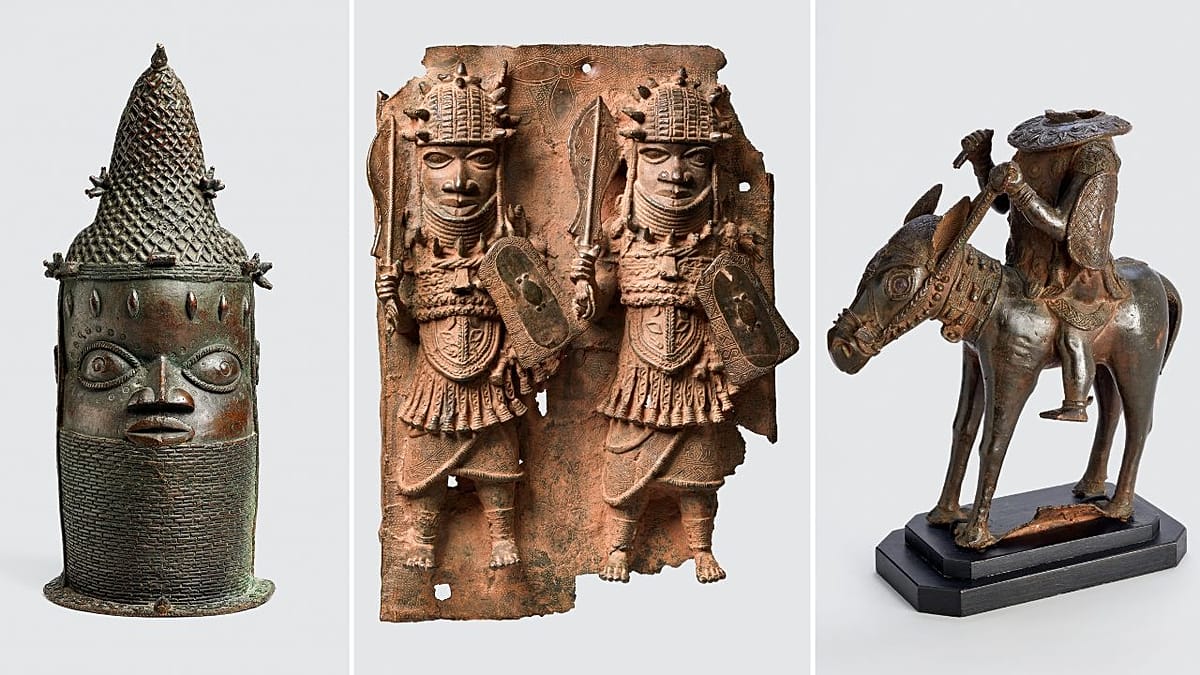
Nigeria’s campaign to recover cultural artefacts looted during the colonial era reached another milestone this week, as Switzerland formally handed over 18 Benin Bronzes in a ceremony at the National Museum in Lagos.
The restitution, carried out under the Benin Initiative Switzerland, a provenance research programme launched in 2021, involved three Swiss institutions: the Ethnographic Museum at the University of Zurich, the Museum Rietberg Zurich, and the Musée d’Ethnographie de Genève. Fourteen of the pieces came from the University of Zurich’s collection, with two each from the other two museums.
Monday’s handover is the first concrete step in an agreement signed in March 2026, under which Switzerland committed to transferring ownership of 28 Benin objects to Nigeria. The remaining ten are expected to follow in due course.
A History of Plunder and a Slow Return
The Benin Bronzes — a term that encompasses hundreds of metal and ivory sculptures and plaques — once adorned the royal palace of the Kingdom of Benin, in what is now Edo State in southern Nigeria. They served both political and religious functions, central to the kingdom’s authority. British colonial forces seized the vast majority during a brutal punitive expedition in 1897 that killed thousands and led to the kingdom’s absorption into colonial Nigeria.
In the decades that followed, the objects were sold to more than 130 museums across 20 countries, with the largest concentrations in the United Kingdom and Germany. Calls for their return are as old as the thefts themselves, but effective repatriations have only begun to accelerate in recent years.
Nigeria’s culture minister, Hannatu Musa Musawa, described the return as reflecting “the power of dialogue, trust, and international cooperation.” The Swiss Federal Department of Home Affairs noted that the ceremony also included the restitution of a bronze bracelet and four archaeological monoliths from the Niger Delta region, which had been seized in Switzerland during criminal proceedings.
The two countries also signed a cooperation agreement aimed at strengthening cultural heritage protection, part of what Swiss authorities called “a broader effort to address historical injustice.”
Nigeria at the Forefront of a Continental Movement
Nigeria has been one of the most persistent advocates for the return of looted African heritage. In 2025, the Netherlands returned 119 Benin Bronzes, the largest single physical restitution to date. Earlier this year, the University of Cambridge transferred legal ownership of 116 Benin Bronzes to Nigeria’s National Commission for Museums and Monuments (NCMM), though the physical transfer has yet to be completed.
Other African nations have also secured notable victories. Benin received 26 royal treasures from France in 2021, a process documented in Mati Diop’s award-winning film Dahomey. French colonial troops had stolen those pieces during the 1892 colonisation of the Dahomey kingdom. Earlier this year, France returned the Djidji Ayôkwé, a sacred talking drum, to Ivory Coast, 110 years after it was seized.
Yet the restitution battle remains uneven. Nigeria sent a formal repatriation request to the British Museum in October 2021. The institution holds more than 900 objects from the Kingdom of Benin, including 203 Benin Bronzes, but has so far refused to return them, arguing that its collections are legally unalienable under UK law.
Even after repatriation, ownership disputes can persist. In November 2025, protesters disrupted the opening of the Museum of West African Art in Benin City, claiming that its handling of returned artefacts undermined the authority of the city’s traditional rulers. The museum’s launch was postponed indefinitely.
Some of the artefacts returned by Switzerland will go on display at the National Museum in Lagos, while most will be sent to Edo State for temporary storage at the National Museum in Benin City. The NCMM has announced plans to build a dedicated gallery to house all recently returned Benin artefacts, including those from the Netherlands and the expected Cambridge transfers.