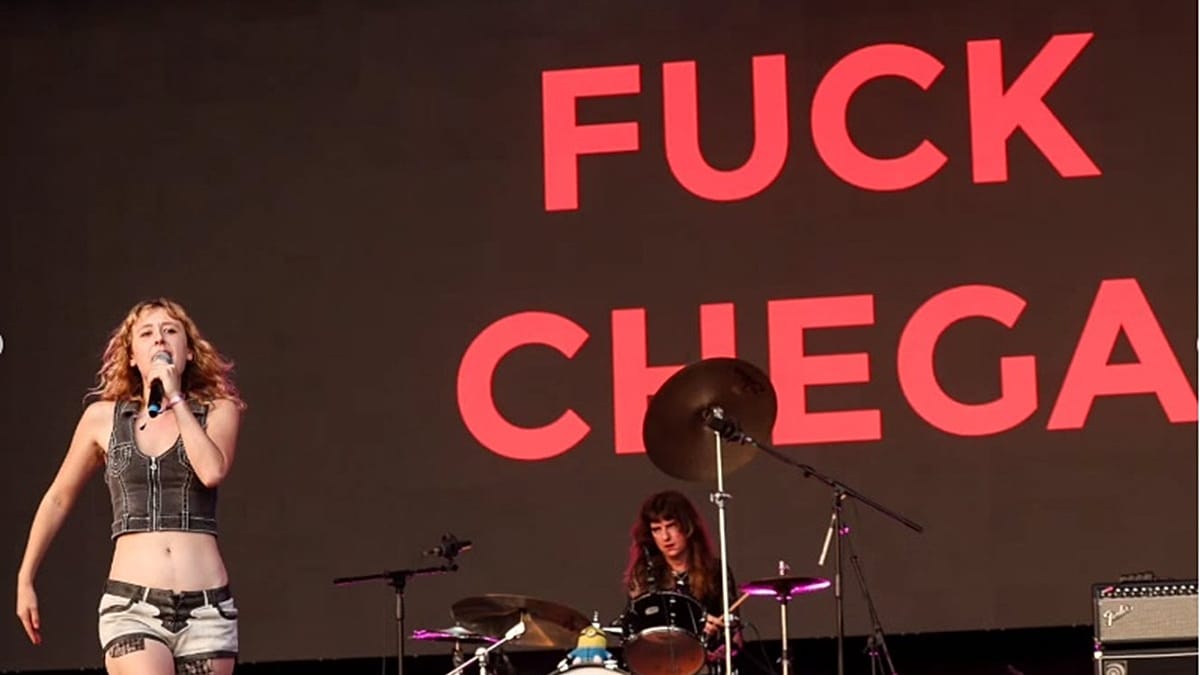
The opening night of Portugal's CA Vilar de Mouros festival, the Iberian Peninsula's oldest music event, took a political turn when British punk duo Sprints aimed a profanity-laced message at the country's right-wing Chega party. The Brighton-formed band, comprising Phoebe Lunny and Selin Macieira-Boşgelmez, projected the words "Fuck Chega" on the stage screen and urged the crowd to chant the phrase, sparking immediate controversy.
Beyond the anti-Chega slogan, the duo used their set to voice broader political sentiments, including "To hell with the far right" and "Free Palestine, free Congo, free Sudan," while also displaying the Palestinian flag. The performance, part of their debut album tour Who Let the Dogs Out, was a deliberate fusion of music and activism.
Political backlash
Chega's leader, André Ventura, took to X to condemn the act, questioning the use of public funds for what he called "nonsense." He wrote: "'Fuck Chega' was heard on stage at the Vilar de Mouros Festival, where thousands of euros of taxpayers' money are spent (so Chega members and supporters also paid for this nonsense). Is anything allowed when it comes to insulting us? Can drugs and a 'fried' brain be used as a justification for offending millions of Portuguese people, and with public money on top of that?"
The mayor of Caminha, Liliana Silva, who represents the Social Democratic Party (PSD), also distanced herself from the band's actions. In a Facebook post, she described the situation as "regrettable," emphasizing that the festival "has no party and no colours" and belongs to the municipality. She expressed outrage that artists would use the event "to insult whatever it may be," calling such behaviour "an affront to the freedom, respect and harmonious coexistence that we want to prevail at this festival."
The festival, held in the village of Vilar de Mouros in the Caminha municipality for over six decades, has long been a cultural landmark. This year's edition, however, has been overshadowed by the political row, drawing attention to the growing intersection of music and politics in Europe.
Artists defend their stance
In an interview with Jornal de Notícias, a festival media partner, vocalist Phoebe Lunny defended the band's political engagement. She argued that artists do not need to belong to political parties, but given "the overall rise of fascism worldwide, I think all artists have a responsibility at least to reflect the opinions of the people around them and the situations and environment in which they find themselves."
Bassist Selin Macieira-Boşgelmez, who has Portuguese roots, added that the band aims to reconnect with punk's rebellious origins. "I think political climates are becoming much more extreme, and I think that is also being reflected in music. I think that we, in particular, as a band and as an identity, are in a way very much built around that," she told the same outlet.
The incident highlights a broader trend across Europe, where festivals and cultural events are increasingly becoming arenas for political expression. Similar tensions have emerged at other gatherings, from wellness-focused festivals in the UK to quirky Belgian traditions, though few have sparked such direct political confrontation.
As the debate over artistic freedom and public funding continues, the Vilar de Mouros festival finds itself at the centre of a national conversation about the role of culture in political discourse. For now, the band's message has resonated with some and infuriated others, underscoring the deep divisions within Portuguese society over the rise of the far right.