At Wasing Estate in Berkshire, England, more than 10,000 people have gathered for the Medicine Festival, an event that defies easy categorisation. It is part retreat, part workshop, part communal celebration. Attendees have come from across Europe—from Strasbourg to Stockholm—to take part in ancestral ceremonies, dance, yoga, and a wide range of practices that promise to reconnect body and mind.
The festival is part of a broader phenomenon of "conscious festivals" that have been gaining traction across the continent. These events are not just about music or entertainment; they are spaces where people seek to reconnect with themselves, with nature, and with each other, often exploring alternative approaches to health and wellbeing that sit outside the mainstream medical model.
A festival of many practices
The programme at Medicine is vast. There are sessions on movement, gender, sexuality, and personal growth, alongside workshops led by practitioners of alternative therapies from around the world. The atmosphere is one of openness and experimentation, with participants encouraged to step outside their comfort zones.
Mylène, a yoga and kinesiology practitioner from Strasbourg, is one of the many facilitators. Kinesiology is an alternative practice that uses muscle responses to identify imbalances in the body and seeks to correct them. "I help people understand what is happening inside their bodies," she explains. "To do so, I explore different ways of understanding the language of the body. Movement and dance bring a lot of things to life within us."
Her approach reflects a growing interest in somatic practices—methods that emphasise the connection between physical sensation and emotional or psychological states. For many participants, these practices offer a way to address stress, trauma, or simply the disconnection of modern life.
Yoga Nidra: the art of conscious sleep
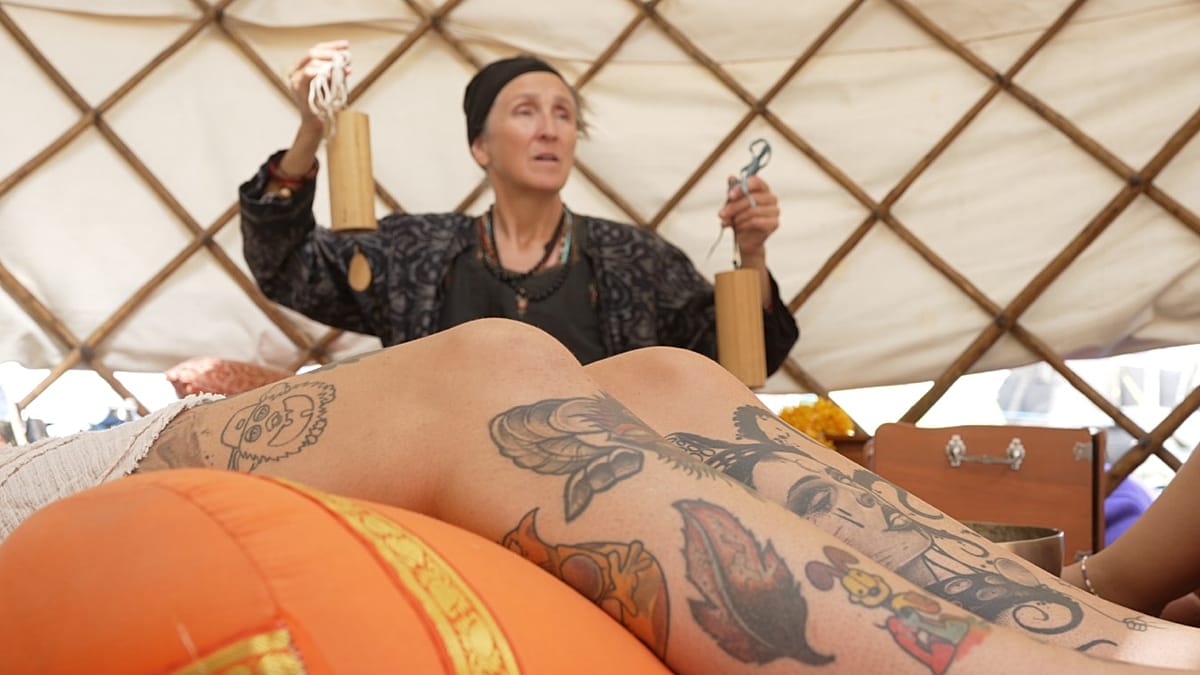
One of the most popular sessions is Yoga Nidra, led by Uma Dinsmore-Tuli, author and co-founder of the Yoga Nidra Network. The session feels less like a traditional meditation and more like a theatrical performance—somewhere between a musical, a comedy, and a guided meditation. Participants lie down, close their eyes, and follow Dinsmore-Tuli's voice through a journey of relaxation and awareness.
"Nidra is a Sanskrit word and it means 'sleep'," Dinsmore-Tuli explains. "So what it actually means is the state of consciousness that is very naturally arising when you are drifting in your sleep, when you are awake and nearly not asleep. You can cultivate conscious awareness of that state. It's a good way to downregulate your nervous system, it supports good digestion, it supports the menstrual cycles and all the kinds of rhythmic practices within us, and it allows you to navigate your way consciously into a more relaxed way of being."
Her words resonate with many in the audience, who are seeking tools to manage the stresses of daily life. The practice is increasingly being studied by scientists interested in the effects of meditation on the body, from reducing cortisol levels to improving sleep quality.
Science and scepticism
While the festival is a celebration of alternative approaches, the scientific evidence for many of these practices remains mixed. Some studies suggest that yoga and meditation can have measurable benefits for mental health, but the claims made by practitioners often go beyond what research has confirmed. The line between evidence-based therapy and unproven speculation can be blurry.
Nevertheless, the popularity of events like Medicine suggests a deep-seated desire for a more holistic understanding of health—one that acknowledges the role of the mind, emotions, and community. As one participant from Berlin put it, "We are not just bodies to be fixed; we are whole beings."
The festival also taps into a wider European conversation about wellbeing and the limits of conventional medicine. From the rise of conscious festivals to the growing interest in traditional practices, there is a clear appetite for alternatives. Whether these approaches will gain broader acceptance in healthcare systems remains to be seen, but for now, they offer a space for exploration and connection.
As the sun sets over the Wasing Estate, the sounds of drums and chanting fill the air. For many, this is not just a festival—it is a way of life, a community, and a path to a different kind of wellbeing.