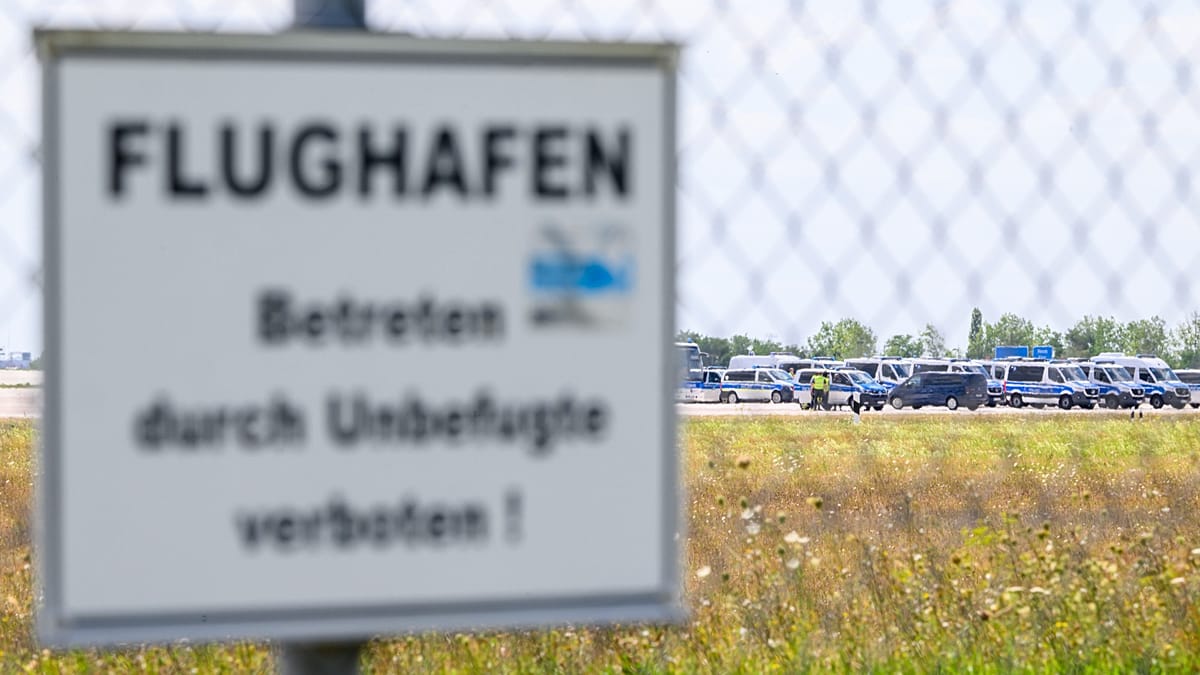
Investigators in Germany have uncovered a third drone and what they believe to be military-grade explosives in connection with an attempted attack on Leipzig/Halle Airport earlier this month, according to public broadcasters NDR and WDR and the Süddeutsche Zeitung daily.
The drone was discovered west of the airport on 14 August, ten days after the initial incident. Reports indicate that investigators also found approximately 50 grams of a substance suspected to be hexogen, a powerful military explosive.
Other leads took investigators to Kursdorf, a village north of the airport, where they found a device that may have been used to control a drone. An antenna and electronic components had been taped to a tree, according to current findings. In the immediate vicinity, emergency services discovered scorched earth and metal fragments, prompting investigators to examine whether this could have been a blast site.
Attempted attack on a key logistics hub
The initial incident unfolded on the night of 4–5 August, when German police deployed a bomb disposal robot after a drone was found on the tarmac near a Ukrainian cargo plane. The discovery sparked alarm and forced the diversion of numerous flights. One aircraft that had to abort its scheduled landing at Leipzig/Halle then collided mid-air with an unknown object nearby, but later landed safely elsewhere, the government said.
A NATO spokesperson later confirmed that a drone equipped with explosives and a detonator had been found near an aircraft belonging to Antonov Airlines, the Ukrainian cargo carrier. According to the Kyiv Independent, the suspicious object was destroyed in a controlled explosion.
Police spokesperson Olaf Hoppe told Euronews that, at the same time as the sighting, an object was found in the area of the southern runway which the federal police examined. He declined to confirm that a drone had been sighted, but X-ray analysis later revealed it to be a drone.
The airport in eastern Germany plays a crucial role in the transport of military goods, including for the German military and NATO allies, and also serves as a base for Antonov Airlines. Video footage from a local news agency showed the bomb disposal robot near an Antonov plane painted in Ukrainian colours, with the words “Be Brave Like Kherson” written on the side, a reference to a Ukrainian region battered by Russian strikes.
The Bild daily reported that the plane that collided with an unknown object mid-air was a DHL cargo aircraft, hit about six kilometres away, sustaining minor damage to its nose that was discovered when it later landed safely at Hanover airport.
German police first reported on Wednesday morning that a “security-related incident” had temporarily halted flights to the airport. “Shortly before midnight, an unidentified flying object was sighted near Leipzig-Halle Airport, prompting the diversion of several aircraft, including a passenger plane, to other airports,” they said. A passenger plane from Mallorca as well as several cargo planes heading there had to be sent to other locations.
Rising drone incidents across Germany
Germany and other European countries have repeatedly observed drones flying over sensitive sites such as airports, military bases, and industrial plants. Authorities in Germany, one of Ukraine's biggest military supporters, have said they suspect Russia of orchestrating many of these incidents as part of a campaign of sabotage, espionage, and disinformation.
In July 2024, a parcel burst into flames on the ground at Leipzig airport before it could be loaded onto a DHL cargo plane, part of what security services treated as a suspected Moscow-linked arson sabotage plot. Russia has denied being behind any such incidents.
Last year, a Chinese national was convicted for passing on information about flight schedules and cargo movements at Leipzig/Halle airport to a man spying for Beijing. In October last year, local media reported that a laser installation had been deployed near Munich airport to protect the facility from drone sightings, after the airport was closed for two consecutive days over suspicious drone activity. In November, flight operations at Berlin's Brandenburg Airport were interrupted for around two hours due to a drone sighting in its airspace.
Incidents of unidentified drones flying in Germany's airspace are on the rise, with the country's air navigation service DFS saying 144 drone overflights were logged last year, with 35 incidents clustered around Frankfurt Airport. The latest discoveries near Leipzig/Halle underscore the persistent threat to critical infrastructure and the challenges facing European security services.