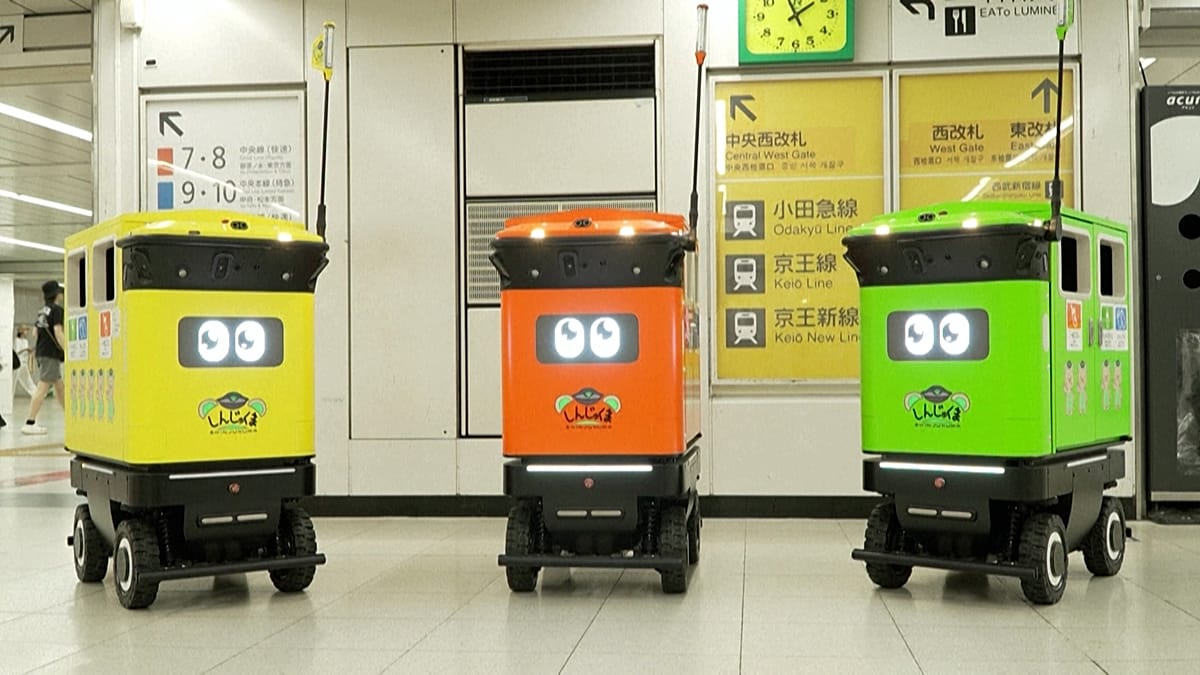
At Shinjuku Station in Tokyo, a new kind of commuter is drawing glances: a squat, wheeled bin that trundles toward litter rather than waiting for someone to approach it. The pilot, launched by the Japanese technology firm Suntory and the station operator, is part of a broader push to automate urban maintenance in one of the world's most crowded transit nodes.
The robotic bins use sensors and cameras to navigate around pedestrians, stopping when they detect rubbish nearby. They are designed to complement, not replace, the station's existing cleaning staff, according to the project's coordinators. The trial is scheduled to run for several weeks, with data collected on efficiency, battery life, and how smoothly the machines move through dense foot traffic.
For European cities wrestling with similar waste-management challenges, the experiment offers a useful case study. Amsterdam's Schiphol Airport and London's King's Cross station have both experimented with automated cleaning, but Japan's approach is distinctive in its focus on mobility and real-time responsiveness. The technology could eventually be adapted for use in European transport hubs, where station managers are under pressure to cut costs while improving passenger experience.
Why Shinjuku?
Shinjuku Station is an ideal testing ground. It handles more than three million passengers daily, making it one of the busiest rail terminals on Earth. The sheer volume of footfall means litter accumulates quickly, and the station's labyrinthine corridors pose a navigation challenge for any autonomous vehicle. If the robots can cope here, the logic goes, they can cope almost anywhere.
The trial also reflects a wider trend in Japan, where an ageing workforce and strict immigration rules have created labour shortages in service industries. Robots are increasingly seen as a pragmatic answer, not a novelty. The country has already deployed humanoid robots in hotels, convenience stores, and even robot ambulances for maintenance, as part of a broader effort to automate everyday services.
European observers are watching closely. Several EU-funded smart-city projects, including those in Barcelona and Copenhagen, have explored similar autonomous waste systems, but they have struggled with regulatory hurdles and public scepticism. Japan's trial could provide valuable data on how pedestrians react to machines sharing their space.
Public reaction and design
Early footage from the station shows commuters mostly ignoring the robots, which move at a cautious walking pace and emit a soft beep when they stop. Some children have been seen following the bins, but station staff report no major disruptions. The machines are equipped with emergency stop buttons and are remotely monitored by a control room.
Designers say the bins are intentionally cute, with rounded edges and a friendly LED face, to put the public at ease. This approach mirrors a broader Japanese aesthetic in robotics, where functionality is paired with approachability. In contrast, European prototypes have often prioritised utilitarian design, which some researchers believe has slowed adoption.
"The key is trust," said Dr. Yuki Tanaka, a robotics researcher at the University of Tokyo who is not involved in the trial. "If people see the machine as a threat, they will avoid it, and the whole system fails. The Japanese approach of making robots look harmless is actually a smart engineering decision."
Implications for Europe
For European cities, the lessons extend beyond design. The trial is being conducted under Japan's strict privacy laws, which require the robots to blur faces in their camera feeds. Similar concerns have been raised in the European Union, where the General Data Protection Regulation imposes stringent rules on surveillance. Any deployment in Europe would need to address these issues from the outset.
There is also an economic angle. The cost of developing and maintaining such robots is still high, and it is unclear whether they offer a better return than simply hiring more staff. However, as labour costs rise across Europe, automation may become more attractive. A recent study by the European Commission estimated that the EU's waste management sector could see a 15% increase in productivity through automation by 2030.
The Shinjuku trial is not the only example of Japan's robotic ambitions. Earlier this year, the Bank of Japan raised interest rates to their highest level since 1994, partly to manage the economic effects of an ageing society. The country's investment in robotics is seen as a long-term strategy to maintain its competitive edge.
For now, the bins are a modest experiment, but they represent a significant step toward a future where machines and humans share public spaces more seamlessly. As European cities look to modernise their infrastructure, they would do well to watch Tokyo's progress.