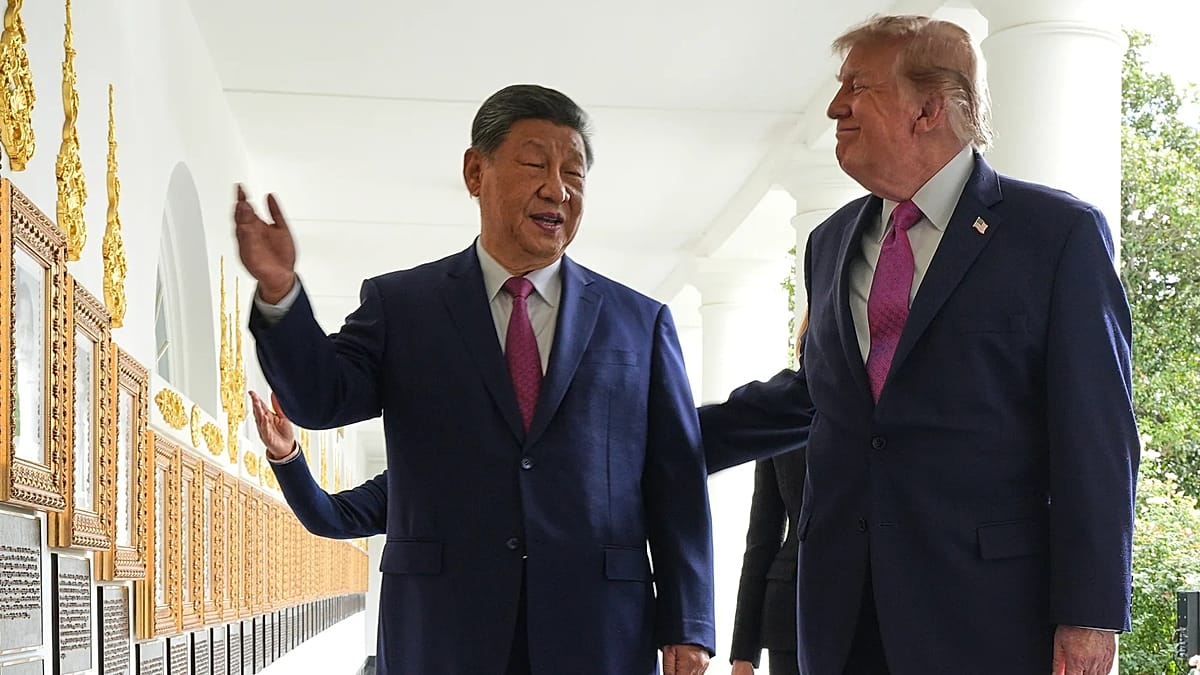
Washington's diplomatic calendar turned to Beijing on Thursday as Chinese President Xi Jinping began a state visit to the United States, with both leaders striking a tone of guarded cooperation despite deep frictions on trade, technology, and regional security. In opening remarks at the White House, President Donald Trump hailed his "truly great friendship" with Xi, while the Chinese leader urged the two superpowers to steer their relationship on a steady course toward the future.
"We must hold the line of no conflict and no confrontation," Xi said, framing the bilateral relationship as a shared responsibility for global stability. He added that the two countries "shoulder a historic responsibility of advancing human development and progress," a phrase that echoed his broader vision of a multipolar world order.
The visit comes at a delicate moment. The two sides agreed on Wednesday to extend by two months a one-year trade truce that was due to expire on November 10, buying time for negotiators to craft a more durable agreement. Yet the underlying tensions remain unresolved, from US export controls on advanced semiconductors to China's insistence on fair treatment for its firms in American markets.
Trade, technology, and the Taiwan question
Trump, who has often touted his personal rapport with Xi, said the two nations were working toward "more balanced" trade relations. The agenda, he said, would cover foreign affairs, trade, financial cooperation, security, and artificial intelligence—a topic that has become a focal point of global anxiety.
Xi, for his part, expressed hope that "Chinese companies are treated fairly here in the United States," while welcoming US firms to China. He stressed that competition should be "a healthy one and should be kept within bounds," adding: "It should be a race of catching up with one another, not a wrestle in which one either wins or loses."
On Taiwan, Xi is expected to press Trump to permanently end US arms sales to the island, which Beijing regards as the most sensitive issue in the relationship. Trump previously described such sales as a "very good negotiating chip," a stance that has complicated efforts to ease tensions. The two leaders last met in Beijing in May, where Xi voiced concerns about what he called "the law of the jungle" in global affairs.
China has also resisted US pressure to use its leverage over Iran, despite its heavy dependence on Gulf oil. Beijing condemned the US-Israeli war on Iran, and Xi is likely to reiterate his call for restraint.
AI governance and people-to-people ties
Artificial intelligence emerged as a key theme. Xi said the two countries had "both the capability and responsibility to develop and manage AI for good and ensure that a development of AI is always under human control and serves the well being of the people." Trump, in a social media post earlier Thursday, said AI would be high on the agenda, adding: "I want to leave it exactly where it is. That is China's position also."
The two finance ministers met earlier this week, with the US proposing a new "notification mechanism" for AI incidents between the two nations—a modest step toward managing a technology that many fear could spiral out of control. The US has also recently renamed AI as 'super intelligence' in official terminology, a shift that underscores its strategic importance.
Beyond the strategic talks, Xi announced two symbolic gestures: China will invite 100,000 American youth to study and exchange in the next five years, and will send two pandas to the zoo in Atlanta. He called the beloved animals an "envoy of friendship."
The visit unfolds against a backdrop of broader transatlantic concerns. European leaders have watched the US-China dynamic with unease, particularly as Washington's trade policies and its stance on international institutions create ripple effects across the Atlantic. The EU's trade chief recently warned that China's trade imbalance is an existential threat, and European capitals are closely monitoring whether the US-China truce will ease or exacerbate pressures on European industries.
For now, the two leaders have projected an image of cooperation, but the hard bargaining lies ahead. As Xi put it, the two countries must "seek common ground, while shelving differences and build up mutual trust." Whether that trust can survive the next round of negotiations remains an open question.