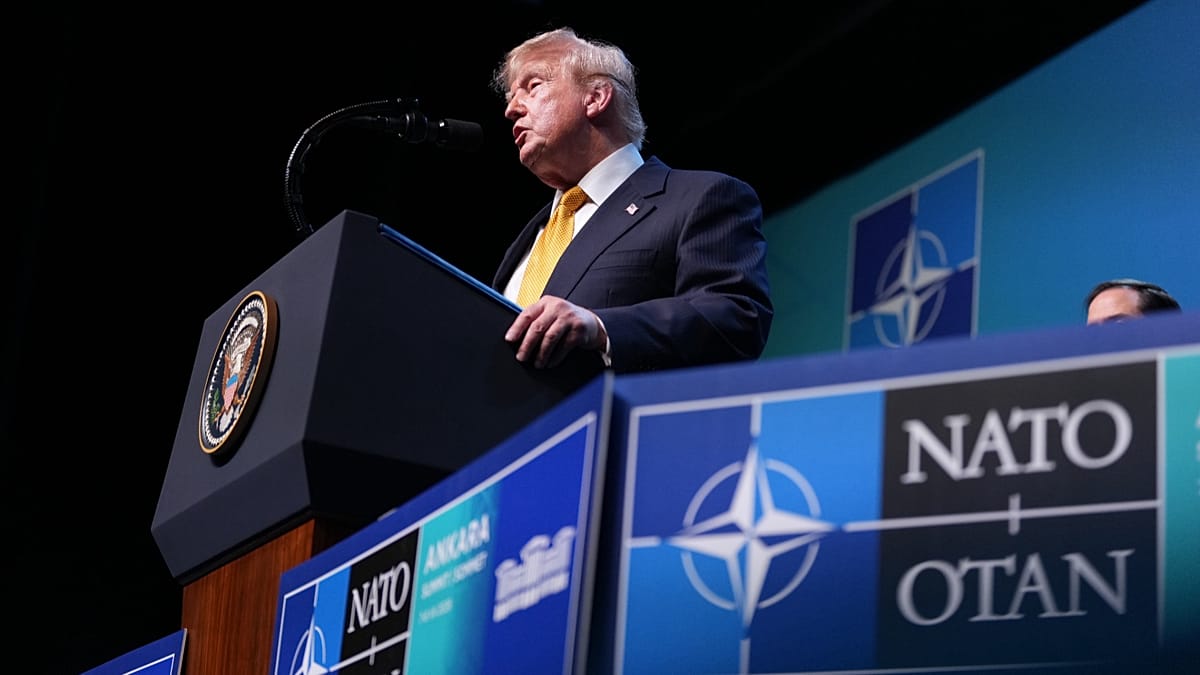
US President Donald Trump offered NATO allies an unexpected warm embrace as the summit concluded in Ankara on Wednesday, a sharp reversal from his earlier lashing out over their response to his Iran campaign. Within hours, the tone shifted from antagonism to affection, illustrating the mercurial nature of the American leader.
“It was amazing, actually. The unity in that room was incredible, really a love, it was sort of pretty wild,” Trump told reporters after the closed-door meeting of 32 leaders. “This was a tremendously successful summit.”
Behind closed doors, Trump reassured his counterparts he wanted the US to remain in the alliance, saying, “We want to remain with you,” according to a source inside the session. This was reflected in the final declaration, where NATO leaders reaffirmed their “ironclad commitment” to Article 5’s mutual assistance clause.
European Defence Spending on Display
European leaders showcased their surging defence spending at the summit, aiming to convince Trump they are fulfilling pledges to ramp up budgets and take more responsibility for their own security. German Chancellor Friedrich Merz said, “I’m returning to Germany with the sense that we have made a major contribution: that NATO is holding together, that it is becoming stronger, and that it is becoming more European.”
The day had not begun well. Trump lashed out over NATO allies’ failure to back his Iran campaign, threatened to cut trade with Spain, and reiterated his desire for Denmark’s territory of Greenland. “I’m very upset with NATO… because of what they did with Greenland, and… because of the fact that they didn’t want to help us with the number one state sponsor of terror, that’s Iran,” he said.
But once face-to-face with leaders, his tone changed markedly. “There is a strong contrast between what Trump says in public and what he actually says inside,” the source told AFP. He made no further mention of Spain or Greenland. Spanish Prime Minister Pedro Sánchez later insisted ties with Washington were “very positive,” a sentiment echoed in Sánchez Downplays Trump's Trade Threat, Calls US Ties 'Very Positive'.
Estonian Prime Minister Kristen Michal said Trump moderated his tone, delivering a “kind of constructive message… that Europe must step up, invest more in defence.” Lithuanian Foreign Minister Kęstutis Budrys urged calm: “I wouldn’t see in it an indicator that we are somehow weakening NATO, and that the transatlantic bond is not there. I think we should dramatise things less.”
Boost for Ukraine
Stalled efforts to halt the Ukraine war were also back on the agenda. Trump pledged to give Kyiv “the right to make” Patriot air-defence missiles during talks with Ukraine’s Volodymyr Zelenskyy on the sidelines. “We’re going to give a licence to you to make Patriots. That’s pretty cool, right,” Trump told Zelenskyy, whose forces have been struggling to shoot down Russian ballistic missiles as supplies of US-made interceptors run low. This development is detailed in Trump Offers Ukraine License to Produce Patriot Interceptors Domestically.
Despite Moscow’s heavy bombardments, Kyiv appears to be stabilising the front line and conducting strikes deep into Russia. Trump said such strikes “can help lead to an end” to the war, repeating his belief that both Zelenskyy and Russia’s Vladimir Putin want a deal. The final NATO declaration saw Europe and Canada pledge to keep military support flowing to Ukraine at €70 billion annually for 2026 and 2027.
Before leaving Ankara, Trump held talks with Syrian President Ahmed al-Sharaa, who is seeking to rebuild Syria’s international image after years of civil war.
Keen to avoid a new confrontation, NATO allies unveiled tens of billions in new arms contracts as proof of their commitment to reducing the US burden for Europe’s protection. NATO chief Mark Rutte insisted the alliance emerged stronger: “I always felt that families where sometimes you have a heart-to-heart and sometimes you fight each other a bit are much stronger.”