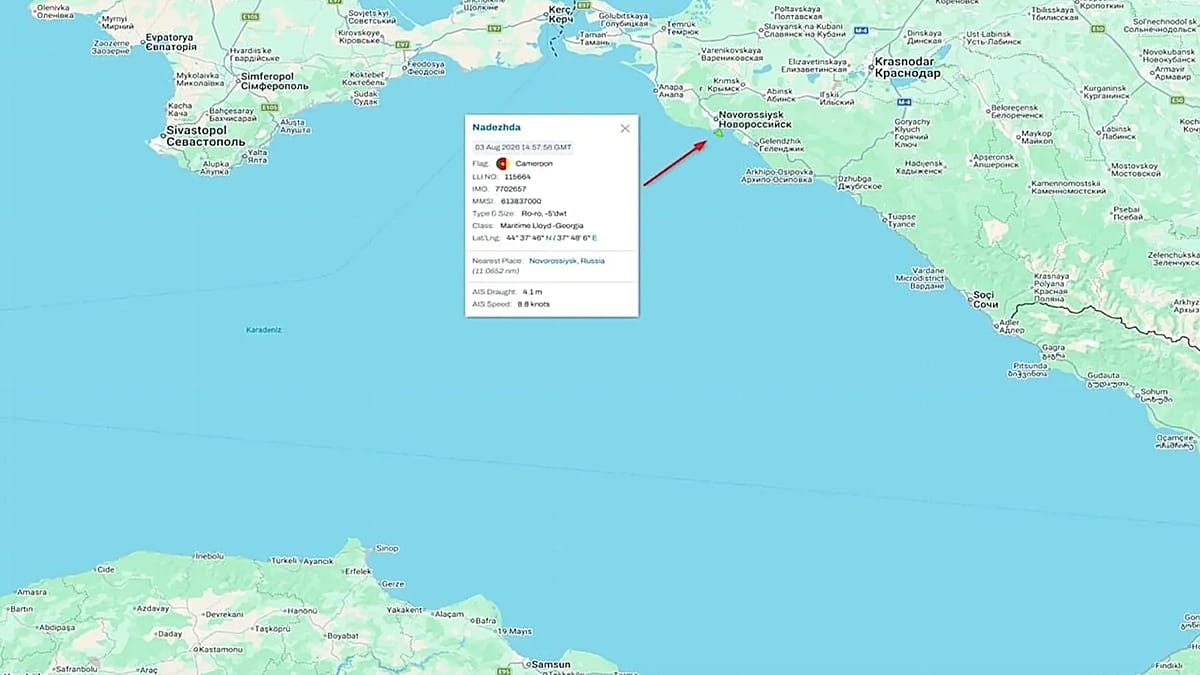
Turkey's foreign ministry on Tuesday condemned drone attacks on two civilian cargo ships in the Black Sea, reporting that crew members were injured in the incidents. The vessels, identified as the Yasar and the Nadezhda, were struck late on Monday after departing from the Russian port of Novorossiysk, according to a statement from the ministry.
The ministry said several personnel were wounded and that their condition is being closely monitored. It expressed deep concern over the intensifying conflict between Russia and Ukraine in the Black Sea, which it said is increasingly affecting civilian shipping despite repeated warnings from Ankara.
“We are deeply concerned about the escalating conflict between Russia and Ukraine in the Black Sea, which is affecting civilian shipping despite our numerous warnings,” the ministry said. It called on all parties to “urgently implement concrete measures to ensure the safety of navigation in the Black Sea” and warned that food supplies could be disrupted if the situation continues to deteriorate.
Rising toll on commercial vessels
The two ships sail under the Panamanian and Cameroonian flags, respectively, but are owned by Turkish companies, according to the MarineTraffic monitoring service. The attacks come amid a broader pattern of strikes on cargo vessels in the region, with both Russia and Ukraine stepping up operations in recent weeks.
In late June, a Turkish fishing vessel was attacked near the coast of Crimea, killing one person and injuring four others. At the end of May, Turkey had already warned of an “uncontrolled escalation” in the Black Sea after a drone attack on a Turkish cargo ship, which the Ukrainian navy attributed to a Russian drone.
The latest incidents underscore the growing risks for commercial shipping in a region that serves as a vital corridor for grain and other exports. Turkey, which has maintained a delicate balancing act between Moscow and Kyiv, has repeatedly called for de-escalation and safe passage for civilian vessels.
The foreign ministry's statement did not assign blame for the attacks, but the timing and location—near Novorossiysk, a major Russian port—suggest they may be part of Ukraine's efforts to disrupt Russian logistics. Earlier this year, Ukraine struck a Russian cargo ship linked to Iran, as the conflict expands beyond the front lines.
Analysts note that the Black Sea has become a flashpoint where any miscalculation could have far-reaching consequences, not only for the belligerents but also for regional stability and global food security. The European Union has been monitoring the situation closely, with some member states calling for enhanced naval patrols and protective measures for commercial traffic.
Turkey's strategic position as a NATO member and its control over the Bosphorus and Dardanelles straits gives it a unique role in mediating the crisis. However, its efforts to broker a safe corridor have so far yielded limited results, as both sides continue to target shipping infrastructure.
The international community, including the United Nations, has urged restraint and respect for international maritime law. The attacks on civilian vessels are a violation of the principles of freedom of navigation and could constitute war crimes under international humanitarian law.
As the situation evolves, the safety of seafarers and the uninterrupted flow of essential goods remain paramount. Turkey's call for concrete measures is a reminder that the Black Sea's waters are not just a battleground but a lifeline for millions of people across Europe and beyond.