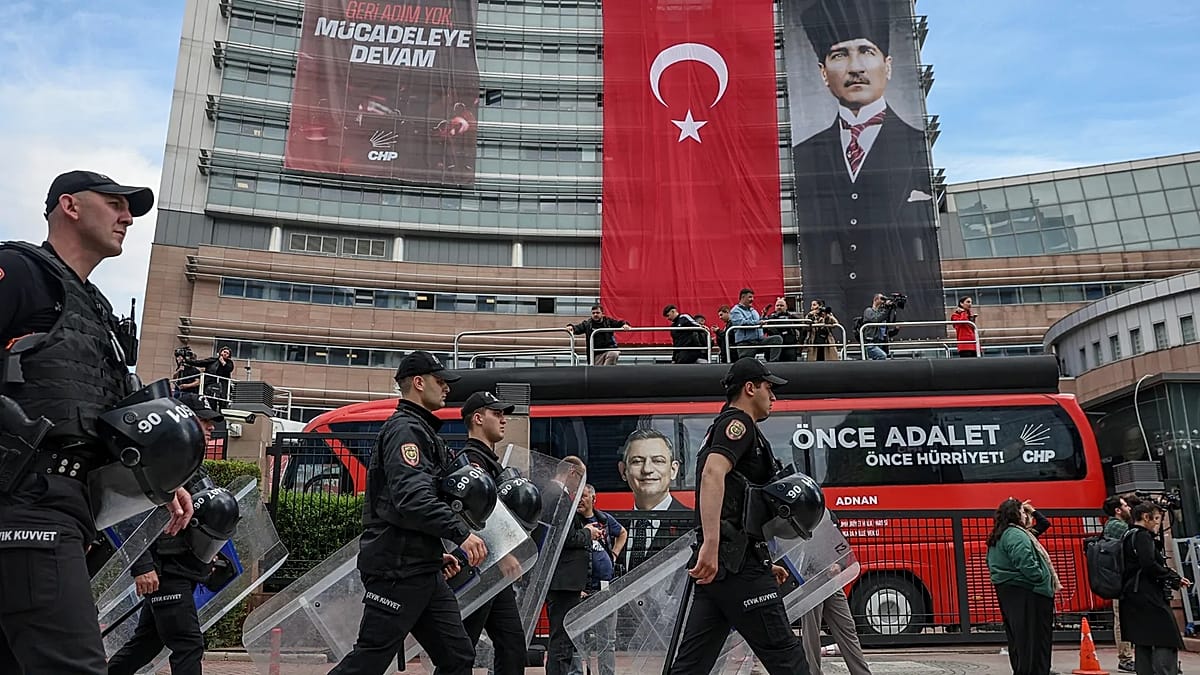
In a dramatic escalation of political tensions in Turkey, riot police in Ankara used tear gas to break into the headquarters of the main opposition Republican People's Party (CHP) on Monday. The raid came shortly after a court dismissed the party's leadership, prompting supporters to block the building's entrances in protest.
The CHP, led by Kemal Kılıçdaroğlu, has been a vocal critic of President Recep Tayyip Erdoğan's government. The court's decision to remove the party's leadership is seen by many as a politically motivated move that undermines democratic processes in the country. The police intervention, which involved the use of tear gas, has drawn widespread condemnation from opposition figures and international observers.
Political Fallout and European Reactions
The incident has raised concerns across Europe about the state of democracy and the rule of law in Turkey, a NATO member and a key partner for the European Union on migration and security issues. The European Commission has called for restraint and respect for judicial independence, while several EU member states have expressed alarm over the crackdown on opposition parties.
This development comes amid a broader context of political repression in Turkey, where journalists, academics, and opposition politicians have faced increasing pressure. The CHP's headquarters in Ankara, a symbol of the party's resilience, became the scene of a confrontation that highlights the deepening divide between the government and its opponents.
For European readers, the situation in Turkey is a reminder of the fragile nature of democratic institutions in the region. The CHP's plight echoes similar challenges faced by opposition parties in other parts of Europe, where populist and authoritarian tendencies have gained ground. The European Union has a vested interest in supporting democratic norms in Turkey, given its strategic importance and the millions of Turkish citizens living in EU countries.
Meanwhile, the Turkish government has defended the court's decision and the police action, arguing that they are necessary to maintain order and uphold the law. However, critics argue that such measures are disproportionate and risk further polarizing an already divided society.
As the situation unfolds, European policymakers will be watching closely. The incident could have implications for Turkey's relations with the EU, particularly in areas such as trade, security, and migration. The European Parliament has previously called for the suspension of EU accession talks with Turkey due to concerns over human rights and the rule of law.
In a related development, Ukrainian President Volodymyr Zelenskyy has been invited to the upcoming NATO summit in Ankara, as the alliance grapples with pressure from the United States. This invitation underscores Turkey's role as a key player in regional security, even as its internal political turmoil raises questions about its reliability as a partner.
The CHP headquarters raid is likely to feature prominently in discussions at the summit, with European leaders expected to raise concerns about democratic backsliding in Turkey. The incident also comes at a time when the EU is seeking to strengthen its ties with other democratic actors in the region, such as the opposition in Belarus, whose leader recently visited Kyiv after Russia's largest missile attack of the year.
For now, the CHP remains defiant, vowing to challenge the court's decision and continue its opposition to the government. The party's supporters have called for nationwide protests, raising the possibility of further clashes with security forces. The European community will be watching closely to see how the situation evolves and what it means for the future of democracy in Turkey.