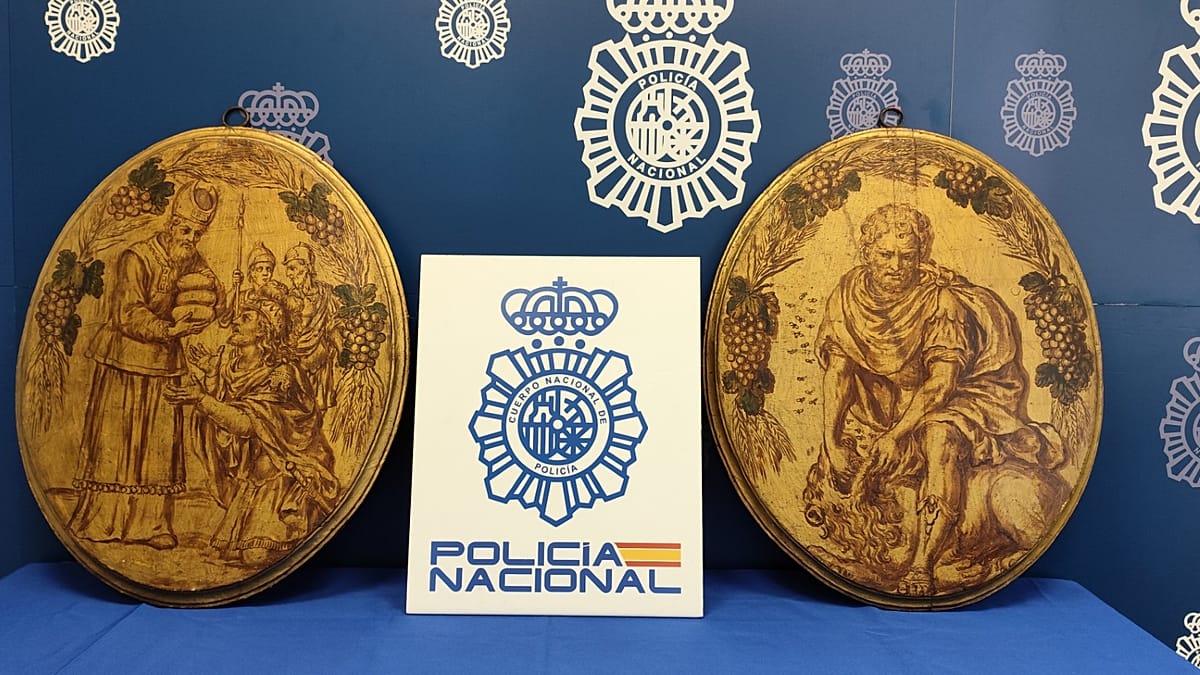
Spanish National Police have recovered two oval oil paintings on pine panel by the 17th-century Sevillian master Lucas Valdés, ending a nearly century-long mystery. The works, which depict biblical scenes, originally formed part of the main altarpiece of the church of the Hospital de los Venerables Sacerdotes in Seville. They were loaned in 1929 for display at the Ibero-American Exposition in Seville, but when the event concluded in 1930, they were never returned to their rightful owner.
The investigation began in September 2025, when the Ministry of Culture’s Illicit Trafficking of Cultural Goods unit, alerted by the Archdiocese of Seville, notified police that two pieces listed in an auction house catalogue matched the description of the missing paintings. With the auction scheduled just days later, officers from the Historical Heritage Brigade acted swiftly to verify the provenance of the works.
From Auction Block to Handover Ceremony
Once the authenticity of the paintings was confirmed—and it was established that they were indeed the missing pieces from the church of the Hospital de los Venerables Sacerdotes—police proceeded to their precautionary seizure. This measure prevented their sale and ensured their protection while the legal and heritage status of the works was clarified.
During the investigation, officers identified the current holders of the paintings and informed them of the pieces’ provenance. Through mediation between the holders and the Archdiocese of Seville, an agreement was reached for the voluntary return of both works. On 20 March 2025, the two paintings were formally deposited with the Archdiocese in a ceremony held at the church of the Hospital de los Venerables Sacerdotes in Seville.
The recovery of these artworks is a significant cultural victory for Spain, highlighting the ongoing efforts to repatriate looted or missing heritage. The case also underscores the importance of international cooperation in tracing stolen cultural goods, a challenge that resonates across Europe as institutions and collectors grapple with the legacy of historical displacements.
Lucas Valdés (1661–1725) was a prominent painter of the Sevillian Baroque school, known for his religious compositions and frescoes. His works are held in several Spanish museums and churches, including the Museo del Prado in Madrid and the Cathedral of Seville. The recovered paintings, executed in oil on pine panel, are notable for their oval format, a shape often used in altarpiece decorations of the period.
The Ibero-American Exposition of 1929 was a major international fair held in Seville, showcasing the cultural and economic ties between Spain and Latin America. Many artworks and artifacts were loaned for the event, but some, like these Valdés paintings, were never returned. Their disappearance had remained a cold case until the recent police intervention.
This recovery adds to a growing list of successful repatriations of cultural property in Europe. For instance, the Bayeux Tapestry is set to be displayed flat in full length for the first time at the British Museum, a move that has sparked discussions about the ownership and display of medieval treasures. Similarly, the oldest English poem was recently found in a 9th-century manuscript at a Rome library, highlighting the enduring importance of provenance research.
The Archdiocese of Seville has expressed gratitude for the recovery and plans to restore the paintings before returning them to their original location in the church of the Hospital de los Venerables Sacerdotes. The hospital, founded in the 17th century, is a historic building that now houses a cultural center and a museum dedicated to Baroque art.
For now, the two Valdés paintings are safe, their long journey from the auction block back to Seville a testament to the persistence of heritage authorities and the value of collaboration between law enforcement and cultural institutions.