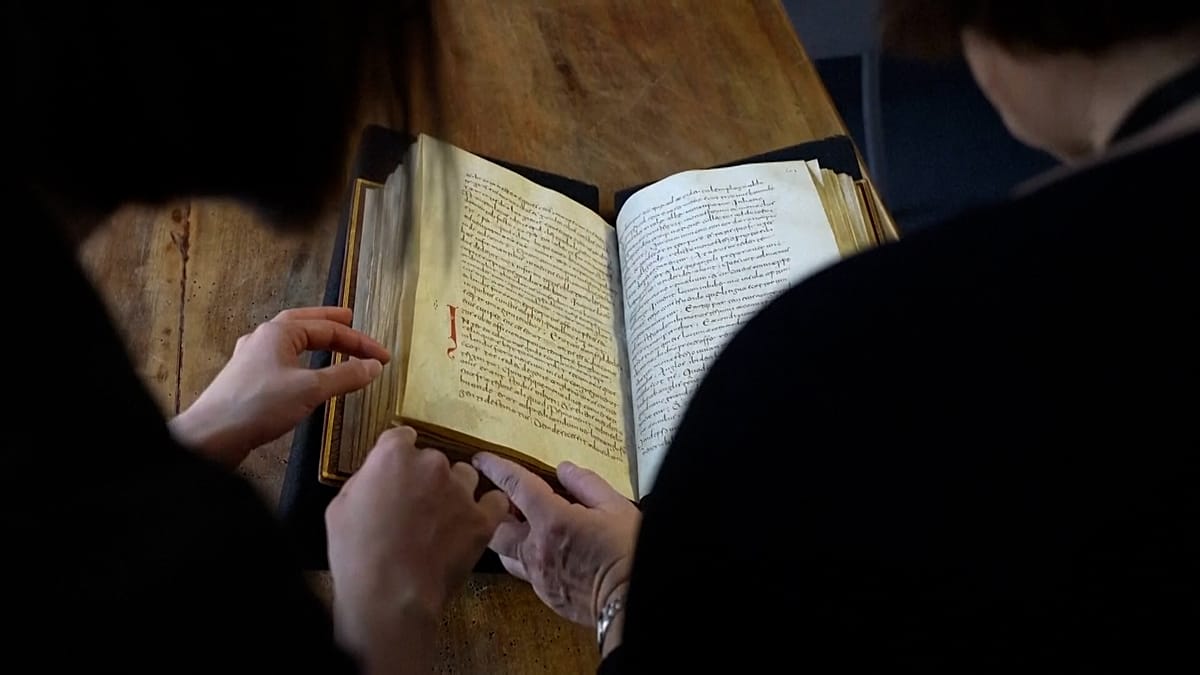
In the archives of Rome's National Central Library, scholars have uncovered a lost 9th-century manuscript containing the earliest known poem in the English language: Caedmon's Hymn. The nine-line composition, which praises God for the creation of the world, was originally composed in the 7th century by a cowherd from Whitby, North Yorkshire, who claimed divine inspiration.
The manuscript is a copy of Bede's Ecclesiastical History of the English People, an 8th-century Latin history of England written by the Venerable Bede, a Northumbrian monk and saint. While over 200 copies of Bede's work survive, this particular version had been presumed lost for centuries. It was rediscovered after the library digitised its collection, allowing Dr Elisabetta Magnanti and Dr Mark Faulkner of Trinity College Dublin to study it remotely before travelling to Rome to examine the original.
A Journey from Northumbria to Nonantola
The manuscript was produced in the 9th century by a monk at the Benedictine abbey of Nonantola in northern Italy, a major centre of medieval scholarship. How it ended up there is a testament to the extensive networks of pilgrimage and cultural exchange that connected England and Italy during the Middle Ages. The copy is one of only five or six surviving early manuscripts of Bede's text, and its discovery provides crucial insights into how the work spread from Northumbria southward across Europe.
Dr Faulkner, an Associate Professor in Medieval Literature at Trinity College Dublin, noted the significance: "Bede's Ecclesiastical History of the English People is one of the most widely copied works in the Middle Ages, there's almost 200 manuscripts. But the most famous two are the earliest two, one of which is in Cambridge, one is in St. Petersburg. Then there's a much smaller number of slightly later copies of which this is one. We're talking a handful, maybe five or six, and the fact that this has now been recognised as a copy of the Ecclesiastical History will be very important for how we understand the transmission of Bede's text."
Two older copies, held in Cambridge and St Petersburg, include the poem in Latin with the Old English text added in the margins. The Rome manuscript is unique because it integrates the Old English poem directly into the main body of the Latin text. "The Rome manuscript is the earliest one to incorporate in the text. Prior to the discovery of the Rome manuscript, the earliest one was from the early 12th century. So this is three centuries earlier than that. And so it attests to the importance that was already being attached to the English in the early ninth century," Faulkner explained.
The manuscript also features unusual punctuation—points or full stops—not present in other versions of Bede's history, offering new clues about early medieval scribal practices.
This is the first early copy of Caedmon's Hymn discovered since the 1920s and the third oldest surviving text of the poem. Dr Andrea Cappa, Head of Manuscripts and Rare Books Reading Room at the National Central Library of Rome, emphasised that the discovery is part of a broader project to make the library's vast collection of rare books accessible worldwide through digitisation.
The find underscores the deep historical ties between England and Italy, echoing other recent archaeological discoveries such as a Roman soldier's commemorative cup from Hadrian's Wall found in Spain and a 16th-century Italian ship sunk by Drake discovered in Cadiz Bay. These artifacts collectively illuminate the movement of people, texts, and objects across medieval and early modern Europe.