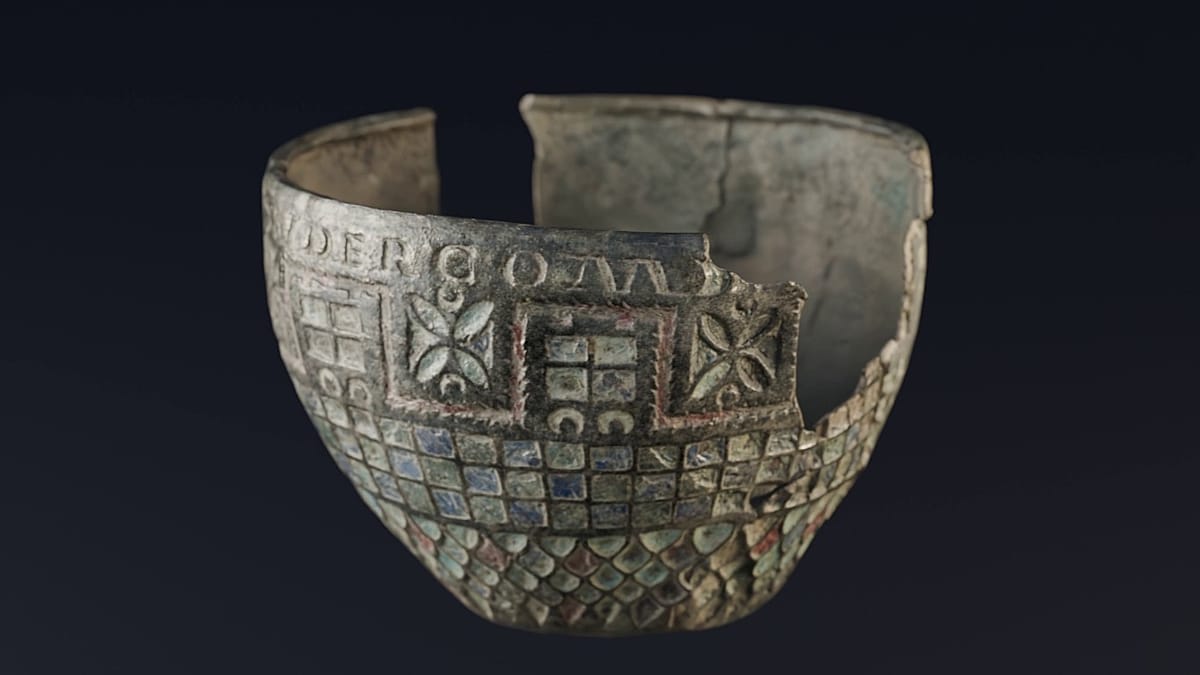
Almost two millennia ago, a Roman soldier of Celtiberian origin completed his military service on the northern frontier of the Empire and began the long journey home to what is now the province of Soria in Castile and León, Spain. Among his possessions was a small, exquisitely enamelled bronze cup—a miniature replica of the most remote border he had defended: Hadrian's Wall.
This piece, discovered by chance centuries later in Berlanga del Duero, is now the subject of a study published in the journal Britannia by a team including researchers from the Consejo Superior de Investigaciones Científicas (CSIC) and the Museo Arqueológico Nacional (National Archaeological Museum) in Madrid. Known as the 'Berlanga cup', it is reshaping what historians know about one of the most intriguing artefacts of the Roman world.
A Unique Souvenir from the Edge of Empire
Hadrian's Wall, a 117-kilometre defensive barrier built between 122 and 128 AD under Emperor Hadrian, protected the Roman province of Britannia from raids by the Picts. Fewer than a dozen commemorative bowls associated with the wall have ever been found: enamelled bronze hemispherical cups decorated with a frieze of turrets and the names of forts engraved on the rim. Until now, only five complete pieces and two fragments were known—most discovered in England, one in France, and a fragment in the Iberian Peninsula now held in London. All of these mentioned only forts from the west-central sector of the wall.
The Berlanga cup changes that picture dramatically. It is the only piece in the entire series that includes inscriptions from the eastern sector: Cilurnum (modern Chesters, Northumberland), Onno (Halton Chesters), Vindobala (Rudchester), and Condercom (Benwell). None of the other known cups mention these forts, making the Soria find an unprecedented contribution to archaeological knowledge of the wall.
Fractured, deformed, and incomplete, the cup retains between 80 and 90 percent of its original volume. The research team created a digital twin using photogrammetry with Agisoft Metashape software, producing a high-resolution three-dimensional reproduction. The original piece measured 11.34 cm in diameter at the mouth, 4.95 cm at the base, and 7.89 cm in height—making it the largest of the entire series, surpassing the famous Rudge cup, the Amiens Pátera, and the Ilam Pátera by more than three centimetres.
Its decoration features three horizontal friezes enamelled in red, green, turquoise, and navy blue, reproducing the wall's profile with crenellated turrets. A Latin inscription runs along the top edge in 5.5-millimetre letters filled with glass paste. Notably, the names are arranged from west to east, as if the observer were looking at the wall from the Roman side—an orientation that researchers say offers a new reading of these commemorative cups.
Provenance and Dating
To determine the cup's origin and date, the team conducted compositional analysis using portable X-ray fluorescence spectrometry and lead isotope analysis at Durham University's geochemistry laboratory. The results show the cup is made of a quaternary zinc-lead bronze alloy, characteristic of 2nd-century AD metal artefacts from Britannia, where such alloys account for 30 to 40 percent of analysed pieces. Isotopic analysis of the lead, processed with the AMALIA algorithm, points to mines in northern England or Wales—specifically the North Pennines, Durham, or Wales—as the most likely source. The geographical proximity of these mines to Hadrian's Wall reinforces the hypothesis of local manufacture in Britain. Combining this technical data with historical information about the forts mentioned, the team dated the piece to between 124 and 150 AD.
A Soldier's Journey Home
How did a cup made in northern Britannia end up on a farm in Soria? The researchers propose a compelling narrative: it travelled nearly two thousand kilometres in the hands of a veteran soldier returning to his homeland, Roman Celtiberia—a region covering much of modern Soria and parts of La Rioja, Zaragoza, Guadalajara, Teruel, and Cuenca. The decisive clue comes from Roman military history. The Romans systematically incorporated troops from conquered territories into their army, and a Celtiberian unit, the Cohors I Celtiberorum, is known to have served on Hadrian's Wall. 'We know that the Romans incorporated troops from recently conquered territories into their army and that a Celtiberian unit served at Hadrian's Wall,' says Roberto de Pablo, first author of the study.
This discovery not only enriches our understanding of Roman military souvenirs but also highlights the mobility of soldiers and objects across the Empire. It underscores how personal mementoes could carry deep meaning, linking a soldier's service on a distant frontier to his identity back home. For Spain, the find adds a layer to its Roman heritage, connecting the province of Soria to the broader story of the Empire's northern defences. As Spain continues to invest in cultural heritage—such as the recent €7 billion commitment to public housing—this artefact reminds us of the layers of history beneath modern infrastructure.
The Berlanga cup now stands as a testament to the interconnectedness of the Roman world, from the windswept moors of Northumberland to the sun-baked plains of Castile. Its study, published in Britannia, offers a rare glimpse into the lives of soldiers who served at the edge of the known world and carried a piece of it home.