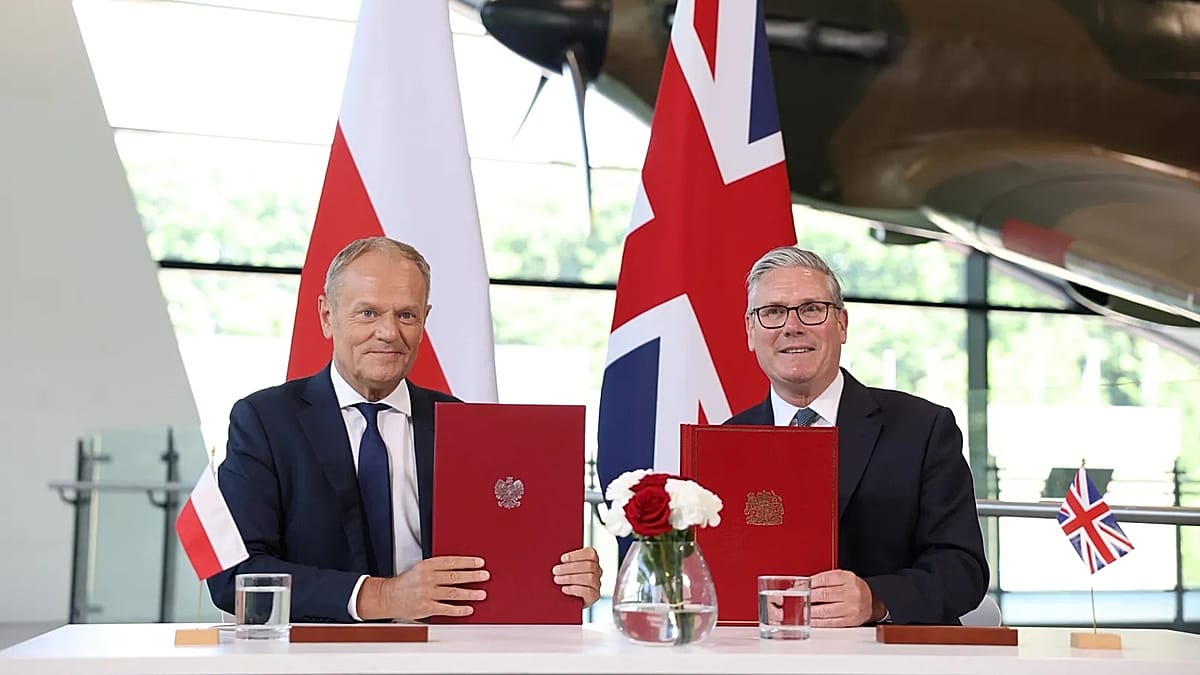
British Prime Minister Keir Starmer and his Polish counterpart Donald Tusk signed a new defence and security treaty in London on Wednesday, marking a significant step in the UK's efforts to rebuild ties with the European Union after the 2016 Brexit vote.
The agreement, described by both leaders as a "major" accord, aims to strengthen border security, combat organised crime, and enhance collective defence. It also includes provisions for military assistance in the event of a threat, technology transfer, and cooperation on cybersecurity, with Russia explicitly identified as the greatest threat to Europe, according to Cezary Tomczyk, Poland's secretary of state for defence.
"History is unfolding before our eyes," Tomczyk wrote on X, sharing a video of the two leaders after the signing.
Part of a Broader European Pivot
The treaty follows similar agreements the UK has recently signed with Germany and France, reflecting Starmer's broader strategy to deepen cooperation with the EU. This comes as the UK government faces mounting domestic pressure, with Labour suffering heavy losses in local elections earlier this month. Starmer has resisted calls to resign, vowing to "face up to the big challenges" and restore hope to the country.
The Brexit debate has resurfaced in British politics, with Labour figures positioning themselves ahead of a potential leadership contest. Former health secretary Wes Streeting called the Brexit vote a "catastrophic mistake" at the party's Progress conference, arguing it has left the UK "less wealthy, less powerful and less in control than at any point before the industrial revolution." He advocated for a "new special relationship with the EU" and expressed hope that Britain would one day rejoin the bloc.
Opposition leader Kemi Badenoch dismissed such calls as evidence that Labour lacks a plan for the country.
The defence treaty with Poland is particularly significant given Warsaw's role as a key NATO ally on the alliance's eastern flank. Poland has been actively modernising its military, including taking delivery of its first F-35 jets to strengthen NATO's eastern flank. The country has also welcomed additional US troops, though questions remain over the long-term commitment under a potential second Trump administration.
Starmer's push for closer EU ties comes as trust in the US as a NATO ally has declined, with a recent defence study showing a sharp drop in German confidence in Washington's reliability. The UK's pivot towards Europe may also reflect concerns about the future of transatlantic security guarantees, particularly as the US considers rebuilding its military presence in Greenland.
For Poland, the treaty reinforces its position as a central pillar of European defence, while for Starmer, it offers a chance to demonstrate progress on foreign policy amid domestic turmoil. The agreement is likely to be welcomed by EU member states seeking to maintain strong bilateral ties with London despite Brexit.