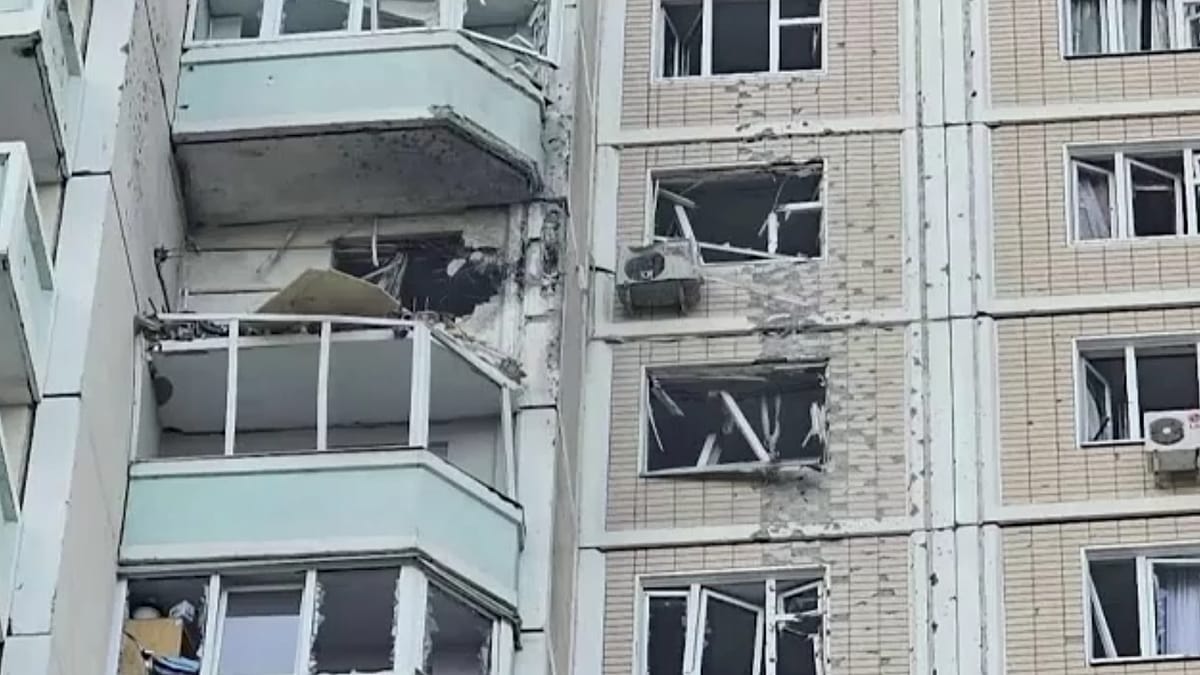
In what Russian authorities describe as the most extensive drone assault since the full-scale invasion began, Ukrainian forces struck the Moscow region overnight, killing at least three people. The attack marks a significant escalation in Ukraine's ability to project force deep into Russian territory.
Moscow's regional governor, Andrey Vorobyov, reported on Telegram that a woman died after a drone hit a private residence on the outskirts of the capital. Two more fatalities occurred in the village of Pogorelki, roughly 100 kilometres southeast of Moscow. The Russian Ministry of Defence said its air defences intercepted 556 Ukrainian drones across the country from Saturday night into Sunday morning, with an additional 30 shot down later in the day.
Ukrainian President Volodymyr Zelenskyy confirmed the operation in a post on X, sharing a video of a large plume of black smoke rising in the distance. He wrote that “Ukrainian long-range sanctions reached the Moscow region,” framing the attack as a direct response to Russia's ongoing bombardment of Ukrainian cities. “Our responses to Russia’s prolongation of the war and its attacks on our cities and communities are entirely justified,” Zelenskyy said. He noted that the distance from Ukraine’s border to the target area exceeds 500 kilometres, and that “the concentration of Russian air defence in the Moscow region is the highest. But we are overcoming it.”
A Strategic Shift in Ukraine's Capabilities
This drone barrage represents one of the largest such operations by Ukrainian forces since Moscow launched its full-scale invasion in February 2022. It follows a Russian missile and drone barrage earlier this week that killed at least 24 people in Kyiv, the Ukrainian capital. In a separate social media post, Zelenskyy reported that Russian forces had launched over 3,170 attack drones, more than 1,300 guided aerial bombs, and 74 missiles against Ukraine this week alone, frequently targeting residential buildings and civilian infrastructure and killing 52 people.
The attack comes amid a complex diplomatic backdrop. This week, Ukraine and Russia exchanged 205 prisoners of war each, in what was the first phase of a planned “1,000-for-1,000” swap deal mediated by the United Arab Emirates. The prisoner exchange, while a rare moment of cooperation, has done little to slow the pace of hostilities on the ground or in the air.
The drone strike also underscores the evolving nature of the conflict, where both sides increasingly rely on long-range unmanned systems. For Ukraine, the ability to strike deep into Russian territory—including the heavily defended Moscow region—serves both a military and psychological purpose. It demonstrates that Russia's air defence network, while formidable, is not impenetrable, and that the war is not confined to Ukrainian soil.
European capitals have watched these developments closely. The European Union has provided Ukraine with substantial military aid, including drone technology and air defence systems, though Kyiv has repeatedly called for more advanced long-range capabilities. The attack may intensify debates within the EU about the limits of support for strikes on Russian territory.
Meanwhile, the human toll continues to mount. In the Ukrainian city of Kharkiv, a Russian drone barrage hit a residential area this week, adding to the civilian casualties. The cycle of retaliation shows no signs of abating, with each side accusing the other of targeting non-combatants.
As the war enters its fourth year, the use of drones has become a defining feature of the conflict. For Ukraine, the ability to launch large-scale drone attacks on Russian soil is a strategic asset, but it also risks provoking a harsher Russian response. The Kremlin has already threatened to target decision-making centres in Kyiv, raising the stakes for both sides.