Ukrainian drone commanders fighting on the front lines argue that modern warfare has evolved faster than Europe's armies can keep up. As Germany accelerates its rearmament under the so-called Zeitenwende, soldiers in Kyiv contend that the future of conflict will be determined not by battle tanks but by drones, mass production, and skilled operators.
Russia's full-scale invasion of Ukraine has fundamentally altered the nature of combat. Corporal Dmytro Zhluktenko, who analyses combat lessons for the 413th Unmanned Systems Regiment "RAID" of the Armed Forces of Ukraine, noted: "In the past year, I've seen one tank on the battlefield." Speaking at a press briefing organised by the German-Ukrainian Bureau in Berlin, he added: "When you speak with the German military, they say: you need these tanks because they are the most important thing in war. We don't think so, as warfare has changed so much since 2022, to the extent that old approaches will not work. Drones can be bought at the last moment, as the technology is continuously changing."
Has Germany adapted to modern warfare?
Over the past four years, Russia's war against Ukraine has forced a turning point in Germany, with Berlin ramping up defence spending to rebuild the Bundeswehr in both manpower and hardware. That push includes traditional heavy weaponry such as battle tanks. By 2027, for example, the armoured brigade 45 in Lithuania is due to receive 123 Leopard 2A8 tanks, alongside several thousand attack drones.
Yet four Ukrainian drone officers from the 413th Regiment argue this is a step in the right direction but still far from sufficient. Captain Oleksandr Voitko, the unit's deputy commander, said: "I saw too many problems in the German army as speaking about drones." He added that armies need "as many FPV kamikaze drones as bullets." Voitko explained: "Bullets are very simple to produce. But you don't say that you will produce bullets at the last moment. Because the last moment is when you shoot your enemy. I think nobody knows when this last moment will be."
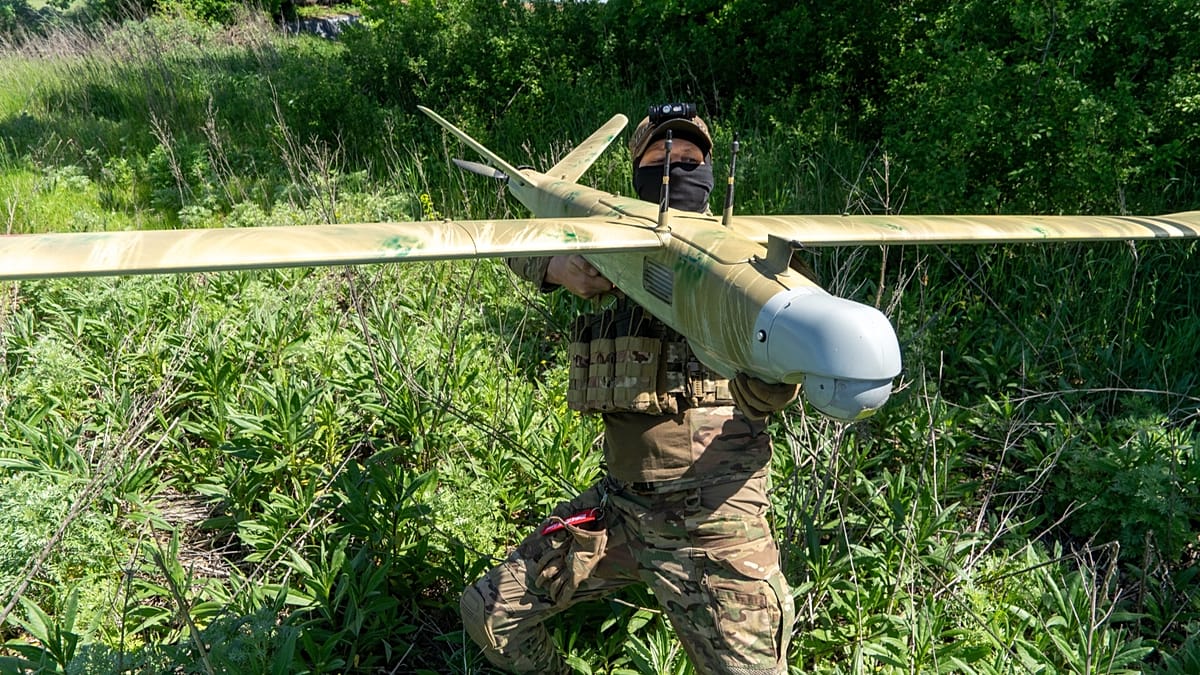
Voitko acknowledged that the Bundeswehr possesses some high-tech drone capabilities, including fixed-wing kamikaze drones and long-range reconnaissance systems, but lacks what he described as "the two most effective instruments against enemy infantry": FPV kamikaze drones and bomber drones capable of dropping explosives. According to him, "80% of Russian infantry in Ukraine is destroyed by these two types of drones." He stressed: "As I understand, this matter isn't even on the agenda of the German army now, but it's the most effective instrument against enemy infantry."
He added that Germany would need those capabilities to defend the Baltic states in the event of a Russian attack. Zhluktenko reinforced this: "Right now, Germany is not prepared to face this type of warfare that Russia has mastered in Ukraine. There are two militaries in the world right now who are ready and know a lot about drone-centric warfare: Ukraine and Russia."
Voitko also highlighted the issue of scale: "The second problem is that even with these high-tech drones the German army doesn't have enough." He noted that countries such as Russia "can afford very high rates of loss." He elaborated: "You need many drones to destroy so many targets that a large army such as the Russian army will suffer. You can destroy many targets, even if you have very good drones, but it will be a rate of loss such an army can afford – and you will not win."
Ukrainian soldiers training German troops
Captain Markiian Yatsyniak, deputy commander of the 413th Regiment, emphasised that the challenge is not just about numbers but also about trained pilots. "I don't know how many well-trained pilots the German army has now. I don't think many," he said. For security reasons, the German military does not disclose its current number of drone operators, but it has announced plans to sharply expand drone training across the armed forces. The German defence ministry says drone operation will become part of basic military training later this year, as the Bundeswehr accelerates efforts to adapt to lessons from Ukraine.
The Ukrainian officers believe Kyiv could help train German troops directly. "Yes, we are ready now," Yatsyniak said when asked whether Ukrainian instructors would be willing to train German soldiers. One option, he suggested, would be for Ukraine to send certified instructors with frontline experience to Germany. "The easiest way for us obviously would be to provide it on our soil, so that German troops will arrive in Ukraine and we will provide the full spectrum of training services."
In February 2026, the German and Ukrainian defence ministries signed an agreement allowing Ukrainian soldiers to take part in training German troops. Ukrainian fighters with combat experience are now instructing Bundeswehr personnel, a move that underscores the growing cooperation between the two countries. As the war in Ukraine continues to reshape military doctrine, the lessons from the front lines are becoming increasingly clear: the era of tank-centric warfare is giving way to a new reality dominated by drones, mass production, and highly trained operators.