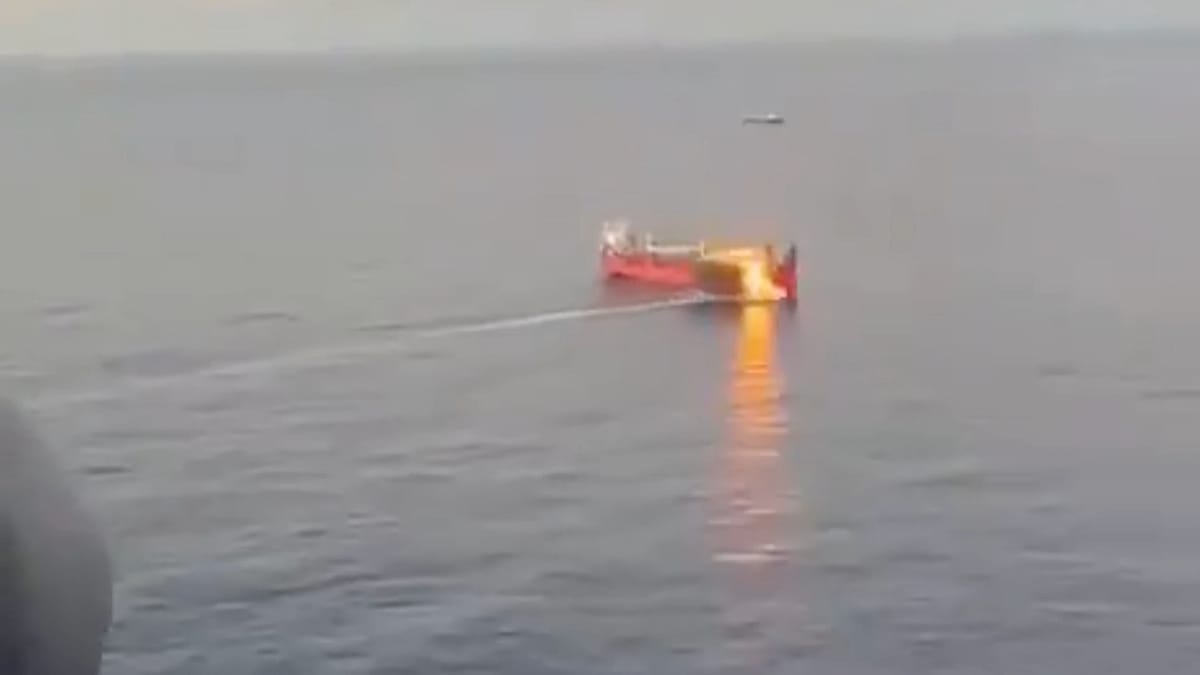
Ukraine's long-range naval drone strikes on Russian ships in the Mediterranean have reached Libyan waters, and the fallout is being felt most acutely in Rome. On Sunday, Ukrainian naval drones struck two Russian vessels — one docked at the Benghazi naval base and another just off the Libyan coast. Ukrainian President Volodymyr Zelenskyy hailed the operation as an "exemplary Ukrainian operation."
The attacks are part of a broader Ukrainian campaign to target Russian naval assets beyond the Black Sea. Just a day earlier, a Ukrainian drone hit a Russian ship near Finland's territorial waters, and in May, Greek fishermen discovered an unexploded Ukrainian naval drone in the Ionian Sea. But it is the strikes in Libya that have triggered the strongest diplomatic reaction from Italy, which views the country as its southern neighbour and a key security concern.
Italian Foreign Minister Antonio Tajani raised the issue directly with his Ukrainian counterpart Andrii Sybiha on Tuesday, according to a readout of the phone call. Speaking to reporters on the sidelines of a visit to Baku, Tajani said: "We were not informed of absolutely anything; we did not provide any kind of support to the Ukrainians, they did everything without informing us." He pledged to work to prevent the conflict with Russia from spreading across the Mediterranean basin, while respecting Libya's sovereignty and avoiding its destabilisation.
Italian Prime Minister Giorgia Meloni has so far avoided public comment on the episode, but according to the Italian daily la Repubblica, she privately described the attacks as "unacceptable." The Italian government's concern is rooted in the fragile state of Libya, which has been divided since the civil war that followed the fall of Muammar Gaddafi in 2011. A UN-recognised government in Tripoli controls much of the west, while the east is dominated by military strongman Khalifa Haftar and his Libyan National Army, backed by the rival administration in Benghazi.
A nightmare scenario for Rome
For Italy, the prospect of renewed fighting in Libya is a nightmare scenario that evokes the chaos following Gaddafi's death. Russia backs Haftar, while Italy supports the Tripoli government. Turkey has also increased its military presence in the region since intervening in 2019 to stop Haftar from capturing Tripoli. A Russian retaliation in Libya could easily reignite the conflict between the rival factions, destabilising the country and sending new waves of migration towards Europe.
Italy can do little but hope that the strikes do not trigger a new round of violence. Domestically, the Italian government also fears that the attacks could undermine political support for aid to Ukraine, which remains a sensitive issue in Italian politics. The government's position is delicate: it has supported Ukraine's right to self-defence, but it is wary of actions that could escalate the war into the Mediterranean.
MEP Lucia Annunziata (Italy/S&D) told Euronews: "We all know that Libya and the Mediterranean Sea have been a zone of Russian intervention for a long time. Italian politics prefers to ignore international developments rather than taking responsibility to try to prevent an escalation." She argued that Kyiv should have notified Rome of the attacks, but stressed that the Italian government cannot simultaneously recognise Ukraine's right to self-defence while imposing geographical limits on how it exercises that right.
Italy is not alone in its concern. On Tuesday, a German government spokesperson warned against escalation in the Baltic Sea region, following the drone strike near Finland. Greece, which has its own maritime interests in the Mediterranean, lodged a formal protest with Ukraine in June after the discovery of the unexploded drone in the Ionian Sea. "Ukraine's right to self-defence cannot justify such actions," said Foreign Ministry spokesperson Lana Zochiou at the time.
According to an EU official who spoke with Euronews on condition of anonymity, Ukraine intended to send a clear signal that Russian vessels in the Mediterranean are within arm's reach, forcing them to reroute and raising the costs for Moscow. "No member state wants to see the war in its backyard," the official said. "But the spillover didn't start two days ago. Russia is violating EU territory every day of the week. Russian vessels are a legitimate military target."
The strikes come as Ukraine continues to press its allies for more support, including sanctions on Russian energy giants and new EU measures against Moscow. But the Libyan operation has exposed the limits of European solidarity when the war spills into a region where member states have competing interests.
For Italy, the immediate concern is stability in Libya. The government in Rome has long sought to position itself as a mediator in the country, and it views any external interference as a threat to that role. The strikes have also complicated Italy's relationship with Ukraine, which Rome has supported but with reservations. As Tajani's comments suggest, the lack of prior notification has strained trust.
The broader question is whether Ukraine's expanded maritime campaign will force a recalibration of European support. While some officials argue that Russian vessels are legitimate military targets, others worry about the unintended consequences of attacks in sensitive regions. The Baltic and the Mediterranean are both areas where EU member states have significant security and economic interests, and the risk of escalation is real.
In the meantime, Italy is left to watch and wait. The government has not publicly condemned the strikes, but it has made clear its displeasure. Whether that translates into a change in policy towards Ukraine remains to be seen. What is certain is that the war in Ukraine has reached the shores of North Africa, and Europe's southern flank is now feeling the tremors.