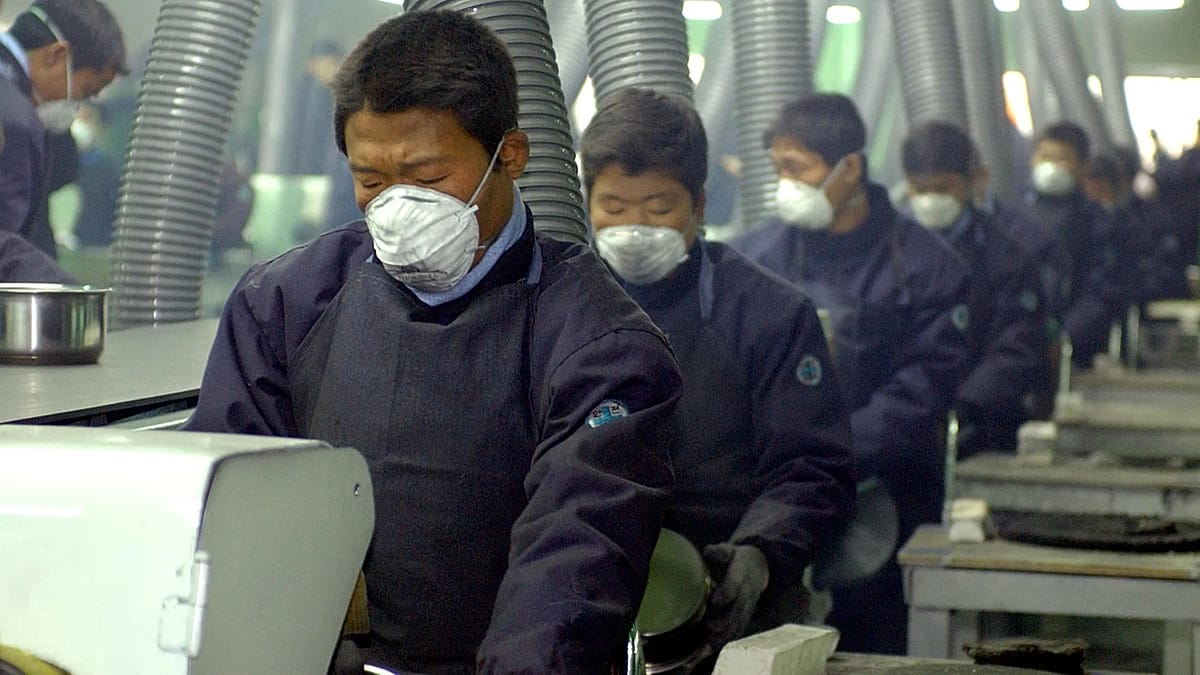
New data from UN sanctions monitors paints a stark picture of how far Moscow and Pyongyang have gone to bypass international restrictions: as many as 25,000 North Korean citizens are now working in Russia, many of them on assembly lines producing strike drones used against Ukrainian cities.
The UN Security Council's Multilateral Sanctions Monitoring Team (MSMT) reported that between 15,000 and 30,000 North Korean workers were present in Russia at the end of 2025. Up to 1,000 were employed at strategically important facilities, including defence plants, steelworks and shipbuilding capacities. Ukrainian outlet Ukrainska Pravda and Radio Liberty have both confirmed that the Alabuga special economic zone in Tatarstan—where Russia builds its own versions of Iran's Shahed drones—is a key hub for this labour.
Sanctions evasion through 'student' visas
UN sanctions have banned the export of North Korean labour since 2017, but Moscow and Pyongyang have built an entire ecosystem to circumvent these rules. The MSMT report details how North Koreans are registered en masse on student and tourist visas, allowing them to work legally at Russian companies. In 2025, Russia issued more than 36,400 visas to North Korean citizens, of which 35,800 were student visas.
Russian legislation was reportedly amended to create legal loopholes that allow these so-called students to receive income officially. The report also describes cases where Russian universities were bribed to arrange fictitious study programmes, and where intermediaries from third countries, including Belarus, helped organise entry and distribute the workforce. This is a systemic scheme that earns Pyongyang millions of dollars while helping Russia plug labour shortages in strategic industries.
Wages confiscated, conditions called 'slavery'
The working conditions of North Korean labourers in Russia remain extremely harsh, according to the MSMT. The average annual income of such workers is around $7,500 (€6,593), but almost all of it is seized by Pyongyang. In 2025 alone, North Korea received up to $800 million from the labour of its citizens abroad—funds that the report says are channelled into financing the country's nuclear and missile programme.
Workers live under constant surveillance by DPRK security services. Their movements are strictly restricted, contact with Russian citizens is forbidden, and they are housed in closed dormitories with no outside access. Human-rights activists describe these conditions as slavery, citing the absence of freedom, isolation and complete dependence on the regime. Radio Liberty and Current Time have documented these practices in detail.
From soldiers to drone assemblers
The use of North Korean labour is part of a broader military partnership that began in earnest in October 2024, when intelligence services in Seoul, Washington and Kyiv reported that thousands of Pyongyang's soldiers were being sent to Russia. At the BRICS summit that month, President Vladimir Putin acknowledged their presence but did not specify their purpose. Russian military officials later confirmed that North Korean troops were used to help counter Ukraine's incursion into the Kursk region.
Since then, Kim Jong-un's regime has delivered large-scale supplies of artillery shells, ballistic missiles, small arms and artillery systems, and has sent military instructors. The money Pyongyang receives is spent on purchasing more powerful weapons, a massive housing and industrial construction programme and, experts believe, on developing its nuclear programme—where Moscow may also be providing expert advice.
Russia's reliance on North Korean labour is a direct consequence of its war against Ukraine and the resulting mobilisation, which has drained the domestic workforce. As drone attacks on Ukrainian cities continue, the Alabuga facility has become a symbol of this shadow economy. The UN report underscores that the scheme is not a minor loophole but a deliberate, state-level strategy to evade sanctions and sustain Moscow's war effort.
For Europe, the implications are clear: the Kremlin's willingness to outsource critical defence production to a sanctioned state like North Korea shows how far it will go to maintain its military campaign. As Ukraine's president has urged the UN to keep squeezing Russia's war economy, the MSMT findings provide fresh evidence of the scale of sanctions evasion. The question now is whether the international community can close the loopholes that allow thousands of North Koreans to work in Russia under conditions that many describe as modern slavery.