At one of Europe's most imposing industrial relics, the Völklinger Hütte in Saarland, Germany, the Urban Art Biennale 2026 has turned rust, dust, and decay into a sprawling open-air gallery. Opening this Saturday, the exhibition features 50 artists from 17 countries, each responding to the site's towering chimneys, dormant furnaces, and pervasive sense of abandonment.
“This location is at the core of street art and graffiti art,” said Ralf Beil, general director of the museum that now occupies the former ironworks. “It all began in industrial places like this. Artists love this place and they do works for the Völklinger Hütte, in the Völklinger Hütte, with the Völklinger Hütte.”
Art Amidst the Ruins
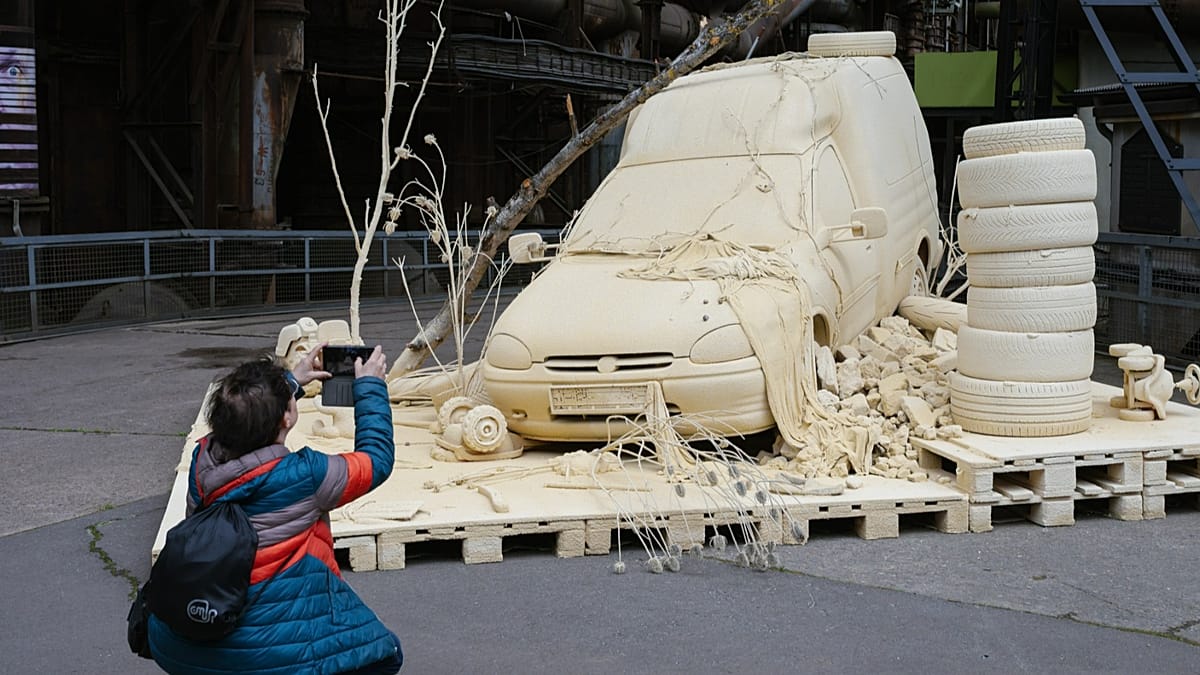
Among the standout installations is Les Silence des Departs by France-based Tomas Lacque, which places a small van, tires, toys, and debris under a coat of paint in a former furnace hall. The piece evokes fossil-fueled mobility buried under ash, reminiscent of Pompeii. Dutch artist Boris Tellegen, known as Delta, contributed One Beam, a massive green-and-black wooden sculpture that illuminates the interior.
French collective Vortex-X, which recycles salvaged materials, stretched white industrial fabric across a hall in Transit der Erinnerung (Memory in Transit). Spanish artist Ampparito painted the words “no hay nada de valor” (“there is nothing of value here”) in large white letters on a shed roof, best viewed from a platform 45 metres above ground.
British artist Remi Rough noted the beauty in decay: “It’s so dusty and it’s so old, but it’s beautiful, you know, there’s beauty in decay. I think what I’ve done makes you kind of just perceive it in a bit of a different way.” Danish artist Anders Reventlov felt “humble to be able to do something here,” adding, “As somebody told me ... it was hell to work here. Now it’s not hell. It’s like a nice place, people walking around, there are bees, there are beautiful flowers, but yeah, we still remember the history and that’s super important.”
Heritage and History
The Völklinger Hütte sprawls over six hectares, a maze of chimneys and furnaces where signs still warn of “danger of crushing.” It has been a UNESCO World Heritage Site since 1994, recognised as “the only intact example, in the whole of western Europe and North America, of an integrated ironworks that was built and equipped in the 19th and 20th centuries.” The furnaces have been cold since 1986, and no new installations were added after the mid-1930s, preserving its early 20th-century appearance.
Beil emphasised that the biennale prioritises site-specific, non-commercial works. “We want pieces which are really original for this space and this also is then prohibiting them from being commercial. This is an installation for the space. This is pure art.”
The biennale runs alongside other major European art events, such as the Venice Biennale 2026, which has drawn attention with its own provocative installations. Unlike the Venice event, however, the Völklingen show is deeply rooted in the site's industrial heritage, offering a unique dialogue between contemporary urban art and Europe's industrial past.