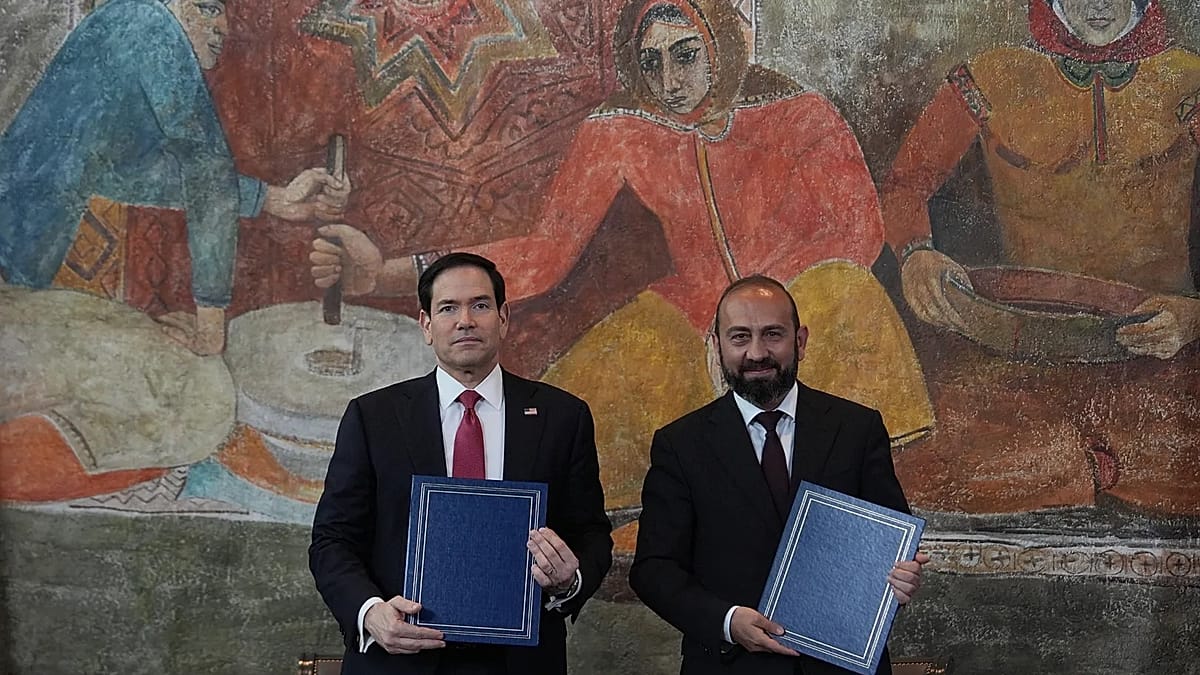
US Secretary of State Marco Rubio made a brief stop in Yerevan on Tuesday, signing an agreement with Armenian Foreign Minister Ararat Mirzoyan to advance the Trump Route for International Peace and Prosperity (TRIPP), a planned road-and-rail corridor linking Azerbaijan with its Nakhchivan exclave through Armenian territory. The visit, a refuelling stop on Rubio's return from India, underscores Washington's growing engagement with a country historically aligned with Moscow.
Rubio described the agreement as "the biggest step to date on making this historic route a reality, on advancing peace and on increasing prosperity in Armenia and frankly in the region." The ceremony took place at Zvartnots International Airport, with the text of the accord not immediately released. In January, the State Department outlined a framework granting the United States a 74% stake in a new TRIPP Development Company, explicitly designed to benefit US firms.
Armenia's Pivot from Russia
Armenia's warming ties with the West come after years of frustration with its traditional ally, Russia. In 2023, Moscow failed to prevent Azerbaijan from launching a lightning offensive that recaptured the breakaway region of Nagorno-Karabakh, prompting anger in Yerevan. Since then, Prime Minister Nikol Pashinyan's government has frozen Armenia's membership in the Russian-led Collective Security Treaty Organization (CSTO) and expressed interest in joining the European Union, a move that has displeased the Kremlin.
Armenia has also navigated a delicate balance amid US and Israeli military operations against neighbouring Iran, with which Yerevan has long maintained cordial relations. Armenian officials have reassured Tehran that the TRIPP corridor will remain under Armenian sovereignty, not US control.
Rubio also signed agreements renewing a broad strategic partnership and cooperating on critical minerals—a priority for Washington as China dominates supply chains for resources essential to modern technologies. "We are laying the groundwork for the sort of economic engagement that allows Armenians to make money and find prosperity and Americans to do the same and to do it together," Rubio said, adding that the deals respect Armenia's sovereignty.
Mirzoyan expressed hope for implementation, calling the agreements "truly beneficial for the Republic of Armenia."
High-level US visits to Armenia remain rare, but Vice President JD Vance travelled to both Armenia and Azerbaijan in February as part of a peace push. Vance's trip was overshadowed after he deleted a social media post referring to the World War I-era mass killings of Armenians in the Ottoman Empire as "genocide."
The developments come as Europe watches Armenia's trajectory closely. The country's potential EU membership bid and its pivot away from Russia have implications for the bloc's Eastern Partnership and energy diversification strategies. Meanwhile, the TRIPP corridor could reshape regional trade routes, linking the South Caucasus with broader Eurasian networks.
For more on US diplomatic efforts in the region, see Rubio Offers US Mediation as Russia Intensifies Threats Against Kyiv. On broader European security dynamics, read Von der Leyen Visits Lithuania as Baltic Tensions with Russia Escalate.