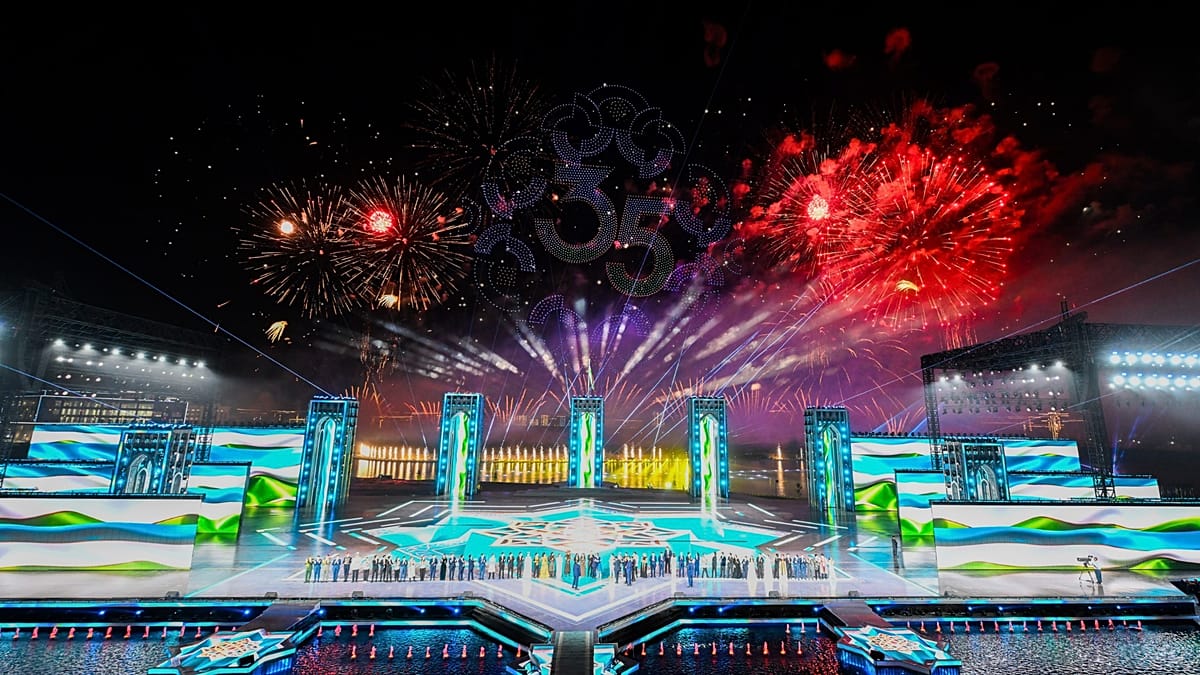
Uzbekistan has begun commemorating the 35th anniversary of its independence with a grand ceremony in New Tashkent, just days before the official Independence Day on 1 September. The country broke away from the Soviet Union on 31 August 1991, and this year's celebrations blended political reflection with a cultural spectacle.
The event brought together Uzbek officials, foreign dignitaries, and performers from across the globe. Spanish tenor José Carreras, British soprano Sarah Brightman, and Italian tenor Alessandro Safina shared the stage with local artists, while 3D projections, lighting effects, robots, and a drone show added a futuristic touch.
New Tashkent: A symbol of ambition
The choice of venue was deliberate. New Tashkent is a massive urban development rising alongside the existing capital, covering roughly 20,000 hectares. Its first phase, spanning 6,000 hectares, is designed to house 600,000 residents, with a long-term capacity for two million. The project includes housing, universities, cultural and scientific institutions, government buildings, business districts, and new transport links.
President Shavkat Mirziyoyev used the anniversary address to reflect on the country's journey since independence and to lay out priorities for the coming decade. He framed independence as a restoration of national identity, paying tribute to the Jadids—a reformist movement of Central Asian intellectuals who championed modern education and social change—and to Uzbekistan's first president, Islam Karimov.
“Independence gave us back our honour and dignity, our mother tongue and our national values,” Mirziyoyev said.
Much of his speech, however, focused on the reforms of the past ten years as Uzbekistan has sought to open its economy and strengthen ties with neighbours and international partners. He highlighted the end of systemic forced and child labour in the cotton harvest, the lifting of currency conversion restrictions, and the easing of residence registration rules. Changes in taxation, customs, and investment policy were cited as evidence of economic opening, with annual foreign investment rising from around $2–3bn (€1.7–2.6bn) to $40–50bn (€34.5–43.2bn).
Mirziyoyev noted that Uzbekistan had initially aimed to raise gross domestic product to $160bn (€138bn) by 2030 but now expects to exceed that level as early as 2026. He also reported that poverty had fallen from 35% in 2017 to 4% this year.
Seven programmes for the next decade
The president described the next ten years as a new phase of national development, unveiling seven programmes covering education, healthcare, the economy, the environment, the rule of law, local government, and foreign policy.
Economic targets are bold: attracting $450bn (€388bn) in foreign investment over the decade and increasing GDP to $300bn (€259bn) by 2030. The government also aims to create two million high-income jobs in industry and make start-ups, venture capital, and artificial intelligence priority areas.
In education, Uzbekistan plans to provide preparatory schooling for all six-year-olds, introduce international standards in technical colleges, train up to one million young people for higher-income professions, and place at least ten Uzbek universities among the world's top 1,000. Healthcare spending is set to rise to 5% of GDP within five years, alongside expansion of preventive medicine and state health insurance.
Another programme targets water scarcity and environmental pressures, with the government aiming to introduce water-saving technologies across all cultivated land within five years. Plans also call for stronger judicial independence and legal protections for citizens and businesses.
The traditional mahalla system—Uzbekistan's neighbourhood-based community organisation—is set to play a greater role, with district budgets, investment programmes, and infrastructure projects increasingly shaped by priorities identified at the local level.
A bigger international role
The seventh programme focuses explicitly on Uzbekistan's international position. Mirziyoyev said the country would continue an open, pragmatic foreign policy, prioritising close relations within Central Asia while expanding partnerships with the European Union, the Americas, Asia-Pacific, Africa, and the Arab and Muslim world.
Uzbekistan is also due to chair the Non-Aligned Movement for the first time from 2027 to 2029, a grouping of more than 120 countries. The anniversary ceremony concluded with a major concert, choreographed light displays, and drones forming images above New Tashkent, bringing the evening to a close.