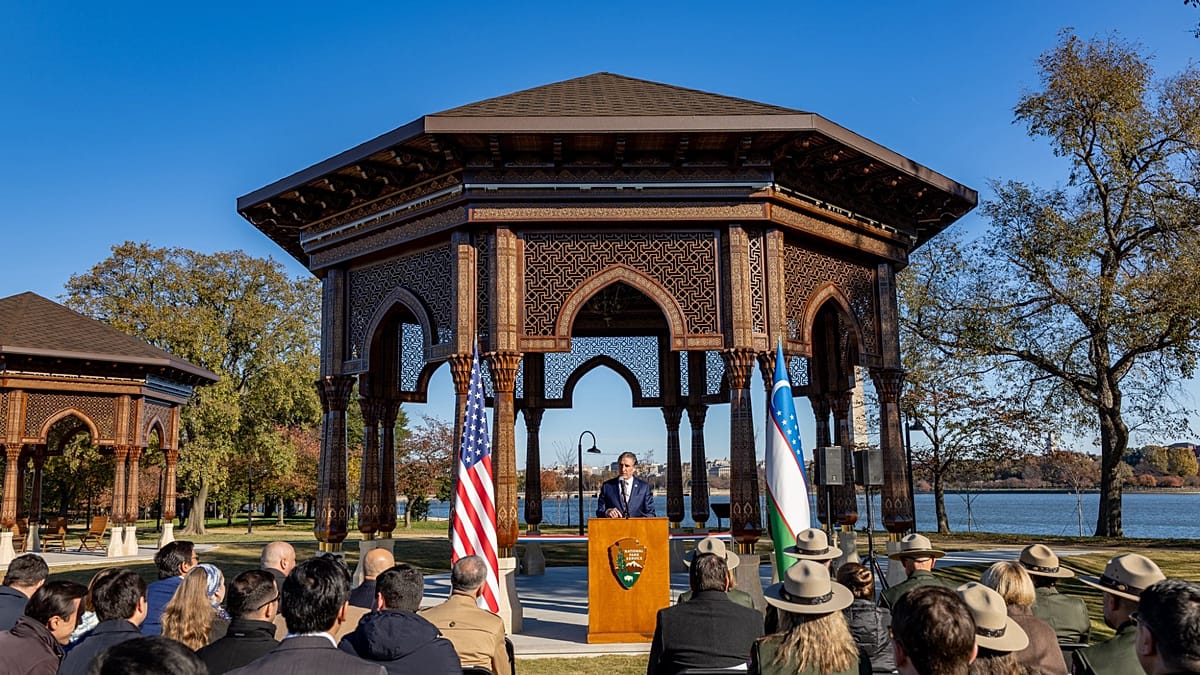
President Donald Trump has formally acknowledged Uzbekistan's gift of two traditional wooden pavilions, now installed in Washington's West Potomac Park. The structures, known as aywans, were presented by President Shavkat Mirziyoyev to mark the 250th anniversary of American independence—a milestone that also coincides with the 35th anniversary of Uzbekistan's own sovereignty.
The open-sided gazebos, carved from the wood of 200-year-old mountain walnut trees, sit near the Tidal Basin with clear views of the Jefferson Memorial and the Washington Monument. Their intricate columns and arabesque-decorated roofs are hallmarks of Uzbek architectural heritage, a style that has evolved over centuries across the Silk Road cities of Samarkand, Bukhara, and Khiva.
In a post on his Truth Social platform, Trump described Mirziyoyev as a “highly respected president” and lauded the Uzbek craftsmen who spent months working on the pavilions in challenging weather conditions. “They had real talent,” he wrote. Rather than keep the gift private, he added, “I wanted to donate these beautiful gazebos to the Public.”
The unveiling ceremony last week drew US Secretary of the Interior Doug Burgum and Uzbekistan's Ambassador to the United States, Furqat Sidikov. Trump noted he had flown over the site aboard Marine One during the event, underscoring the symbolic weight of the gesture.
A diplomatic gesture with Central Asian resonance
For Uzbekistan, the pavilions are more than a decorative offering. They reflect a deliberate foreign policy under Mirziyoyev to project cultural soft power and deepen ties with Washington, even as Central Asia navigates its complex relationships with Russia and China. The gift also highlights the growing economic and security dialogue between the US and the region—a theme that resonates in Brussels, where EU officials are increasingly looking to Central Asia as a partner in diversifying energy supplies and supply chains.
The installation in West Potomac Park, managed by the US National Park Service, places the aywans among some of the capital's most visited landmarks. The Park Service confirmed that Trump accepted the gift on behalf of the American people, and the agency worked alongside the Uzbek Embassy and the craftsmen to ensure the structures met local standards.
This is not the first time Uzbekistan has used architecture as a diplomatic tool. In recent years, Tashkent has funded restoration projects in Afghanistan and offered cultural exhibits across Europe. The pavilions, however, mark a rare permanent installation in the US capital, giving the Central Asian nation a visible presence in a city dominated by monuments to American history.
The timing is notable. Washington's attention has been split between trade disputes with the EU and security concerns in the South Caucasus, as seen in the recent US-backed transit corridor project with Armenia. Yet the Uzbek gift signals that Central Asia remains on the administration's radar, even as other foreign policy files compete for attention.
For European observers, the pavilions also serve as a reminder of the continent's own cultural exchanges with Uzbekistan. The country has hosted EU-funded heritage projects, and its craftsmen have participated in exhibitions in Paris and Berlin. The aywans, with their intricate woodwork, echo a tradition that European travelers have admired for centuries.
As the pavilions settle into their new home, they offer a quiet counterpoint to the often transactional nature of diplomacy. They are, in Trump's words, a tribute to “real talent”—and a tangible link between the Potomac and the Amu Darya.