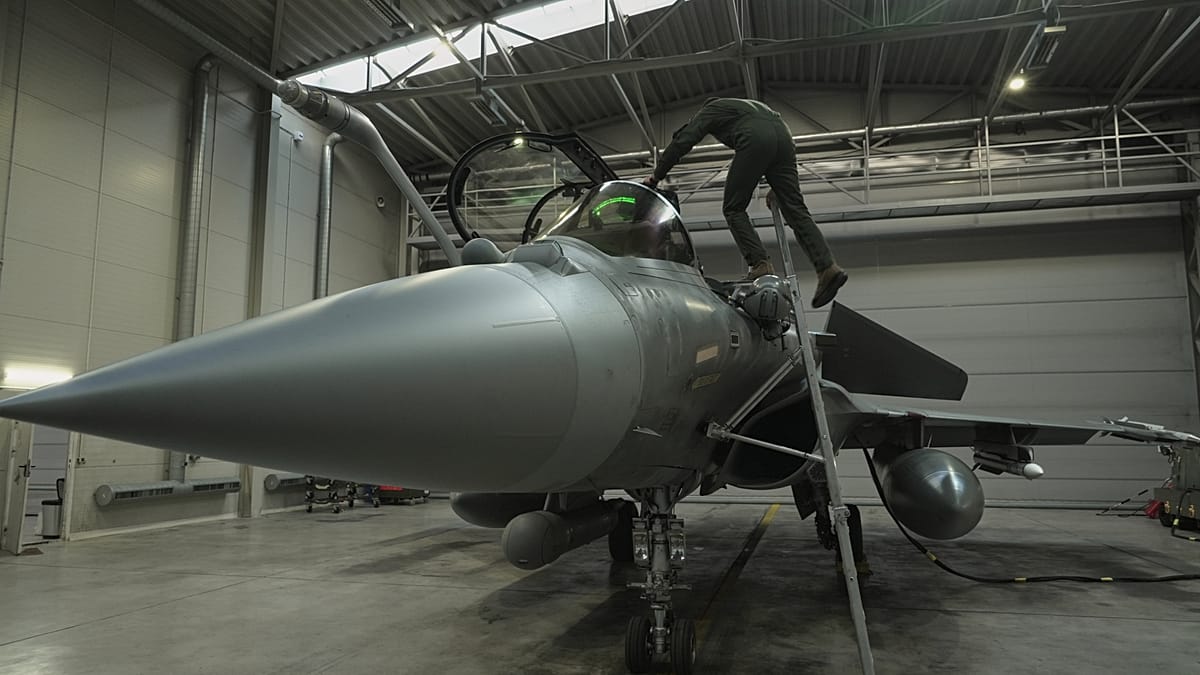
Vilnius airport suspended operations on Wednesday after Lithuanian authorities issued an air alert across parts of the country, triggered by a suspected drone approaching from Belarus. The defence ministry confirmed that NATO’s Baltic Air Policing had been activated in response to the detection near the border.
“Immediately seek shelter in a safe place, take care of your close ones, await new recommendations,” read a message sent to residents of the capital, Vilnius, and surrounding areas. The alert was later lifted, and the airport resumed normal operations.
Latvia Issues Parallel Warning
Latvia also issued a warning on Wednesday morning to residents in the eastern municipalities of Ludza, Krāslava and Rēzekne, citing a “possible threat” to its airspace. The Latvian National Armed Forces (NBS) advised: “Seek shelter indoors, close windows and doors – follow the two-wall principle. If you notice a low-flying, suspicious, or dangerous object, do not approach it and call 112.” The NBS later declared the threat had ended.
The alerts come amid heightened tensions along the EU’s eastern flank, where Belarus and Russia have conducted joint military exercises, including joint nuclear drills that Kyiv has warned could precede an offensive. The Baltic states have repeatedly raised concerns about drone incursions and hybrid threats from Minsk and Moscow.
Just a day earlier, a Romanian F-16 fighter jet intercepted and shot down a stray Ukrainian drone over Estonia, an incident that Estonian Foreign Minister Margus Tsahkna said proved NATO defences worked. That event, detailed in a separate report, underscored the alliance’s readiness to protect its airspace.
The drone activity in the Baltics reflects a broader pattern of aerial threats across Europe. In Ukraine, Russian drone barrages have repeatedly struck civilian areas, while incidents like the stray drone over Estonia highlight the risks of spillover from the war. Lithuania, Latvia, and Estonia have all bolstered their air defence capabilities in recent years, relying heavily on NATO’s rotating Baltic Air Policing mission based at Ämari Air Base in Estonia and Šiauliai Air Base in Lithuania.
Wednesday’s alerts prompted swift coordination between national authorities and NATO command structures. The closure of Vilnius airport, a key transport hub for the region, disrupted flights for several hours. Passengers were advised to check with airlines for updates.
The incident also drew attention to the vulnerability of civilian infrastructure near conflict zones. While no hostile object was confirmed to have entered Lithuanian or Latvian airspace, the precautionary measures reflect a zero-tolerance approach to potential incursions. Defence analysts note that drones, often small and hard to detect, pose a growing challenge for air defence systems designed for larger aircraft.
Lithuania’s defence ministry did not immediately identify the drone’s origin, but the proximity to Belarus—a close ally of Russia—raises questions about possible state involvement. Minsk has previously denied any intent to escalate tensions with NATO members.
The European Union has been working to enhance drone detection and countermeasures, including through the European Defence Fund. However, the patchwork of national systems and the speed of drone technology development mean that incidents like Wednesday’s are likely to recur.