When Péter Magyar took office as Hungary's prime minister in early June, he quickly lifted Budapest's long-standing veto on Ukraine's EU membership talks, a move that brought relief to Brussels and Kyiv. Yet within weeks, Magyar has made it clear that he will not support any fast-tracking of Ukraine's accession, signaling a cautious approach that reflects both domestic constraints and strategic calculations.
A Constructive Start, but with Limits
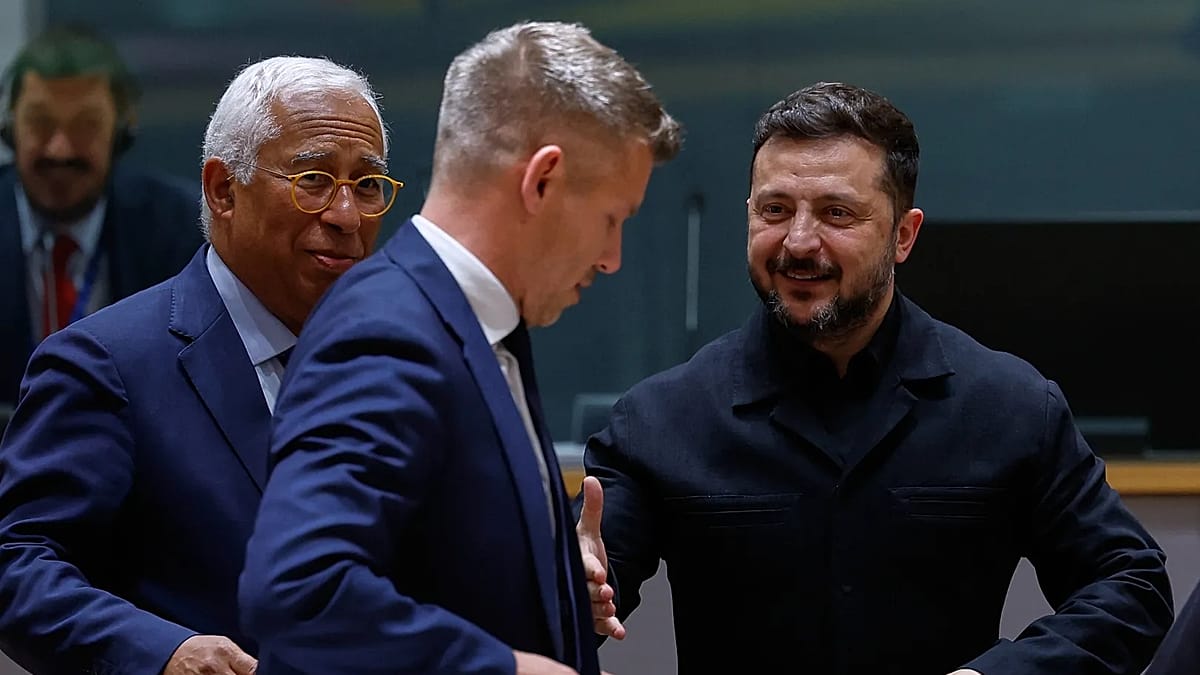
Magyar's decision to allow the opening of the first negotiating cluster with Ukraine was widely seen as a signal of his government's willingness to cooperate with the European Union after years of friction under Viktor Orbán. Commission President Ursula von der Leyen and Council President António Costa both welcomed the move. However, at his first European Council summit in June, Magyar pushed back against language in the joint conclusions that called for opening all remaining clusters "as soon as possible."
"We removed a lot from the text to avoid any explicit suggestion that, now that the first cluster has been opened, all the others will suddenly be opened as well," Magyar told reporters. "We do not think that would be a good idea."
According to Dániel Hegedűs, deputy director of the Institut für Europäische Politik, the veto lift was primarily about rebuilding trust. "This is practically re-establishing Hungary as a trustworthy and constructive partner on the EU stage," Hegedűs said. "And it was a very fundamental expectation from EU partners." Shortly before the decision, Magyar struck a political agreement with von der Leyen on the release of €16.4 billion in previously frozen EU funds for Hungary, though both sides insisted the two issues were unrelated.
Why Magyar Is Now Digging In
Last week, Hungary blocked a joint EU position at working-party level on opening the remaining five negotiating clusters. Magyar argued that the first cluster had only just been opened, and the European Commission itself scaled back its ambitions, now aiming to open just two clusters in July rather than all five.
Hegedűs noted that further moves offer little political benefit for Magyar. "The further moves are not seen as essential by stakeholders of the new Hungarian government to maintain the same image, and there is also no immediate political benefit that Magyar can hope to achieve from improving the bilateral relationship with President Zelenskyy," he said.
Magyar has also framed his position as a defense of Western Balkan candidates—Montenegro, Albania, North Macedonia, and Serbia—which have spent years, and in some cases decades, working toward EU membership. "It also sends the wrong message to the Western Balkan countries that have spent years working towards EU membership," he said. "Some have even changed their names; others have rewritten large parts of their constitutions."
The Minority Rights Deal
The opening of the first cluster followed a bilateral agreement between Hungary and Ukraine on the educational and language rights of the Hungarian minority in Ukraine, a long-standing point of tension. Magyar's precondition for lifting the veto was that the needs of the Hungarian community in the Transcarpathia region be addressed. His Tisza Party now argues that any further progress requires Kyiv to implement the deal, the details of which have not been made public in either capital.
Hegedűs questioned the sincerity of this stance. "If they are now arguing that they would like to see the implementation of the minority deal before opening those clusters, I am simply asking whether they actually communicated this position to the Ukrainian side during those bilateral negotiations," he said. "I think it is very difficult to argue that the Hungarian government is acting in good faith." Magyar had earlier said he was prepared to meet President Zelenskyy in Transcarpathia once the agreement was reached, but that meeting has not yet taken place.
Domestic Politics Loom Large
While Orbán lost this spring's election by a wide margin, a large portion of Hungarian society remains skeptical about Ukraine's EU aspirations. "Survey data from last year clearly show that the majority of Hungarian society opposes Ukraine's EU accession. But those attitudes were shaped in a media ecosystem where Orbán's anti-Ukrainian propaganda was part of everyday media consumption," Hegedűs said.
Magyar, a former Fidesz insider who broke with Orbán in 2024, is often described as a nationalist figure. He recently drew criticism for a remark suggesting that Hungary was one of the few countries in the world to border itself. Hegedűs argued that Magyar wants to avoid criticism from Fidesz and the far-right Mi Hazánk party for being too soft on Ukraine. "If I were to rationalize the whole thing, Magyar would like to avoid criticism from Fidesz and the far-right Mi Hazánk party for being too soft on Ukraine. We know that he is not really pro-Ukrainian in his attitudes," he said.
As the EU navigates the complex politics of enlargement, Magyar's stance reflects a broader tension between the bloc's strategic goals and the domestic realities of member states. For now, Hungary's new leader is treading carefully, balancing his desire for EU credibility with the need to satisfy a skeptical electorate and maintain his nationalist credentials.