Spain is bracing for its first total solar eclipse over the mainland since 1912, but the celestial spectacle will not be equally visible to everyone. Astronomers and meteorologists agree that the event will literally divide the country: those who will experience the full darkness of totality and those who will be left just outside the narrow corridor where the Moon completely covers the Sun.
Who is outside the path of totality?
The path of totality, a strip roughly 100–200 kilometres wide, crosses the Iberian Peninsula from west to east, passing through cities such as A Coruña, Oviedo, León, Bilbao, Zaragoza, Valencia and Palma. Outside this band, the rest of Spain will see a partial eclipse, with the Sun's coverage decreasing with distance from the central line.
Madrid and Barcelona are the two major absentees. The band runs between them, so residents will see up to 99% of the Sun covered, but they will miss the few seconds of total darkness that make the event so unique. Huesca and Zamora sit right on the edge of totality, where the Moon's irregular limb could make the moment of totality imperceptible to the naked eye. The entire southern half of the peninsula will have to settle for a partial eclipse.
The unpredictable enemy: clouds
Being in the right place is no guarantee if the sky does not cooperate. The Cantabrian coast, Galicia, Asturias and Cantabria have a meteorological track record that is not favourable in mid-August, with clear-sky probabilities in some analyses not exceeding 50%. The latest forecasts point to better chances in the west and interior of Galicia, Castile and León, and the Balearic Islands, though models can still shift up to the last minute. For anyone who has travelled hundreds of kilometres chasing totality, a single cloud on the western horizon can ruin in seconds what geography had granted.
Work shifts and the eclipse
There is no special leave in Spain for watching an eclipse, and labour law does not treat it as force majeure. Drivers, hospitality staff and construction workers on shift will, in principle, continue their working day while the rest of the country looks up. At most, the moment of totality—barely a minute or so in the best locations—can be fitted into the 15-minute break stipulated in the Workers' Statute for shifts longer than six hours, but that requires prior agreement with the employer.
The DGT, Spain's traffic authority, has set up a special operation to manage expected congestion in the busiest areas, so road personnel will have a busier afternoon than usual. For those who can step away, exact times for your city are available to plan the break.
Safety first: why many will choose not to look
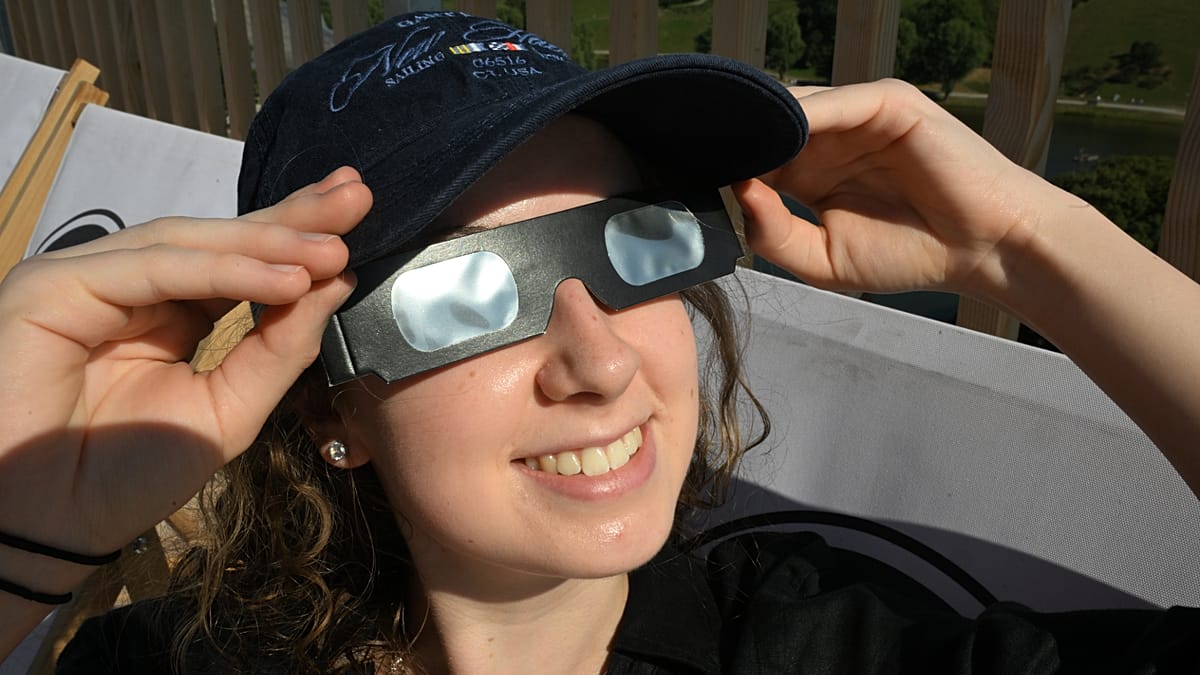
Some people will watch the eclipse but choose not to look directly, or should not. Ophthalmologists have been warning for weeks that looking at the Sun without ISO 12312-2 certified glasses—not even for a few seconds, and never with regular sunglasses, X-ray films or homemade filters—can cause solar retinopathy: a painless burn on the retina that may take 4 to 48 hours to appear as a dark spot in central vision.
The ONCE Social Group has distributed nearly two million certified glasses across the country to prevent accidents, and ophthalmology societies recommend that young children should not watch without direct adult supervision. Anyone without certified protection has two safe options: not to look, or to follow the event via a live stream.
The European Space Agency (ESA) will provide two live feeds. The first, produced from the Javalambre Astrophysical Observatory in Teruel, will include interviews, explanations and live coverage of totality at 20:31, in English, on ESA Web TV and YouTube. The second feed will show telescope images without commentary, also on YouTube. NASA will offer its own streaming starting at 19:15, with views from different locations along the path, including Iceland at 19:45 and Spain at 20:28.
An eclipse you can hear
For blind and partially sighted people, an eclipse has traditionally been an experience from which they were excluded. This year, the Inclusive Eclipse project, led by the CSIC research council, is distributing LightSound devices at various viewing points around the country. These devices convert sunlight intensity into sound in real time: a tone that fades and lowers in pitch as the Moon covers the solar disc, almost disappearing during totality. It is not the same as seeing it, but it allows everyone to share the same moment.
Not everyone missing the eclipse does so because they cannot watch it. Some simply prefer not to go out and look. In recent weeks, several hoaxes have circulated on social media mixing the event with unfounded claims about radiation or health risks, prompting authorities to urge the public to rely on official sources. For those who do step outside, Europe turns skyward for this rare event, and eclipse glasses have sold out in many places as the grid braces for a dip in solar power.
Whether you are in the path of totality or watching from afar, the 12 August eclipse is a reminder of our place in the cosmos—and of the many reasons, from geography to work schedules, that can keep us from looking up.