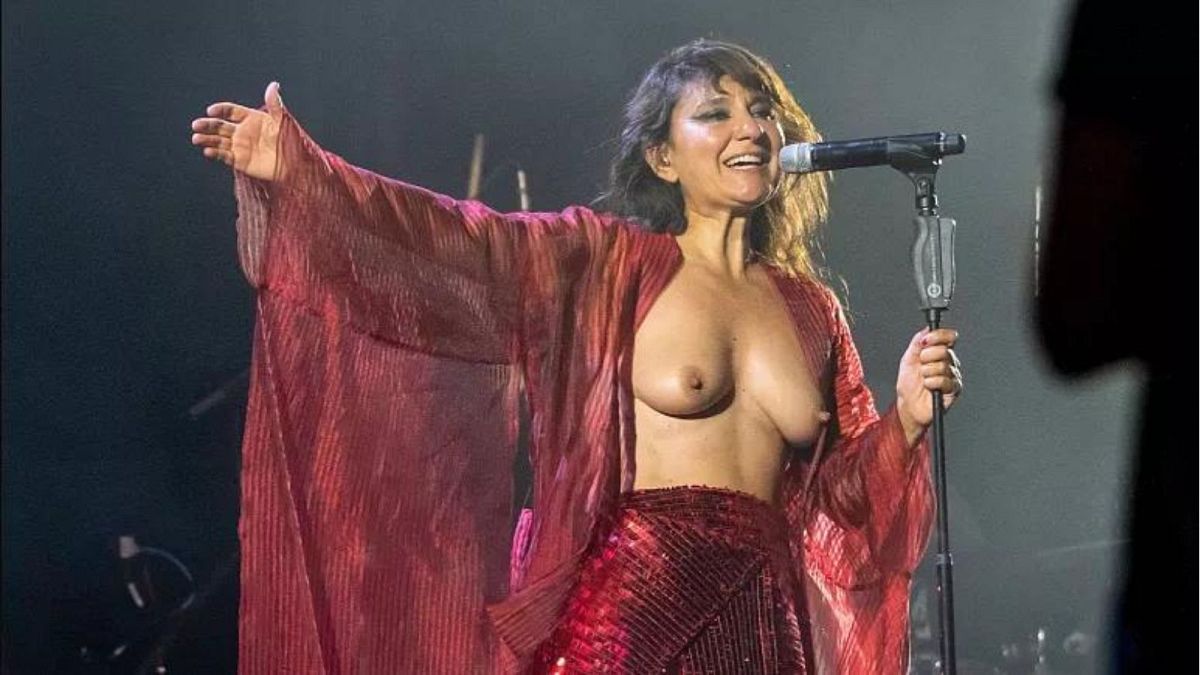
At the Sonorama Ribera festival in Aranda de Duero, Burgos, Eva Amaral—one half of the Spanish rock duo Amaral—marked 25 years of her career with a gesture that has resonated far beyond the stage. After reciting lyrics from her song 'Revolución', she removed part of her dress, exposing her breasts. “No one can take away the dignity of our nakedness, the dignity of our fragility, of our strength,” she told the audience.
The moment was not merely theatrical. Amaral dedicated it to fellow Spanish artists Rocío Saiz, Rigoberta Bandini, Zahara, Miren, and Bebe—women who have faced censorship, threats, and sexist backlash for using their bodies in performance. “This is for Rocío, for Rigoberta, for Zahara, for Miren, for Bebe, for all of us,” she said before the act.
A long history of censorship and solidarity
Rocío Saiz has been topless on stage for over a decade. During LGTBI Pride festivities in Murcia, police stopped her concert and forced her to cover up. She says the worst censorship is invisible: “There are many female colleagues who have taken a stand and have been penalised. Your name is on the list and you are directly discarded.”
Rigoberta Bandini, who competed in Benidorm Fest 2022 with the song 'Ay mamá', regularly bares her breasts during performances. The song’s lyrics ask: “I don’t know why our tits are so scary. Without them there would be no humanity and there would be no beauty.” Despite the song’s popularity, she faced a wave of sexist comments.
Zahara’s 2021 album cover 'Puta', which depicted her dressed as the Virgin Mary, drew accusations of religious offence from conservative sectors. The ultra-right-wing Vox party successfully petitioned to censor her concert poster in Toledo. Zahara explained that the image was a denunciation “of how we are expected to be perfect, of the pressure we feel to be mothers, of how we are expected to be saints, and of every time we have been called a whore.”
The video of Amaral’s performance has been widely shared, drawing both applause and vitriol. Spanish Minister for Equality Irene Montero and Vice-President Yolanda Díaz publicly supported her, but hundreds of sexist comments flooded social media.
Rocío Saiz sees a broader regression: “I think that 21st century men are afraid of losing privileges, of women leaving home, of certain behaviours no longer being allowed. Their response is violence and fear.” She frames the struggle as “an ideological struggle of the patriarchy,” to be fought with “the body, words, books, ideas and education.”
For Saiz, the message is deeper than nudity: “Whoever thinks that the message is someone only taking off their shirt and showing their tits has not understood anything. What we are trying to say is that we are not allowed to be masters of our bodies.”
The debate echoes broader tensions in Spanish society, where issues of gender equality and bodily autonomy remain contested. Recent controversies, such as the archaeological find in a Spanish church that complicates historical narratives, show how cultural flashpoints persist. Meanwhile, the Berlin Pride attack and political responses highlight the fragility of hard-won freedoms across Europe.
Amaral’s gesture, while simple, has become a rallying point. As she said on stage: “Because there are too many of us and they won’t be able to pass over the life we want to inherit, where I’m not afraid to say what I think.”