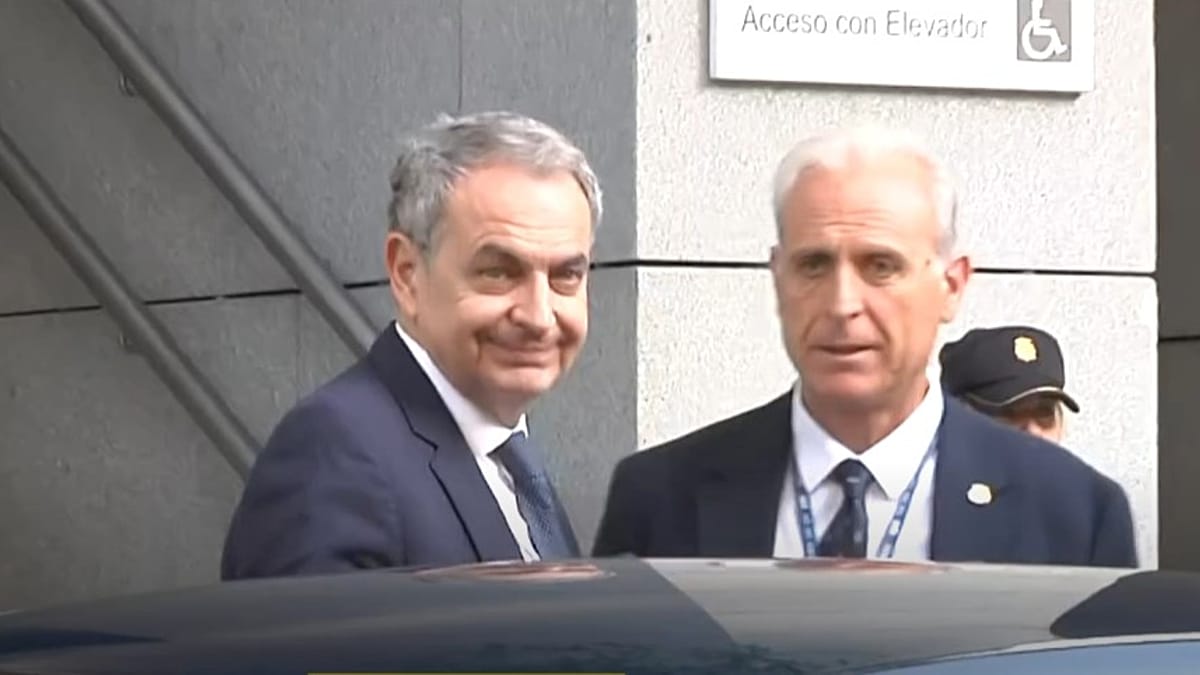
For the first time since Spain's return to democracy, a former prime minister has been formally charged in a corruption case. José Luis Rodríguez Zapatero appeared before Judge Calama at the Audiencia Nacional on Wednesday, marking a historic and deeply uncomfortable moment for the Socialist Party (PSOE) and the government of Pedro Sánchez.
The closed-door hearing, scheduled to run through Thursday, focuses on two distinct but intertwined lines of inquiry. The first concerns the €53 million state bailout granted to the airline Plus Ultra in 2020, during the height of the COVID-19 pandemic. The second involves luxury jewellery discovered during a search of Zapatero's office on Calle Ferraz in Madrid, whose value has been preliminarily assessed at €1.3 million. According to the case file, the origin of these items has not been justified.
An 'Organised Scheme' Alleged
The court order describes Zapatero as the leader of an “organised scheme” designed to channel funds through a web of companies. Among them is What The Fav, a firm owned by the former prime minister's daughters, which received up to €2 million for “consultancy” and layout services. Investigators suspect these payments may have been used to disguise kickbacks.
Zapatero's defence team, led by Víctor Moreno Catena, had sought to limit the scope of questioning by requesting that the jewellery matter be excluded from the first session. Judge Calama rejected the motion, stating there was no “real impairment of his right to a defence”.
The case has sent shockwaves through the PSOE, where Zapatero remains a highly influential figure. He has been a regular presence at campaign rallies and maintains a close relationship with Sánchez, who took office at the Moncloa Palace in 2018. The timing is particularly awkward for the government, which is already facing multiple political battles.
Spain's judicial system has a history of high-profile corruption investigations, but this is the first time a former head of government has been placed under formal investigation. The case is likely to fuel debates about transparency and accountability in public office, especially as the country prepares for upcoming elections.
Zapatero, who served as prime minister from 2004 to 2011, has consistently denied any wrongdoing. His supporters argue that the charges are politically motivated, while critics see them as a long-overdue reckoning with potential abuses of power.
The investigation also raises questions about the broader network of political and business ties in Spain. The Plus Ultra bailout, in particular, has drawn scrutiny because of the airline's connections to Venezuelan and Cuban interests, as well as its links to former officials.
As the hearings continue, all eyes will be on Judge Calama's next moves. The case is expected to take months, if not years, to reach a conclusion. For now, Zapatero's appearance in court represents a watershed moment for Spanish democracy—one that underscores the principle that no one, not even a former prime minister, is above the law.