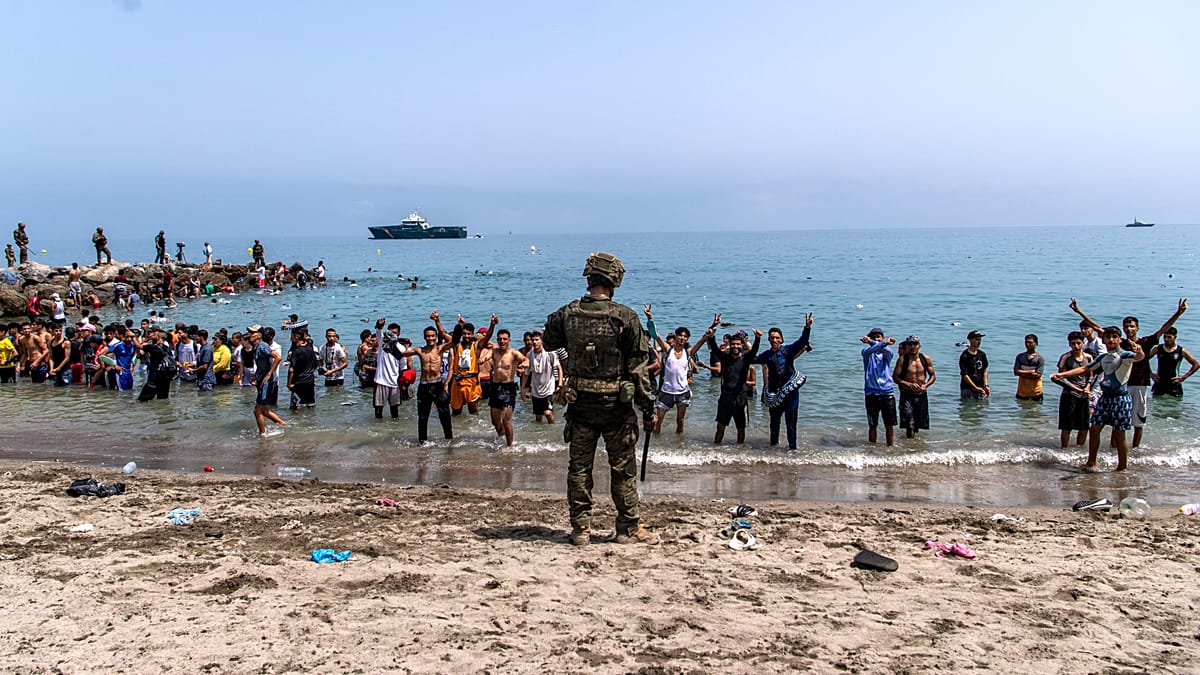
The dramatic surge of migrants into the Spanish enclave of Ceuta has triggered a fierce political battle across Europe, with Italy demanding Spain's suspension from the Schengen free-movement zone and other governments urging restraint. The influx, which saw more than 60,000 people cross into the North African territory in a single day, is the largest single-day irregular border crossing ever recorded on EU soil.
Italian Prime Minister Giorgia Meloni described the images from Ceuta as "shocking" and called for "extraordinary measures" to protect Europe's borders. Her hard-right Brothers of Italy party formally proposed suspending Spain from the Schengen area, a move that drew immediate support from Denmark and Finland.
"On illegal immigration, we will not yield an inch: defending the borders, stopping human traffickers, and ensuring effective repatriations will continue to be the line of this Government," Meloni wrote on X.
Danish Prime Minister Mette Frederiksen echoed that sentiment, saying the EU "must immediately take all necessary measures and consider all options, including a suspension of Schengen cooperation." Finnish Interior Minister Mari Rantanen went further, arguing that "countries that do not fulfil their obligation to protect the external border cannot be members of Schengen."
Spain reacted angrily, summoning Italy's ambassador to Madrid and accusing Rome of "demagoguery." The Spanish government has also pointed out that Ceuta, despite being part of the Schengen area, has a special status that limits free movement to the mainland—a point that French President Emmanuel Macron also stressed.
"Ceuta does not benefit from free movement to the rest of the Schengen Area," Macron said, while announcing the deployment of four mobile police units, aircraft, and drones to reinforce checks at the French-Spanish border. France has stopped short of backing Italy's call, instead expressing support for Spain and emphasising the need to protect the EU's external borders.
Germany's Chancellor Friedrich Merz also avoided endorsing a suspension, instead calling for the "implementation without delay" of the EU Return Regulation. "Protecting the EU's external borders is crucial to combating illegal migration," Merz wrote on X, adding that he supported Spain's intention not to allow irregular migrants onto the European mainland.
Portugal reaffirmed that "the integrity of the Schengen system depends on strict border control and a determined fight against all forms of illegal immigration," but stopped short of calling for Spain's temporary removal. The Dutch foreign minister, meanwhile, urged both Spain and Morocco to take the necessary steps to secure the border.
Right-wing reactions across Europe
The crisis has provided ammunition for right-wing politicians across the continent. Italian Foreign Minister Antonio Tajani claimed that Spain's decision to grant citizenship to over 500,000 irregular migrants was "profoundly wrong and encourages human trafficking." Manfred Weber, leader of the centre-right European People's Party, blamed the "pull factor of massive regularisation" and the "instrumentalisation of illegal migration."
Alice Weidel, co-leader of Germany's far-right Alternative for Germany, warned that "Germany must prepare itself: borders must be secured and rejections rigorously enforced." In France, Jordan Bardella, president of the Patriots for Europe Group in the European Parliament, wrote to Parliament President Roberta Metsola requesting an urgent debate on "the failure of the European Union's migration policies."
But left-wing politicians have condemned these reactions as opportunistic and dangerous. "In Europe, right-wing attitudes have prevailed in picturing migrants as a threat," said Spanish S&D MEP Juan Fernando López Aguilar, a former justice minister. "Italy's position is unworthy of a European partner," added fellow S&D MEP Javi Lopez. "When migration is weaponised, Europe answers with solidarity, not selfishness. After 700,000+ arrivals from Libya, Italy received European support, not lectures. Solidarity is not a one-way street."
Cecilia Strada, an Italian S&D MEP, told Euronews: "This is right-wing propaganda at its worst. Before a humanitarian emergency with tens of deaths and an unknown number of missing people, one would expect European solidarity rather than instrumental attacks aimed at political profiteering."
The European Commission has rejected Italy's call for a Schengen suspension. EU chief Ursula von der Leyen described the scenes in Ceuta as "unacceptable" and said her team was in contact with both Spain and Morocco. A European official acknowledged that "some governments are concerned" but stressed that the priority was "securing our external borders."
The crisis has also raised broader questions about the EU's migration policy and the legal framework governing returns. As Spain's legal deadlock on returns becomes more apparent, the debate over whether the EU can effectively manage its external borders—and whether Schengen can survive such pressures—is likely to intensify. For now, the images from Ceuta have become a rallying point for those who argue that Europe must do more to control its borders, and for those who warn against turning migration into a political weapon.