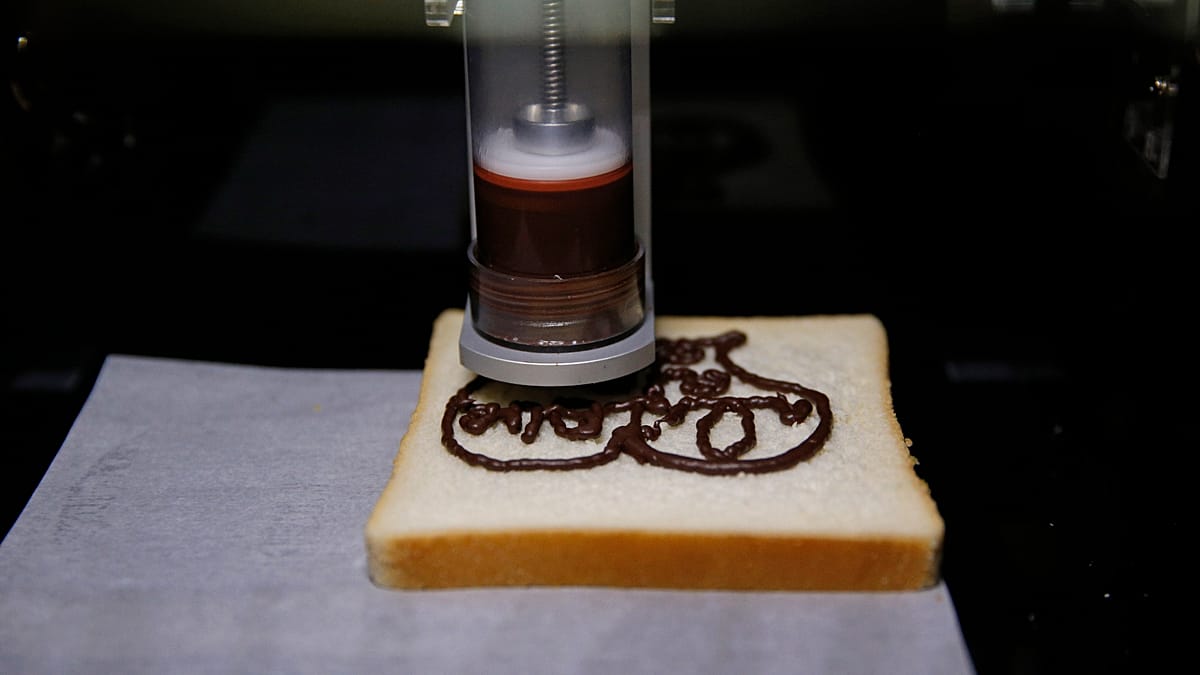
Three-dimensional printing has evolved far beyond plastic prototypes. Across Europe, a growing number of manufacturers are now using the technology to create edible objects, layer by layer, from soft ingredients such as chocolate, cheese, or plant-based meat substitutes. The process begins with a digital design, which the printer then reproduces by extruding a paste through a nozzle, much like a sophisticated piping bag.
Among the companies active in this space are Chocola3D, a Ukrainian-Bulgarian venture; Natural Machines, based in Spain; and Germany's Print2Taste. So far, their machines have found homes in patisseries, hospital kitchens, and research labs, but a breakthrough into everyday kitchens has yet to happen.
From marzipan to medical meals
Chocola3D, which has been in development since 2014, says its printers are now used in Ukraine, Bulgaria, Germany, and Estonia. Users fill refillable syringes with pastes made from chocolate, cheese, vegetables, or pea protein, and the system can handle more than 26 different materials. Unlike closed-capsule systems, this open design lets users experiment with their own recipes, though they must calibrate the printing settings themselves. Prices range from a few hundred to several thousand euros, depending on the model.
Mario Jekle, a food technologist at the University of Hohenheim in Germany, studies the technology independently. He notes that the basic steps are familiar to any cook: “We first produce a fine paste, for example. This paste is then shaped, which is exactly what you do at home with a piping bag when making fine pastries. Then everything is heated, just as it would be at home in an oven or a pan.” What is new, he says, is the digital design and the integration of these steps.
Confectioners already use 3D printers to craft marzipan figures for wedding cakes. Jekle sees the real potential in customised products and small production runs of up to about 200 items. The main technical hurdle is ensuring the printed material sets properly after being deposited in liquid form, so it can be eaten with a knife and fork. This can be achieved by baking the item or using a heated printing chamber.
Personalised nutrition and sustainability
Jekle envisions a future where someone wanting a plant-based steak could simply send a digital design to their printer and have it ready in five to fifteen minutes. The templates could come from databases, apps, or cartridge specifications. The key advantage, he argues, is precise control over ingredients. A printed meat alternative could, for example, contain significantly more fibre than conventional meat, which has none.
He estimates that widespread household use is still five to ten years away, partly because there is no supply chain for refill packs. He also stresses the importance of using minimally processed raw materials. His team works with by-products from the food and agricultural industries, turning residual streams into new foods via 3D printing. The less processing a raw material requires, the lower the energy cost, which benefits both the environment and consumers' budgets.
Clinical applications show promise
The most advanced applications are in healthcare, where precise dosing and texture modification are critical. At the University Medical Center Hamburg-Eppendorf, a team is testing raspberry-flavoured chewable tablets shaped like hearts and stars to help children with cancer take their medication during chemotherapy. Many children struggle with the taste or size of conventional tablets, says senior physician Beate Winkler. The hospital is also trialling individually dosed medication for Parkinson's patients.
For older people with chewing or swallowing difficulties, 3D printing can restore familiar shapes to puréed food. Dorothee Volkert, a nutrition scientist at Friedrich-Alexander University Erlangen-Nuremberg, investigated whether printing could make puréed meals look like their original forms, such as a sausage-shaped dish. Her study found that participants not only responded positively but also consumed more energy and protein, as extra nutrients can be incorporated into the printed food.
Consumer attitudes remain cautious
Public openness to 3D-printed food is growing, albeit slowly. A 2025 survey by Bitkom, a German digital association, found that 24 percent of Germans could imagine eating cultivated meat produced with a 3D printer, up from 13 percent six years ago. Cultivated meat is grown from animal cells in a bioreactor and then given a meat-like structure via printing. Younger people are more receptive: about a third of those aged 16 to 49 would try it, compared with 18 percent of 50- to 64-year-olds and 14 percent of those over 65.
As the technology matures, its role in personalised nutrition and sustainable food production could become more significant. While the home kitchen may not yet be ready for a 3D printer, European researchers and startups are steadily turning this niche technology into a practical tool for health and sustainability. For more on how technology is reshaping European industries, see our coverage of AI's impact on farming.