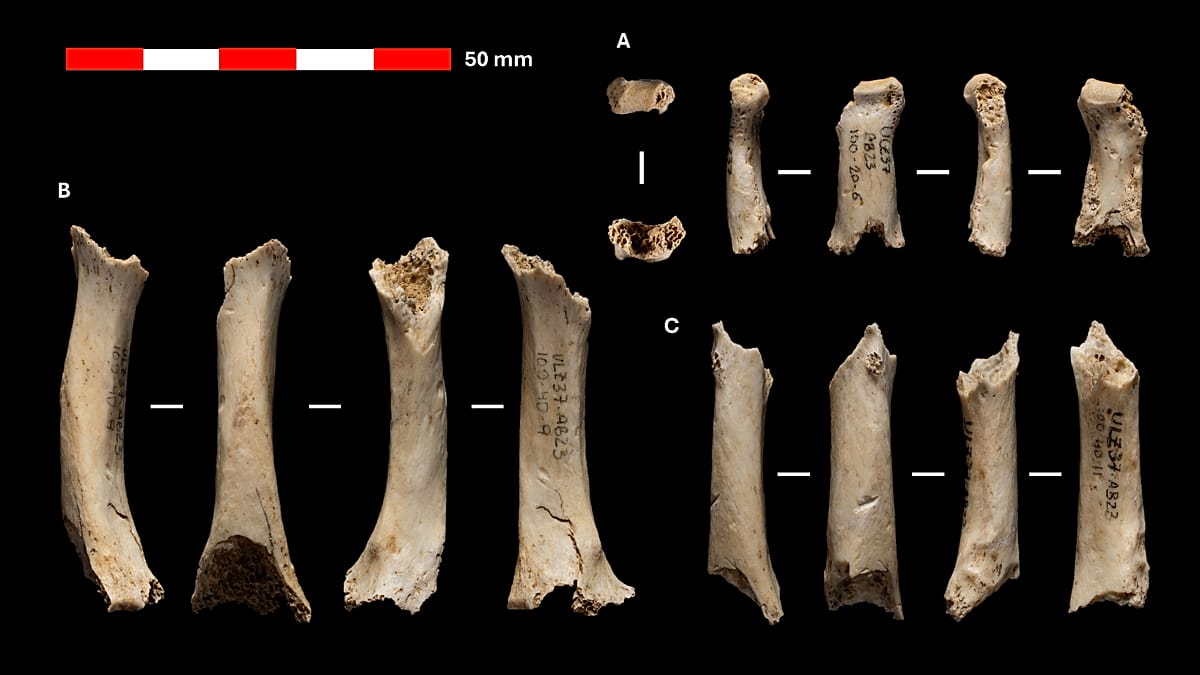
An international research team has confirmed that six bone fragments recovered from Abauntz cave in the Ultzama valley, Navarra, belong to a male Neanderthal who lived approximately 46,000 years ago. The find marks the first direct evidence of Neanderthal presence in the region, filling a long-standing gap in the archaeological record of the western Pyrenees.
The announcement was made on Monday (19 October) at an event led by María Chivite, president of the Government of Navarre. The remains include three metacarpal bones and a middle phalanx from the right hand of an adult individual, along with two additional fragments identified as human through protein analysis. Genetic studies confirmed the sex and species.
Some of the bones bear carnivore bite marks, offering a glimpse into what happened after the individual's death and how the remains ended up inside the cave. The fossils were found alongside stone tools and animal bones, some showing signs of butchery, suggesting that Neanderthals used the site for a range of activities.
A missing piece of the Pyrenean puzzle
Until now, no fossil evidence directly linked Neanderthals to this part of the Iberian Peninsula. "For the first time we have human remains that allow us to directly identify the presence of Neanderthals in Navarre," said Andion Arteaga, co-director of the project, in a press release.
The dating is significant. Around 46,000 years ago, Neanderthals were still widespread across Europe, but within a few millennia they would disappear from the continent, coinciding with the expansion of Homo sapiens. Abauntz lies in a natural corridor connecting Iberia with the rest of Europe, making it a key location for studying mobility and potential contacts between human groups on either side of the Pyrenees.
Ancient DNA from remains this old is rare, as genetic material degrades over time. The team combined palaeoproteomics, genetic analysis, and radiocarbon dating to identify the bones, determine the individual's sex, and establish a precise chronology. The work is being carried out with the University of Vienna and the Max Planck Institute for Evolutionary Anthropology in Leipzig, following the precedent set by the El Sidrón site in Asturias, where genetics has illuminated Neanderthal kinship and social organisation.
"Being able to recover ancient DNA and obtain direct dates for the fossils is particularly significant," stressed Mikel Arlegi, co-director of the project. Ongoing genetic analyses could reveal more about the evolutionary history and demographic dynamics of these populations.
The research originated at the Institut Català de Paleoecologia Humana i Evolució Social (Iphes-Cerca) in Tarragona, with contributions from Lucía López-Polín, Andreu Ollé, and Aitor Burguet. Arteaga is based at the Centre for New Technologies at the University of Warsaw and associated with Iphes-Cerca, while Arlegi is a postdoctoral researcher at the Musée de l'Homme in Paris.
More than 25 specialists from institutions including the National Centre for Research on Human Evolution (CENIEH) and the Institute of Archaeology of Mérida (IAM, CSIC–Government of Extremadura) are involved. The project is supported by the Government of Navarre, the Council of the Ultzama Valley, the Arraitz-Orkin local council, and the Palarq Foundation. A new excavation campaign is currently under way at the cave, with team members attending the presentation event.