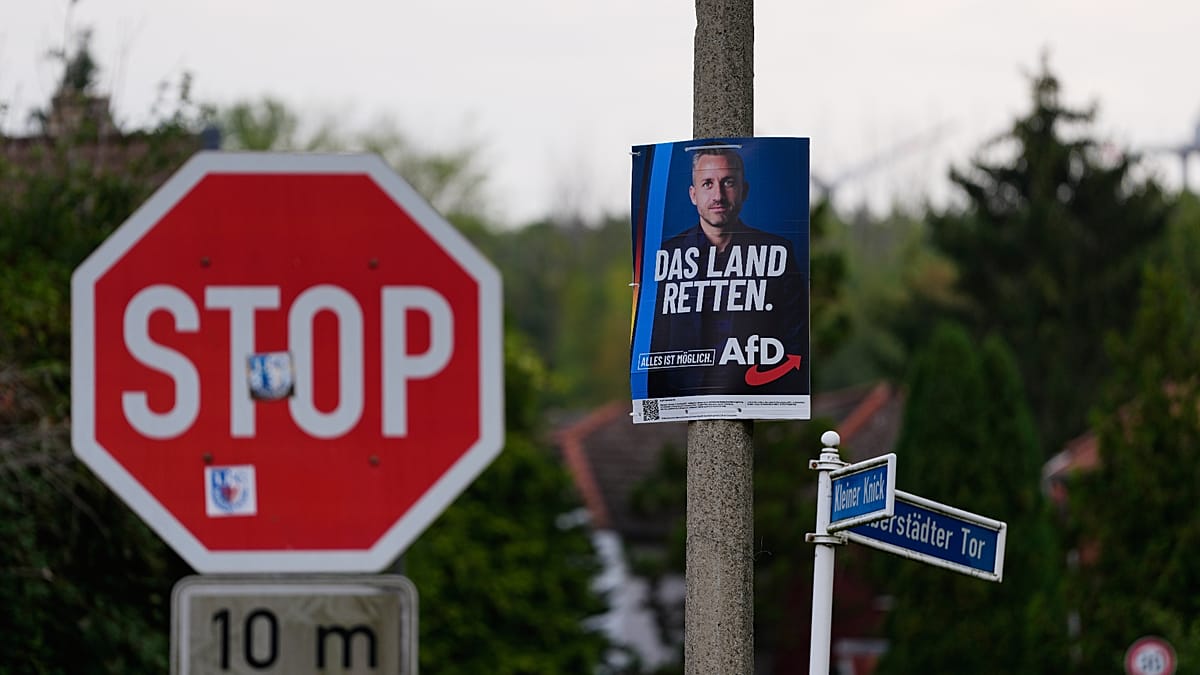
Voters in the eastern German state of Saxony-Anhalt went to the polls on Sunday in a regional election that could reshape the country's political landscape. More than 1.7 million people were eligible to cast their ballots by 6 pm local time, with the far-right Alternative for Germany (AfD) leading in opinion polls at over 40%.
The vote is widely seen as a barometer for Chancellor Friedrich Merz's federal coalition, which has grown increasingly unpopular. A decisive AfD victory would add to the pressure on Merz, whose Christian Democratic Union (CDU) has been struggling to maintain its traditional voter base in the east.
A test for Germany's political taboos
The AfD's top candidate, Ulrich Siegmund, has vowed to govern only if his party secures an absolute majority in the state parliament in Magdeburg. Whether that happens depends largely on how smaller parties perform. The more parties that clear the 5% threshold, the harder it becomes for the AfD to win an outright majority of seats.
That dynamic has sparked calls for tactical voting from various civic groups, urging voters to support smaller parties to dilute the AfD's seat share. The AfD, CDU, Left, SPD, FDP, and the Sahra Wagenknecht Alliance (BSW) have all criticised such campaigns, while the Greens have endorsed them.
The CDU has ruled out any coalition with the AfD, and at a recent party conference adopted an incompatibility clause that also bars cooperation with the Left party. This leaves the CDU with limited options to form a government if it finishes second, potentially forcing complex alliances with the SPD, FDP, or BSW.
Political analysts note that the AfD's rise in Saxony-Anhalt reflects deeper frustrations with the federal government's policies on migration, energy, and the economy. The state, which has a higher-than-average share of older and rural voters, has become a stronghold for the far-right in recent years.
According to the ZDF Politbarometer, 26% of eligible voters surveyed shortly before the election were still undecided, adding to the uncertainty. Polling stations opened at 8 am and closed at 6 pm, with initial results expected later in the evening.
The outcome will be closely watched across Europe, as it could signal the strength of far-right parties ahead of next year's federal elections. In neighbouring Poland and the Czech Republic, politicians have expressed concern about the potential impact on regional stability.
For Merz, a poor result in Saxony-Anhalt could embolden critics within his own party and complicate his efforts to project unity. The chancellor has already faced internal dissent over his handling of the Ukraine crisis and energy policy.
As the votes are counted, all eyes will be on Magdeburg, where the final composition of the state parliament will determine the future of Saxony-Anhalt's government. The AfD's performance will also be a key indicator of whether Germany's political mainstream can hold the line against the far-right's advance.