The Alternative für Deutschland (AfD) secured a decisive victory in Saxony-Anhalt's regional elections, taking 43.8% of the vote and leaving the Christian Democratic Union (CDU) of Chancellor Friedrich Merz far behind at 17.2%. The result has sent ripples across Europe, but nowhere is the reaction more telling than in France, where the far-right's two main currents have responded in starkly different ways.
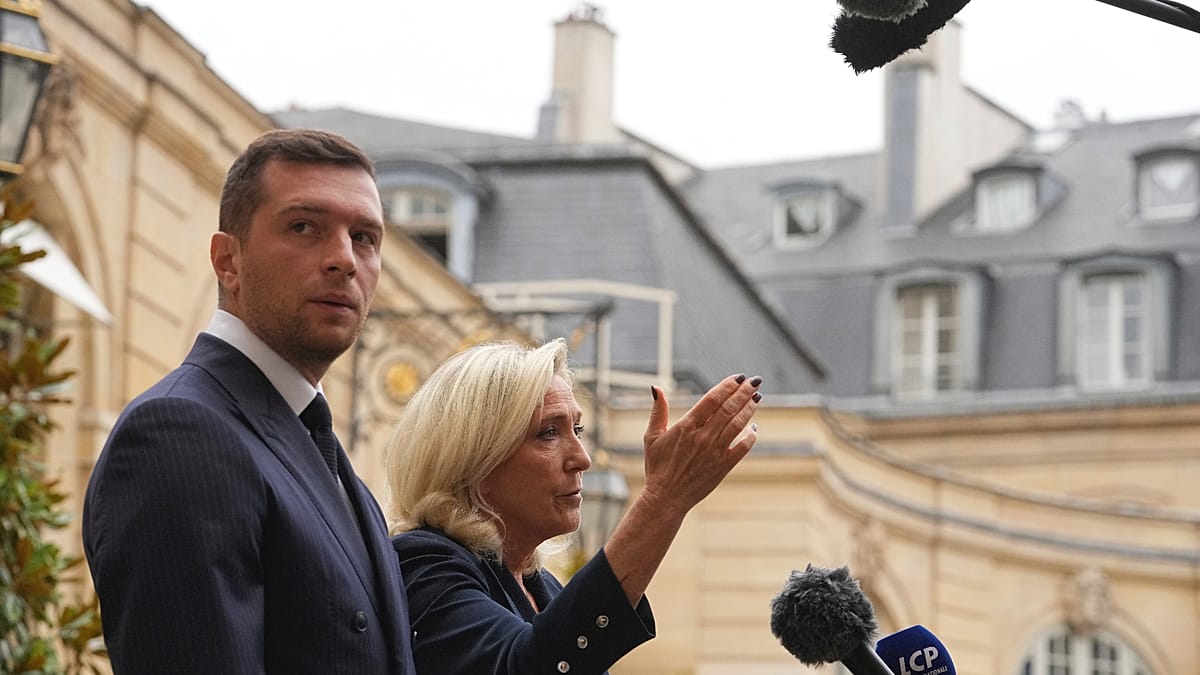
Marine Le Pen and Jordan Bardella, who are respectively positioning themselves for the 2027 presidential and prime ministerial races, have remained conspicuously silent on the AfD's success. Their party, the National Rally (RN), has spent over a decade trying to shed the toxic legacy of its founder, Jean-Marie Le Pen, and present itself as a mainstream conservative force. The AfD's more radical profile, particularly on issues of history and remembrance, makes an open embrace politically risky.
In contrast, Éric Zemmour's Reconquête!, which sits to the right of the RN and shares a European Parliament group with the AfD, has openly welcomed the result. MEP Sarah Knafo called it "historic," adding that "the European peoples have shown a great deal of patience. Today, they want to take their destiny back into their own hands. An entire continent is rising up." Zemmour himself, who has yet to confirm his candidacy for the 2027 presidential election, described the outcome as "the hour of truth."
The divergent reactions underscore a strategic split within France's far-right. The RN, which currently leads in presidential polls with around 34-36% support, is pursuing a strategy of normalization. As Gilles Ivaldi, a politics professor at Sciences Po Paris, explains: "The AfD expresses itself in a more radical and openly far-right manner, whereas the National Rally is currently trying to tone down its platform significantly in order to win the presidential election, because they know that to do this, they need to normalise their image."
Bardella had addressed the issue before the vote, at the Ambrosetti Forum in Italy. Asked whether the RN might renew ties with the AfD, he said it was not "planned," but noted that "the electoral pressure exerted by the AfD in Germany has helped shift the political landscape within [Chancellor Friedrich] Merz's government, as Germany reinstated border controls a few months ago."
The RN's caution is rooted in a history of broken alliances. Until 2024, the RN and AfD were both members of the Identity and Democracy (ID) group in the European Parliament, alongside Italy's League and Austria's Freedom Party (FPÖ). But the relationship collapsed ahead of the 2024 European elections, after AfD lead candidate Maximilian Krah told Italy's La Repubblica that membership of the Nazi SS did not automatically make someone a criminal. The ID group voted to expel the AfD in May 2024, and the party subsequently helped form a new far-right group, Europe of Sovereign Nations (ESN).
RN MEP Pierre-Romain Thionnet, now part of the Patriots for Europe (PfE) group, told Euronews that the AfD's result "should not come as a surprise to anyone," attributing it to "mass immigration, loss of national identity, and social and industrial decline." He insisted, however, that the RN's decision to "no longer be an ally of the AfD" remains "unchanged," citing "positions on historical and remembrance issues that we find unacceptable" and "very significant differences on other issues, such as foreign policy."
Another PfE MEP, speaking on condition of anonymity, echoed that sentiment: "Nothing will move before the French election. No one wants to be associated with the AfD, even though we have some points in common and cooperate on many topics."
Reconquête!, by contrast, has no such qualms. The party aligns with the AfD on the concept of "remigration," a term the RN avoids, preferring to frame its policy as the systematic expulsion of illegal immigrants and foreign criminals. This ideological kinship is reflected in their shared European Parliament group, the ESN.
The AfD's victory is part of a broader pattern of far-right gains across Europe, as seen in recent elections in Italy, Austria, and the Netherlands. The Saxony-Anhalt result has shaken Germany's centrist consensus, and its implications are being felt far beyond the country's borders. For France's far-right, the challenge is how to capitalize on this momentum without alienating the moderate voters they need to win power.
As the 2027 French presidential election approaches, the rift between the RN's pragmatism and Reconquête!'s radicalism is likely to widen. The RN's silence on the AfD's success is a calculated move, but it also reveals the limits of its strategy: to win in France, it must distance itself from the very forces that are surging across the continent.



