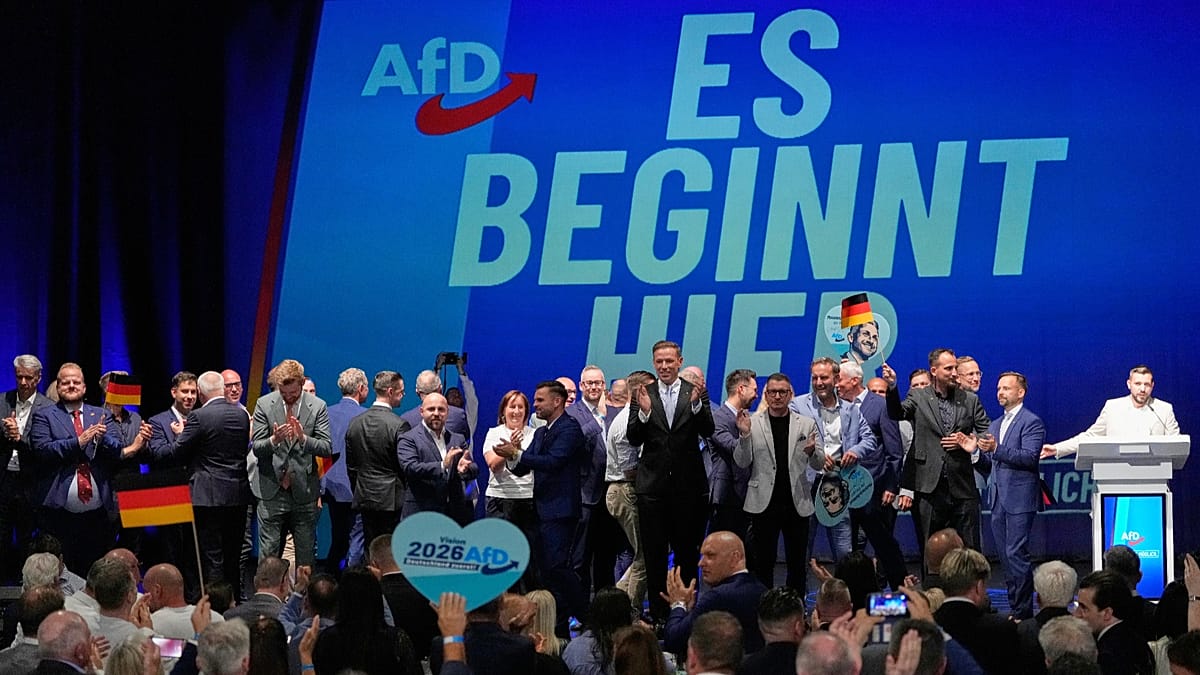
Germany's far-right Alternative for Germany (AfD) is attempting to install one of its own as president of the state parliament in Saxony-Anhalt, a move that would mark a first in the eastern state and carry national significance. Lawmakers convene in Magdeburg for the inaugural session of the newly elected chamber, where the AfD, having won the 6 September election with 43.8 percent of the vote, holds 39 of 83 seats.
The party has nominated Tobias Rausch, a pragmatic figure by his own account, for the post of parliament president. While the largest parliamentary group traditionally has the right to propose a candidate, the election requires a simple majority of valid votes, meaning Rausch cannot rely solely on his own party's deputies. The Sahra Wagenknecht Alliance (BSW), with five seats, has announced it will back him, while the conservative CDU, the Social Democrats (SPD), the Greens, and the Left Party have all signalled opposition. If the BSW follows through, Rausch would secure the necessary votes.
Why this vote matters beyond Saxony-Anhalt
The significance of this ballot extends far beyond the procedural choice of a speaker. The AfD's state branch in Saxony-Anhalt is officially classified as a confirmed right-wing extremist organisation by the state's domestic intelligence service, a designation that has made the party a pariah in mainstream politics. Electing an AfD politician to a senior parliamentary office would be a watershed moment, breaking a long-standing taboo and potentially normalising the party's role in state institutions.
The role of parliament president is not merely ceremonial. The officeholder chairs plenary sessions and the council of elders, and oversees the parliamentary administration. Political scientist Nicolas Spohn told Focus magazine that the president's power lies "above all in procedural issues and powers relating to the rules of the house." How an AfD politician would exercise such authority remains an open question, as the party has often clashed with democratic norms.
Rausch, for his part, has sought to project moderation. "I am not a hardliner, I am pragmatic," he told the German Press Agency, adding that he wants "to take the interests of everyone into account as far as possible." He described his desired debating culture as "tough on substance but fair to individuals."
A test for future alliances
The immediate focus is on the parliament presidency, but the vote is widely seen as a dry run for a more consequential decision in December, when the AfD will attempt to elect its lead candidate, Ulrich Siegmund, as minister-president. Siegmund would need at least 42 votes in the 83-seat chamber, a threshold that would require support from outside his own party. The BSW's stance will be crucial, making today's ballot a first test of the relationship between the two parties.
The CDU, which has governed Saxony-Anhalt for years, has made clear it will not support the AfD candidate. Outgoing minister-president Sven Schulze announced his party's opposition, underscoring the deep divisions that persist in the state's political landscape.
The session begins at 11am CET, with Eva von Angern of the Left Party, as the longest-serving member, presiding over the opening. After establishing quorum and adopting provisional rules, the election will be held by secret ballot. If no candidate secures a majority in the first round, further rounds are possible. Following the vote, the session will be suspended to allow the council of elders to discuss procedural changes, with vice-presidential elections scheduled later.
In a symbolic move, the AfD has already pushed through a change to the seating plan: as the largest group, it will now sit in the centre of the chamber rather than on the far right. Outside the parliament building, protests are planned by the "Solidarisches Magdeburg" alliance and other groups, reflecting the public unease over the AfD's rise.
The outcome of this vote will be closely watched across Germany, as it may signal how the AfD intends to wield power in the east, and whether other parties are willing to break with convention to accommodate it. The broader implications for the country's political culture are significant, as the far-right party continues to gain ground in former East German states, a trend that has already reshaped the political landscape ahead of the next federal election.